
Nof Zion, Sheikh Sa'ed, South American Road to Bethlehem Checkpoint (300), Sheikh Jarrah
7:00 Nof Zion, Apartheid neighborhood in Jabal Mukaber
The hill of Jabal Mukaber (near the Commissioner’s Palace) which overlooks all of East Jerusalem from the south is being peeled and quarried. The goal: to build thousands more housing units for Jews only. Additional concrete and cement belt around Al Quds (Jerusalem). The laborers are Palestinian. In the first round of construction, Palestinian residents of Jabal Mukaber tried to buy houses in this neighborhood that is their neighborhood. And big surprise – they were rejected. We learned from Ir Amim that there is also a plan to build a neighborhood up the road here, to the Border Police camp at the top of the nearby hill. The bulldozers there had done a lot of demolition work in recent months. In the development plans the above area was designated for public buildings of Jabal Mukaber.

7:15 Sheikh Sa’ed
Traveling to the Sheikh Sa’ad checkpoint we made some mistakes on the narrow and steep road descending to the American road, but in exchange we got an unfamiliar view of a neighborhood of small and picturesque ancient stone houses, with domes. A boy happily leads a friend to school on a donkey and gallops back.
It’s quiet in Sheikh Sa’ad. Hardly any pedestrians are seen because today is Sunday and many schools are closed. After the German television filmed a video with us about six months ago, the gate was closed, fenced and locked, making it no longer possible to watch and communicate with those waiting at the checkpoint. It is possible to enter the secluded neighborhood, but return through the checkpoint is prohibited! Allowed are only residents of Sheikh Sa’ad who have a transit permit or for residents of Jabal Mukaber with blue (Israeli) certificates. Outside we met three nice young women, students of medicine and pharmacology at Al Quds University. They enter Sheikh Sa’ad from Jabal Mukaber in Jerusalem to travel by taxi in a long but relatively cheap way to the University of Abu Dis, across the wall (NIS 5). They do not know Hebrew.
8:15 Bethlehem Checkpoint (300)
The southern American Road splits into the Tekoa and the Bethlehem roads, coming from checkpoint 300. The road itself is not congested, because it is intended for residents of the settlements and for Palestinians living in Jerusalem only. Residents of the huge Har Homa are still standing in traffic jams at the exit to the Hebron Road. And we’re stuck too.
We arrived late. We saw only one position open (farthest) and the humanitarian entryway for women and the disabled was closed. It only opens during rush hour, according to checkpoint workers. We are not approached and so we can greet and exchange a few words with the few women passing through. Come at four in the morning, they say, it’s hell on the Palestinian side then.
Sheikh Jarrah
We also visited the western part of the neighborhood, near the tomb of Shimon the Righteous. As early as 10 years ago, settlers took over the first houses in Sheikh Jarrah and expelled their residents. A pavilion, added by one of the residents to his garden, was taken over by the settlers. Today the settlers are no longer there. There is a graffitied wall and a lot of dirt. We also drove up the hill in front of the Shepherd Hotel neighborhood, where the house and nursery of the Salahiya refugee family were destroyed. Tractors work there and level the area. By the way, right next door is a Jewish settler house. Of course, it is not touched or expropriated for public purposes of an educational institution …
We also visited the western part of the neighborhood, near the tomb of Shimon the Righteous. As early as 10 years ago, settlers took over the first houses in Sheikh Jarrah and expelled their residents. A pavilion, added by one of the residents to his garden, was taken over by the settlers. Today the settlers are no longer there. There is a graffitied wall and a lot of dirt. We also drove up the hill in front of the Shepherd Hotel neighborhood, where the house and nursery of the Salahiya refugee family were destroyed. Tractors work there and level the area. By the way, right next door is a Jewish settler house. Of course, it is not touched or expropriated for public purposes of an educational institution …
We came in order to witness the burning battlefield of Jerusalem today: To see where is the destruction, where is Ben Gvir (a far-right MK) sitting, and most importantly to see if the residents of the neighborhood are being blocked on a daily basis, as they did in the previous Ramadan flare-up.
Today’s front is on the side closest to Highway 1 (opposite Musrara and Mea Shearim), where the home of the Salem family (11 people) is located, which will be evicted and replaced with a far-right activist. The place has a checkpoint of three police cars and of course right there is Ben Gvir seat, when he comes to his “office” to disperse media explosives. It is now empty. Later we heard that he had arrived at noon which sparked immediate fierce confrontations with the locals. Later this week, after the shift on Sunday, the Magistrates’ Court delayed the flexible eviction that was supposed to take place any minute. “Flexible” means at an unexpected time – night, or even pre-dawn.

We also visited the western part of the neighborhood, near the tomb of Shimon the Righteous. As early as 10 years ago, settlers took over the first houses in Sheikh Jarrah and expelled their residents. A pavilion, added by one of the residents to his garden, was taken over by the settlers. Today the settlers are no longer there. There is a graffitied wall and a lot of dirt. We also drove up the hill in front of the Shepherd Hotel neighborhood, where the house and nursery of the Salahiya refugee family were destroyed. Tractors work there and level the area. By the way, right next door is a Jewish settler house. Of course, it is not touched or expropriated for public purposes of an educational institution …


Bethlehem (300)
See all reports for this place-
Located adjacent to the Separation Wall ("Jerusalem Wrap") at the north entrance to Bethlehem, this checkpoint cuts off Bethlehem and the entire West Bank from East Jerusalem, with all the serious implications for health services, trade, education, work and the fabric of life. The checkpoint is manned by the Border police and private security companies. It is an extensive infrastructure barrier and is designated as a border terminal, open 24 hours a day for foreign tourists. Israeli passport holders are not allowed to pass to Bethlehem, and Palestinian residents are not allowed to enter Jerusalem, except those with entry permits to Israel and East Jerusalem residents. Israeli buses are allowed to travel to Bethlehem only through this checkpoint.The checkpoint, which demonstrated harsh conditions of crowding and extreme passage delays for years, started employing advanced electronic identification posts and has upgraded its gates' system as of the middle of 2019 - and conditions improved.Adjacent to the checkpoint, in an enclosure between high walls and another passage, is the historic Rachel's Tomb, which is now embedded within a concrete fortified building. It contains prayer and study complexes for Jews only, as well as a residential complex. updated November 2019 .
-
Sheikh Sa'ed
See all reports for this place-
A checkpoint limited to pedestrians, located on Jerusalem’s municipal boundary.
The checkpoint sits on the separation fence at the entrance to Sheikh Sa’ad, dividing it from its neighbourhood of Jabel Mukkabar. It’s manned by Border Police soldiers and private security companies and operates 24 hours a day. Palestinians are forbidden to go through, other than residents of Jabel Mukkabar or Sheikh Sa'ad who have permits. Both groups are permitted through only on foot. Residents of East Jerusalem who don’t live in Jabel Mukkabar are also allowed to cross to Sheikh Sa’ad, but not in the opposite direction; they must return through the Sawahira ash Sharqiya checkpoint.
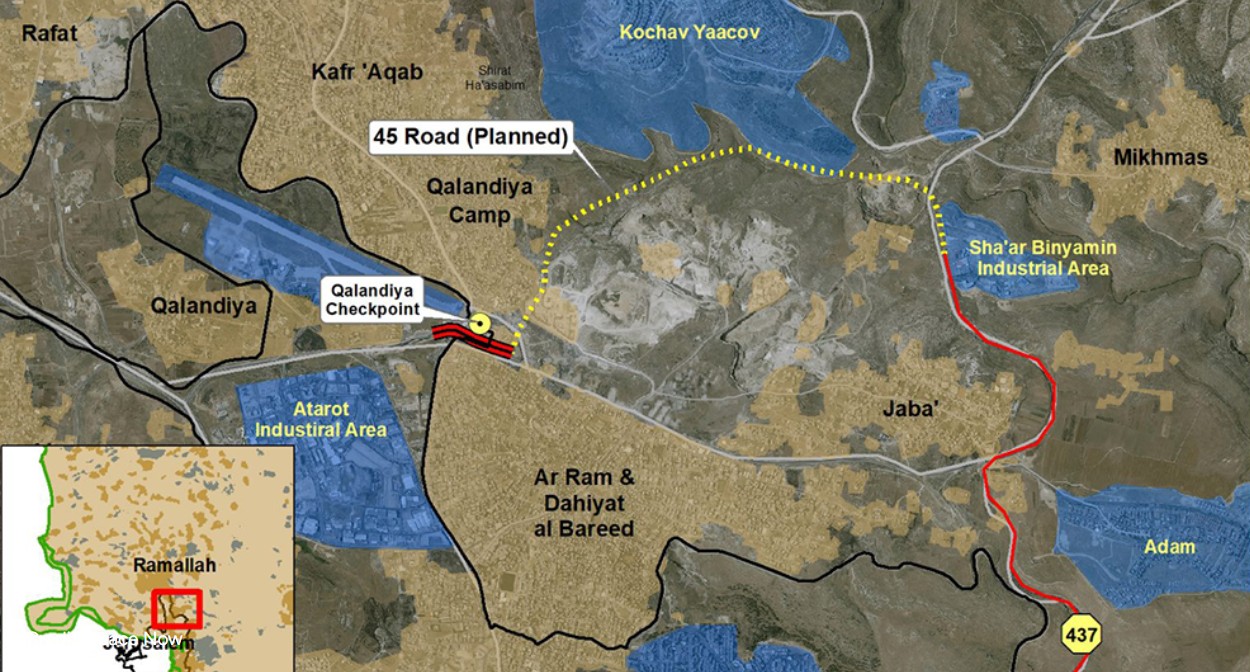 Anat TuegSep-9-2026Road 45. For Israelis only, from Road 60 near Kochav Ya'akov to the Qalandiya underpass
-
