
Ofer military court
The military court at Ofer, Tuesday 10.05.06Observers: Nurit S., Michal Z., Chava H. (reporting)Translation: Ilene M. Today we saw a few lawyers who didn’t agree to be rubber stamps of the detention process. They differed, not by their viewpoints, but rather, by their commentaries. Even so, it did not affect the judges decisions very much.Present in the hall were : the military prosecutor, the judge – Captain Binjo – four military policemen and two soldiers. The four detainees were brought in tied together, two by two, by their feet. The first detainee (we didn’t catch his name or the names of the other detainees), was accused of possession of firearms. He was a young man who worked as a clerk in the Hebron court – because of his job he had access to the storerooms of the court. In order to earn a bit of money on the side, he stole a gun and asked his friend to sell it for 1700 shekels. This didn’t work out and he returned the gun to the storeroom. The story came out a few months later and now he is accused of possession of firearms This story was full of unexplained questions which became apparent later on. His lawyer, Tzvi Shamir, contended that the detainee was a first time offender; his lack of experience can be seen through the evidence of the prosecution and mainly by the foolishness that he demonstrated in his attempt to sell the gun for much less than its true value. He suggested an alternative to detention – releasing his client on bail for any amount set by the court. This would be guaranteed by a friend of the family – a Jewish Israeli living in Jerusalem whom the family of the accused saved during a terrorist incident. The family of the accused has never been involved in a security incident in the past. The lawyer contended that even if the detainee slipped one time, it is important to help him to rehabilitate himself. The Jewish Israeli spoken about was present at the courtroom and was revealed to be none other than Itzik Magraf, who had been kidnapped by the Hamas a long time ago while he was passing out food in Hebron. His story has been told in the newspapers many times. Either because of the Jewish lawyer, or the Jewish family friend, or because he really thought so, the judge ruled that the danger posed by the defendant does not justify detention and as an alternative, suggested release under limited conditions and 20,000 shekels bail, to be raised in three days. The prosecution requested a postponement of 72 hours in order to appeal the decision. The lawyer Ahlam Haddad represented the second detainee – 28 years old, married and a father. She requested a review of an incident that apparently had already been deliberated in the court. The charge was membership in the Osra of the Hamas. According to her, the Osra is a group that meets together for religious purposes – to pray and to study the Koran. The defendant admitted to participating in processions and to waving flags and signs. The lawyer asked the court if anyone knows what was written on the signs. Perhaps the procession was in commemoration of a holiday? Perhaps it was a funeral procession mourning the death of a political or religious leader? Perhaps the signs carried religious messages or messages of peace? The lawyer claimed that a procession presents no implicit danger to the public. The detainee has no criminal past and, in his case, an alternative to detention should be enough. The prosecutor differed with the defense lawyer. He held that the fact that the detainee participated in processions showed evidence of membership in the Hamas and quoted, Even abstract membership in a forbidden organization justifies detention until the end of the legal process and, in this case, the membership is not even abstract. The defense lawyer claimed once again that the evidence shows no proof of danger from the defendant and that the Osra of the Hamas is not a forbidden organization. The judge postponed the request for further review. The third detainee was represented by the lawyer Elia Theodori. He objected to detainment until the end of the legal process.. The accusations against the detainee are : in 2005 he put up a Hamas leaflet in the Naalin village, in 2006 he hung up pictures of Hamas candidates in the Naalin elections. The judge decided : there is no reason for the accused to be detained until the end of the legal process. The judge ordered release under limited conditions (what is that?), 7000 shekels bail and 20,000 shekels self-bail. The prosecutor appealed this decision and received a postponement of 72 hours. Once again, we are presented with the issue of the amount of bail set for very poor people. The trial might begin in another year, or more, and might continue for a long time. And it is no simple matter to get bail money back. Could it be that the Palestinians themselves are financing the occupation?
Hebron
See all reports for this place-
According to Wye Plantation Accords (1997), Hebron is divided in two: H1 is under Palestinian Authority control, H2 is under Israeli control. In Hebron there are 170,000 Palestinian citizens, 60,000 of them in H2. Between the two areas are permanent checkpoints, manned at all hours, preventing Palestinian movement between them and controlling passage of permit holders such as teachers and schoolchildren. Some 800 Jews live in Avraham Avinu Quarter and Tel Rumeida, on Givat HaAvot and in the wholesale market.
Checkpoints observed in H2:
- Bet Hameriva CP- manned with a pillbox
- Kapisha quarter CP (the northern side of Zion axis) - manned with a pillbox
- The 160 turn CP (the southern side of Zion axis) - manned with a pillbox
- Avraham Avinu quarter - watch station
- The pharmacy CP - checking inside a caravan with a magnometer
- Tarpat (1929) CP - checking inside a caravan with a magnometer
- Tel Rumeida CP - guarding station
- Beit Hadassah CP - guarding station
Three checkpoints around the Tomb of the Patriarchs
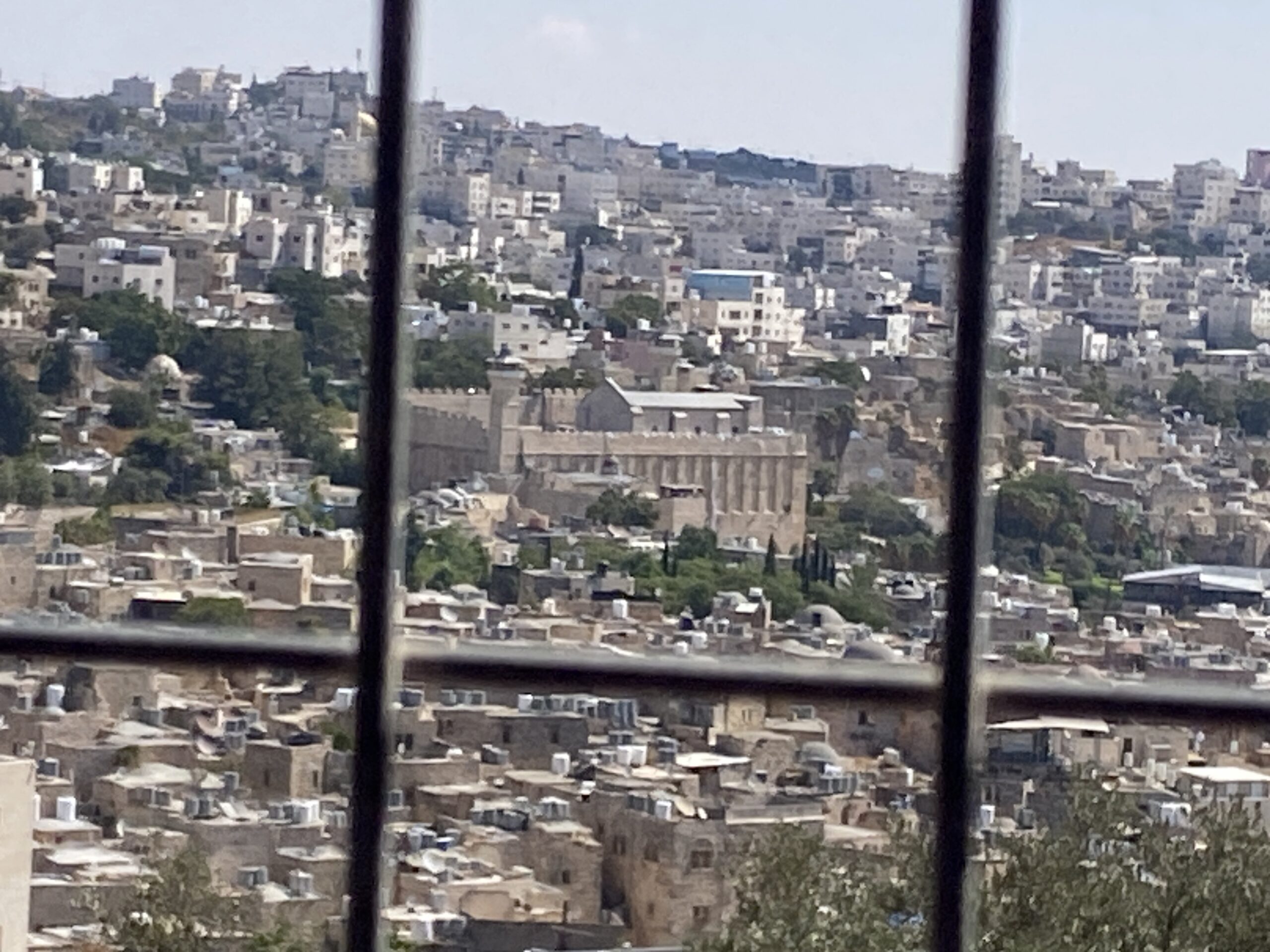 Yael ZoranSep-24-2026Hebron and the Cave of the Patriarchs from Beit Hashalom
-
Ofer
See all reports for this place-
Ofer The Military Court in the Ofer camp is located halfway between Ramallah and Jerusalem. The place has seven courtrooms, most of them spacious. This court is one of two courts of the "first instance", in addition to the military court in Salem. Here are the Palestinian hearings trials and some of the hearings in detention extensions. In addition, there is also a military court of appeals (on rulings of the courts of 'the first instance' in Salem and Ofer). Family members of detainees from the territories (usually only two family members) are allowed to enter the hearings but are prohibited from talking to the detainees. The families have at their disposal a waiting yard and a large, air-conditioned waiting room.
 Jun-25-2024Ofer prison
-
