
PM
HUWWARA, Thursday 15 April PM Observers: Menuha M., Tamar L., Dalia G (reporting) colour=red> Our group of six women left from Kfar Saba with N., our driver, and travelled to Beit Iba meaning to drop off Dafna, Naomi and a guest from Boston and continue from there to Huwwara. But our plans changed: just before we reached Beit Iba we drove to Deir Sharaf to look for a woman with whom the soldiers had driven off the day before in an army jeep. Luckily, and apparently due to the intervention of our colleagues (who alerted various bodies), she was returned safe and sound. What we wanted to do was to find her and learn from her exactly what had happened. We entered Deir Sharaf , proceeded to the other side of the village and continued along a dirt track until we reached the army blockade, from where one has no choice but to continue on foot, climbing over the hillside, to get to the village we were aiming for. But that’s not what we did, for N. turned to some shepherds who were there and asked (in Arabic, of course) , if they knew how to get hold of the young woman by phone. Of course they knew exactly what we were talking about and gave him her telephone number. But when N. called her and asked her to tell her story, she refused. Dafna asked whether she would be ready to talk to a woman and to that she agreed. But, unfortunately, none of us is an Arabic speaker. N. told her that an Israeli Arab woman would call her the next day and that we were very interested to know what had happened to her. Meanwhile, we said goodbye.As we neared the Beit Iba checkpoint a man and a woman approached us excitedly. The woman wanted us to listen to her: she said she didn’t dare go from the checkpoint home all alone. Her husband comes to fetch her because soldiers sometimes stop young women and force them to lift up their dresses, and they laugh and curse. We asked her to note down the licence number of the army vehicle, but she claimed that the soldiers don’t come in jeeps. These episodes occur during the soldiers’ rest hour under the shady trees. We explained that we need some kind of proof to enable us to take action. She continued and told us about the woman who had been abducted yesterday: the soldiers had picked up four women, later they had brought three of them back and disappeared with the fourth. After a while they brought her back, too, apparently because they had received a call that had forced them to return her, so they [the local women] were told (and apparently it really was due our intervention).The Beit Iba team stayed on there and we continued as planned.We reached Huwwara only at 15:30. On the southern side of the checkpoint (the entrance to Nablus) there were 15 detainees down in the pit. That area has changed: the entrance is now steeper and the section that used to be open now has barbed wire all around, so that it has become impossible to get to it other than via the steep side. This made it much more difficult for me to get to the people there and talk to them.I went up to the edge and simply asked : “ Can anyone help me?” Right away there was a volunteer who gave me his hand and lead me safely down. Among those that approached there were no Hebrew speakers. But one of them, a student, spoke English. Students apparently don’t get issued with the normal entry and exit permits. Their student cards do allow them to enter and leave Nablus but only on certain days: one leaves on a Wednesday and comes back on a Saturday [the Palestinian university week runs from Saturday to Wednesday], but today was Thursday… What to do? One has to go down to the pit and wait — for up to four hours at least — to have one’s ID card checked [against a list of suspect persons that is compiled and held by the Israeli security services — Shin Bet] Everybody knows that after a few hours they will be allowed through, but those are the rules. And one can’t argue with rules. One must simply wait. We asked the soldier why the men in the pit had been detained. The answer:“We have to check. Suspects — we detain them.”“What are your criteria for deciding whether they are suspects?”“ When they start making up stories. For example one told me six stories and then started shaking…”“That’s the sign?” The conversation ended with a question mark.We turned to the checkpoint commander with the same question and he explained the checking procedure:”We check the Palestinian ID cards of all those who don’t have permits (and are between the ages of 15 and 35) and all those whose cards we take go off to the pit and wait. Only after we have gathered a few IDs do we send the names and numbers to the brigade’s operations room. There they fill out forms with the information they want checked and when these are ready they are faxed to the Shin Bet (Shabak) [the general security services} where a check is run . Only the names of suspects are underlined . When the Shin Bet check is completed the forms are sent back to the operations’ room from where the names underlined are relayed to the checkpoint. There, all those whose names are not singled out get the ID cards back and are free to go, until next time. The procedure is repeated every time anew. In our experience, it usually takes three to four hours.”The regular line moved relatively fast and with no unnecessary delays. Vehicles also went through and the line was not very long. The soldiers were careful to follow the rules, for good or for bad.Thus, on the good side: A man was accompanying two women, one of whom was so sick that she could scarcely stand. The soldier dealing with them went up to her, held her hand and lead her to an ambulance, although no one asked him to do so. And, in stark contrast: a woman with a sick and crying baby in her arms, accompanied by her husband and three small children, sought to go through the checkpoint. But they didn’t have a permit between them. The child was very sick and needed to get to hospital — all this was attested to in a doctor’s referral letter. But: no permit, no passage! All our pleading and arguing achieved nothing . “Anybody can forge a doctor’s letter”, the soldiers said. At the checkpoint, nobody is convinced just by what he sees. The woman was allowed through with her children, but without her husband. He must wait until the check of his ID card is completed. The soldiers were even ready to allow her to travel in a passing ambulance. The husband explained that his wife would not be able to manage without him, but the soldier was immovable. After a few complaints by the woman, the soldier did — as we have noted — grant her passage through the checkpoint, but she stayed and waited for her husband on the other side. It started to get really cold, which affected the sick child, but the woman wouldn’t move. The other children were also crying and she looked at me as if imploring me to do something ( but what could I do?)Again, I approached the soldier and tried to make conversation. I got lucky and we talked. I suggested that he should read the doctor’s referral letter. He agreed. I signalled the husband and quick as a flash, there he was close to the soldier. While the soldier read, apparently becoming more convinced , another soldier approached and asked: “What, are you going to release him?” The first one answered hesitantly: “I’m just thinking…”The moment the second soldiers turned his back , the first one signalled the husband with his hand and told him quietly: “Go on! Go through!” and the family disappeared. I gave the soldier a look of quite open appreciation and he said: “You know that I’ll have to carry the can on this one!” To which I answered: “Blame it on me! I want you to know that I really take my hat off to you for taking responsibility and using your own judgement!” I realised just how important it was to him to have my approbation. After all, he too wants to feel OK, and who is going to appreciate it when he behaves like this? Only us.A delegation from the Belgian Parliament arrived — 12 people, eight of them members of parliament , with four parliamentary assistants. They didn’t have a permit to enter Nablus, nor did they understand why they should need one. They explained to the checkpoint commander that they were there as part of a tour that had been arranged by the Israeli and Belgian Foreign Ministries. They had an itinerary that they had received even before leaving Belgium detailing where and when they were to go. They had already been to Qalqiliya, Qalandiya and several other places, and no one had yet asked them for a permit.The commander explained that Nablus was not like other places. The responsibility for them in Nablus was Israel’s . They suggested he should hand the responsibility over to them, to each of them personally. He laughed. That wasn’t possible. “Explain to them,” he asked me, “that if anything happens to them — I’ll end up in jail”.I suggested that at least he should try to speed up the process. “You think I want to hold them?” he asked. He called the brigade’s operations room , which in turn called some other number — we didn’t know whom. He couldn’t receive directives from the Foreign Ministry. It was not clear whom he should turn to. There was no choice but to wait. Meanwhile a conversation started up .One of the Belgians said : “Do you know that it’s because of what is happening here that anti-Semitism is on the rise in Europe and everywhere else.”The others joined us and conversation was lively and easy. I asked them what they propose doing about all they see here and the answer was that they would work for peace as hard as they could. We talked and meanwhile the checkpoint commander worked ceaselessly to try to sort things out. But although he called everyone, nothing happened.The oldest man in the group approached me and asked: “How do you feel about this situation?”Me: “Last week I just couldn’t sleep all week. Today — I feel like crying…”He moved closer, hugged me and began to cry. While we were crying and hugging eacxh other, the signal came through and the commander let them pass. We all wished each other well and went our separate ways. For my part, I think the commander simply got fed up.The detainees were still around and many more had joined them. The experienced ones among them said that at 18:00 , when some of the soldiers finish their shift, both ends of the checkpoint are amalgamated then all the detained Palestinians are released, almost without a check-up.Meanwhile it was already six, Menuha informed us that they were releasing everyone at the other side. But it hadn’t yet happened at our end. Three men and a woman came up to me and the woman told me that they were on their way to a wedding and were not being allowed to pass. The men, she said, were members of her family. They had permits but they didn’t want to leave her alone here. She is an Israeli citizen from Deir Hanna. She didn’t know that she needed a permit to come to a wedding. She has an Israeli ID card and she thought that because of that she would have no problems, she had even thought of taking her daughter with her. Now, looking at the woman with her baby who had been standing there in the wind and waiting despairingly for her husband, she blessed the moment she had decided not to bring her. She talked to the checkpoint commander who, meanwhile, had become quite friendly with us. He made a call, but wouldn’t let us know to whom, and asked the woman to give the young clerk on the phone all the information she needed. From the other end of the line came a promise to call back soon, but nothing happened. The woman was about to give up and tell the men to leave without her; but how was she to return home all alone, it was already late.Suddenly I noticed that all four had disappeared. The commander had let them through. “You are a sweetheart,” I said, and we both laughed. From the other side, Menuha reported that they had let through a woman who had forgotten her ID card and that there were no detainees left. We decided to go home.On the way to the car, we saw that they were releasing “our” detainees.I had a strange feeling of a “happy end” in all this misery. That, too, can happen sometimes.
Beit Iba
See all reports for this place-
A perimeter checkpoint west of the city of Nablus. Operated from 2001 to 2009 as one of the four permanent checkpoints closing on Nablus: Beit Furik and Awarta to the east and Hawara to the south. A pedestrian-only checkpoint, where MachsomWatch volunteers were present daily for several hours in the morning and afternoon to document the thousands of Palestinians waiting for hours in long queues with no shelter in the heat or rain, to leave the district city for anywhere else in the West Bank. From March 2009, as part of the easing of the Palestinian movement in the West Bank, it was abolished, without a trace, and without any adverse change in the security situation.
 Jun-4-2014Beit-Iba checkpoint 22.04.04
-
Huwwara
See all reports for this place-
The Huwwara checkpoint is an internal checkpoint south of the city of Nablus, at the intersection of Roads 60 and 5077 (between the settlements of Bracha and Itamar). This checkpoint was one of the four permanent checkpoints that closed on Nablus (Beit Furik and Awarta checkpoints to the east and the Beit Iba checkpoint to the west). It was a pedestrian-only barrier. As MachsomWatch volunteers, we watched therre since 2001 two shifts a day - morning and noon, the thousands of Palestinians leaving Nablus and waiting for hours in queues to reach anywhere else in the West Bank, from the other side of the checkpoint the destination could only be reached by public transport. In early June 2009, as part of the easing of Palestinian traffic in the West Bank, the checkpoint was opened to vehicular traffic. The passage was free, with occasional military presence in the guard tower. Also, there were vehicle inspections from time to time. Since the massacre on 7.10.2023, the checkpoint has been closed to Palestinians.
On February 26, 2023, about 400 settlers attacked the town's residents for 5 hours and set fire to property, such as houses and cars. Disturbances occurred in response to a shooting of two Jewish residents of Har Bracha by a Palestinian Terrorist. The soldiers stationed in the town did not prevent the arson and rescued Palestinian families from their homes only after they were set on fire. No one was punished and Finance Minister Smotrich stated that "the State of Israel should wipe out Hawara." Left and center organizations organized solidarity demonstrations and support actions for the residents of Hawara.Hawara continued to be in the headlines in all the months that followed: more pogroms by the settlers, attacks by Palestinians and a massive presence of the army in the town. It amounted to a de facto curfew of commerce and life in the center of the city. On October 5, 2023, MK Zvi established a Sukkah in the center of Hawara and hundreds of settlers backed the army blocked the main road and held prayers in the heart of the town all night and the next day. On Saturday, October 7, 23 The "Swords of Iron" war began with an attack by Hamas on settlements surrounding Gaza in the face of a poor presence of the IDF. Much criticism has been made of the withdrawal of military forces from the area surrounding Gaza and their placement in the West Bank, and in the Hawara and Samaria region in particular, as a shield for the settlers who were taking over and rioting.
On November 12, 2023, the first section of the Hawara bypass road intended for Israeli traffic only was opened. In this way, the settlers can bypass the road that goes through the center of Hawara, which is the main artery for traffic from the Nablus area to Ramallah and the south of the West Bank. For the construction of the road, the Civil Administration expropriated 406 dunams of private land belonging to Palestinians from the nearby villages. The settlers are not satisfied with this at the moment, and demand to also travel through Hawara itself in order to demonstrate presence and control.(updated November 2023)
.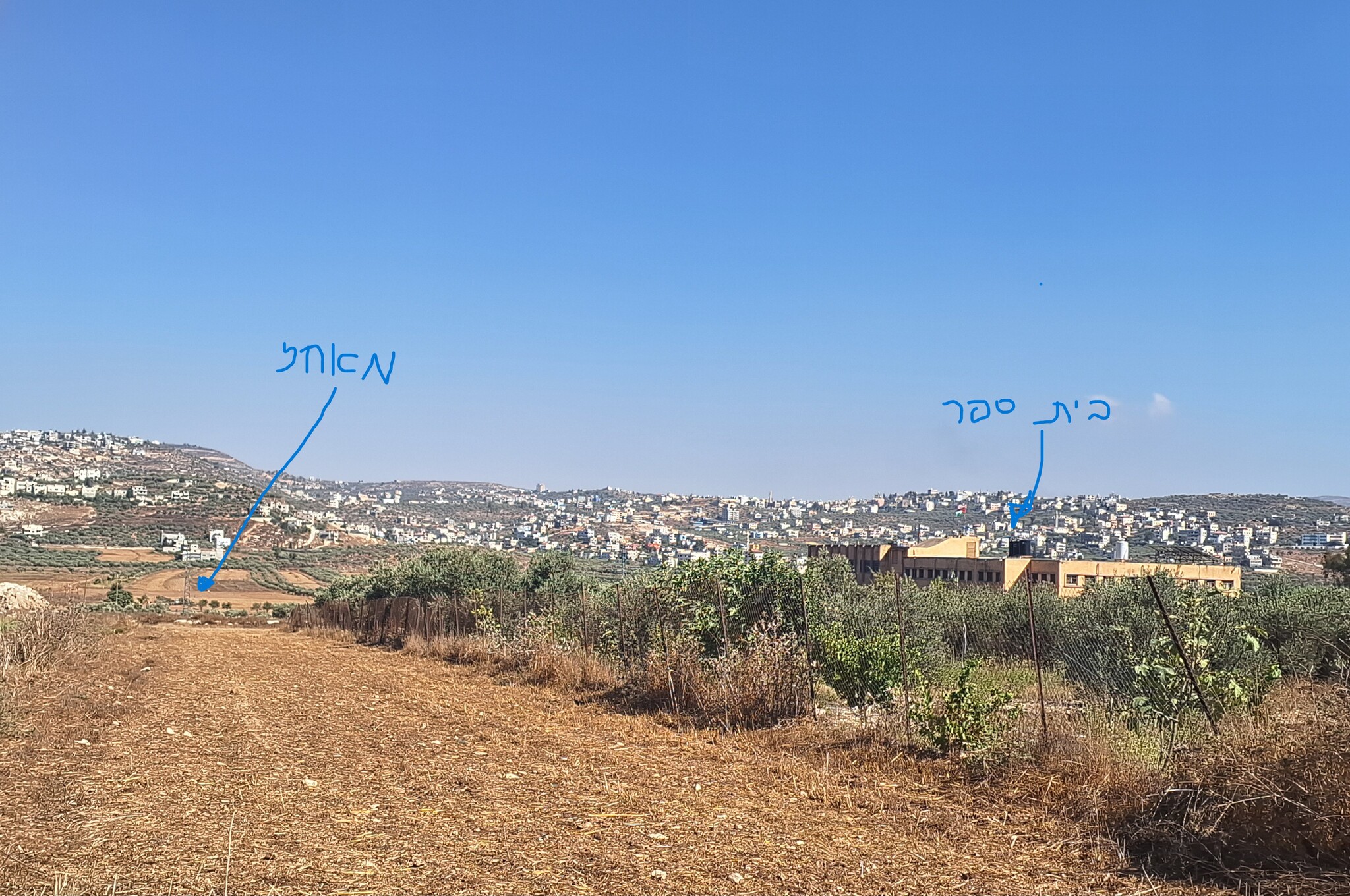 Ronit Dahan-RamatiAug-24-2026Huwara: The school on the outskirts of town and an outpost hidden among the trees
-
