
PM
BEIT FURIK, Thursday 6 May 2004 PMObservers: Anat S., Michal B., Menuha M. (reporting)color=red>Circumstances brought us to Beit Furik instead of to Beit Iba, which turned out to be a good thing. The checkpoint was closed and hundreds of people had been waiting for hours to go through to Nablus on a blazing hot day without water or shade.14:25 As we reached the Jit junction, we saw an unannounced road block, with three buses standing by the roadside, apparently en route to some family celebration. There were several detainees sitting on one side. We decided to go and see what was happening and wait until our driver returned from taking our colleagues to Huwwara. We talked to the detainees who said they’d already been through two checkpoints (one at Shavei Shomron and another unannounced roadblock near the gas station) and only at Jit had it been decided to check their ID cards. An army jeep, with an extremely hostile lieutenant who kept referring to the suicide bombing in Haifa, came past. The lieutenant explained that there was a new “hot” [terrorist] alert and so the checks were stricter and would last another half an hour or an hour. Then he went. We split up. Anat stood near the detainees while Michal and I stood about 30 metres away facing the bus from which the women had been taken off.Several minutes after the officer left, a private car arrived, stopped at the corner of the junction alongside the detainees: two women got out carrying a yellow-brown flag with a black Magen [Star of] David on it and attacked Anat with screams and curses. Several minutes later Daniella Weiss[ a radical Jewish Israeli settler leader] arrived with several men. In addition to shouting and cursing, the women were physically violent towards us. Meanwhile N., our driver, arrived and halted the car beside me. The men ran over to the car and attacked N., hit him in the face and tried to open the door and drag him out.At this stage, one of the soldiers intervened and succeeded in pushing the [ settler] men away, but they jumped into one of the cars and blocked our path to Beit Iba, so that we were forced to turn back. When we discovered that Daniella Weiss’s car was following us and the road to Beit Iba was blocked, we decided to go to Beit Furik.15:15 — Beit FurikThe checkpoint was closed and hundreds were waiting at the exit from Nablus and several at the entrance. It was a particularly hot day. The water tank was empty ( Had someone emptied it? There was a large puddle under it and one of the soldiers suggested that we give the puddle water to the thirsty waiting Palestinians). The soldiers kept us away and so we stood on one side and watched.A few minutes after we arrived a Border Police jeep arrived and a border policeman, who spoke fluent Arabic, began to call the men – old and young, the really elderly and fathers of children – who were told to stand on one side.Meanwhile another Border Police jeep arrived together with three more army vehicles, one of them with a lieutenant-colonel . This was a clear indication that something was going on. According to one of them, there was a woman suicide bomber in the large crowd and so women soldiers had been brought to check the women.15:45 – They started evacuating the checkpoint little by little. There was evident preference given to humanitarian cases like a couple with a three-year-old returning from hospital, women with small children and elderly women. Anat and Michal distributed water and candies to the people going through. At the checkpoint at the time there were more and more detained women who were sent to stand in an area with a concrete fence, but when that was full they were told to stand on one side.16:40 –The flow of traffic from Nablus to Beit Furik increased. All the military and police vehicles left, apart from one Border Police vehicle. However, nobody went through to Nablus.17:45 A woman with heart problems and high blood pressure asked our help; she was on her way to hospital in Nablus and had been waiting for more than an hour. Anat’s appeal to the officer got a positive response and she and another two women, waiting for more than an hour with their little girls, were allowed through. Anat also obtained passage through the checkpoint for an ice-cream van which had already been waiting when we arrived and whose driver had begun handing out ice-creams which had started melting.To our astonishment, it was only now that a soldier standing at some distance from the checkpoint began to forward the details of the women detainees [names and ID card numbers of detainees are sent from the checkpoints to a central point where they are cross-checked against lists compiled by Israel’s General Security Services –AKA the Shabak or Shin Bet — the detainees are held until they are cleared, a process which can last several hours] . We had been unaware of this delay because we were standing at a considerable distance from the checkpoint.18:00 The names of the detained men were called out , but not the women’s names. Since it was clear that the latter had been sent more than an hour after the women had been detained, we contacted the Centre for the Defence of the Individual to ask them to take some action to expedite the checks. About half-an-hour later, we were told that within a few minutes the women’s release would begin, excepting for three whose ID numbers were wrong.18:45 –The women went through. We stayed another few minutes and left when there were still eight women at the checkpoint. Later we learned from the Centre that they too had been allowed through.
Beit Iba
See all reports for this place-
A perimeter checkpoint west of the city of Nablus. Operated from 2001 to 2009 as one of the four permanent checkpoints closing on Nablus: Beit Furik and Awarta to the east and Hawara to the south. A pedestrian-only checkpoint, where MachsomWatch volunteers were present daily for several hours in the morning and afternoon to document the thousands of Palestinians waiting for hours in long queues with no shelter in the heat or rain, to leave the district city for anywhere else in the West Bank. From March 2009, as part of the easing of the Palestinian movement in the West Bank, it was abolished, without a trace, and without any adverse change in the security situation.
 Jun-4-2014Beit-Iba checkpoint 22.04.04
-
Huwwara
See all reports for this place-
The Huwwara checkpoint is an internal checkpoint south of the city of Nablus, at the intersection of Roads 60 and 5077 (between the settlements of Bracha and Itamar). This checkpoint was one of the four permanent checkpoints that closed on Nablus (Beit Furik and Awarta checkpoints to the east and the Beit Iba checkpoint to the west). It was a pedestrian-only barrier. As MachsomWatch volunteers, we watched therre since 2001 two shifts a day - morning and noon, the thousands of Palestinians leaving Nablus and waiting for hours in queues to reach anywhere else in the West Bank, from the other side of the checkpoint the destination could only be reached by public transport. In early June 2009, as part of the easing of Palestinian traffic in the West Bank, the checkpoint was opened to vehicular traffic. The passage was free, with occasional military presence in the guard tower. Also, there were vehicle inspections from time to time. Since the massacre on 7.10.2023, the checkpoint has been closed to Palestinians.
On February 26, 2023, about 400 settlers attacked the town's residents for 5 hours and set fire to property, such as houses and cars. Disturbances occurred in response to a shooting of two Jewish residents of Har Bracha by a Palestinian Terrorist. The soldiers stationed in the town did not prevent the arson and rescued Palestinian families from their homes only after they were set on fire. No one was punished and Finance Minister Smotrich stated that "the State of Israel should wipe out Hawara." Left and center organizations organized solidarity demonstrations and support actions for the residents of Hawara.Hawara continued to be in the headlines in all the months that followed: more pogroms by the settlers, attacks by Palestinians and a massive presence of the army in the town. It amounted to a de facto curfew of commerce and life in the center of the city. On October 5, 2023, MK Zvi established a Sukkah in the center of Hawara and hundreds of settlers backed the army blocked the main road and held prayers in the heart of the town all night and the next day. On Saturday, October 7, 23 The "Swords of Iron" war began with an attack by Hamas on settlements surrounding Gaza in the face of a poor presence of the IDF. Much criticism has been made of the withdrawal of military forces from the area surrounding Gaza and their placement in the West Bank, and in the Hawara and Samaria region in particular, as a shield for the settlers who were taking over and rioting.
On November 12, 2023, the first section of the Hawara bypass road intended for Israeli traffic only was opened. In this way, the settlers can bypass the road that goes through the center of Hawara, which is the main artery for traffic from the Nablus area to Ramallah and the south of the West Bank. For the construction of the road, the Civil Administration expropriated 406 dunams of private land belonging to Palestinians from the nearby villages. The settlers are not satisfied with this at the moment, and demand to also travel through Hawara itself in order to demonstrate presence and control.(updated November 2023)
.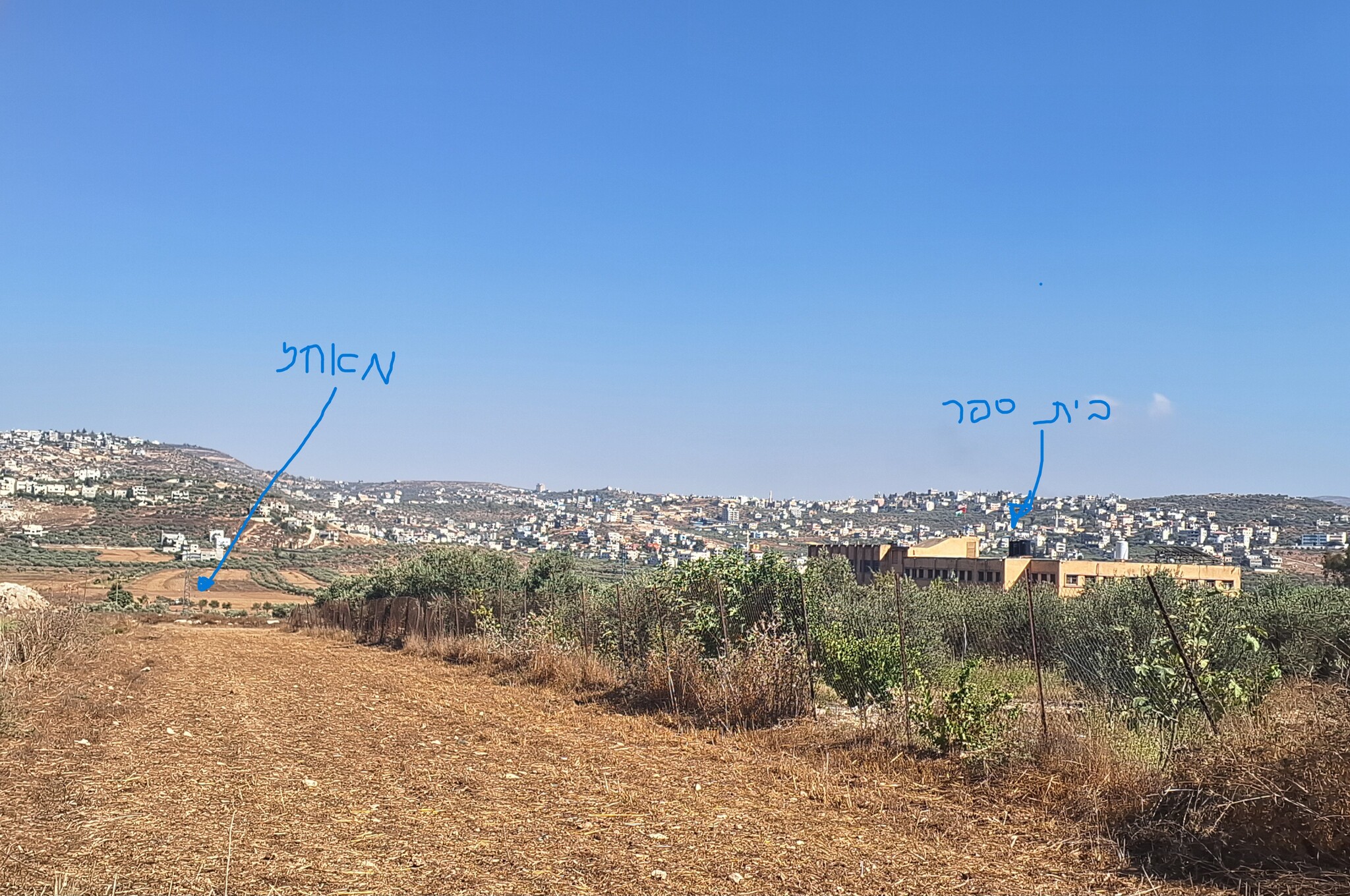 Ronit Dahan-RamatiAug-24-2026Huwara: The school on the outskirts of town and an outpost hidden among the trees
-
