
PM
HUWWARA, Sunday 9 May 2004 PMObservers: Selma M. (reporting), Yehudit V. (photographing), Ruti B. and Dalia G. color=red>We arrived at the southern checkpoint , the entrance to Nablus, at 14:30 to find that there was almost nobody in line. Four cars were awaiting checks, but neither they nor their drivers were detained. Twelve detainees were waiting in the “pit”, the sunken area parallel with the road and the checkpoint. The area was fenced with barbed wire. Dalia went down to the detainees, with a Palestinian giving her a hand down the steep and quite hazardous descent. Ruti went to the northern side – the exit from Nablus.At the southern end it was the usual , depressing routine, without drama, but with a great deal of frustration. After about half-an- hour, the line grew longer and the number of detainees increased. They sat on the ground in the sun without shade or water. Some had been there since morning. We took down bottles of water we’d brought with us.Beside the checkpoint is a water tank and a trough with faucets, but the tank was lying on its side, empty, and there was no pipe connecting the two. (Dina, who was there in the morning, called us to check whether the situation had changed, and since then she has been dealing with it full blast.) I talked to the checkpoint commander about the need for a roofed shelter for the detainees. He claimed that he himself had built one. We asked him to make sure that a sturdier shelter was built which wouldn’t collapse when leaned on. (People apparently lean on it when climbing up). We also requested that the ascent to the checkpoint be made less steep. He smiled: “Perhaps you’d like me to build them a staircase?” (Why not?)There were several cases of Palestinians being punished “educational purposes”. For example: a young man in a hurry who had pushed to the head of the line in front of the old people that the soldier wanted to let through first. Although he had a permit, he was sent down to join the detainees, and then sent to the back of the line. We tried to persuade him not to show his anger but to accept his lot and stand in line, because the soldier had promised to let him through without problems, and that was what happened. A boy, with an application for a magnetic card didn’t understand what he had to do [the magnetic card is issued by the District Coordinating Office (DCO) — the army section that deals with civilian matters — and is effectively the prerequisite for the granting of any other permit; basically it testifies to the holder’s clean security record vis a vis the Israeli occupying authorities]. He said it was the first time he had left Nablus in the past three years and he didn’t know the procedure. He, too, was sent down to the detainees. Meanwhile we talked to the checkpoint commander. We wanted to know what the procedure was so as to explain it to him.It goes like this: first he has to go to the Palestinian Interior Ministry in Nablus to ask for a referral to the Israeli DCO in Nablus. Then he must go to the post office and pay for three stamps. Armed with the referral, he goes through the checkpoint, but only once! Just in order to reach the DCO. If he doesn’t succeed in entering the DCO (because of the long line or for any other reason) he has to start all over again with the Palestinian ministry and the post office. At the DCO they check and write on the document whether he is banned from going through the checkpoint or whether he can go through for the time being until the General Security Services’ [AKA the Shabak (Hebrew acronym) or the Shin Bet (Hebrew initials )] answer arrives. It’s not clear when that answer will arrive (so we understood). After all the explanations, the commander agreed to let the boy through, after he had first promised to arrange the next day for the DCO permit (I think the boy didn’t understand the whole thing, and won’t dare leave Nablus again).At 15:30 some of the detainees were released, and an hour-and-a-half later – some more. When we left there were still a few there. We gathered that “in the end” they would all be released.At the northern checkpoint – the exit from Nablus – there were dozens of men, women and children in line and about 20 detainees on one side. The soldiers were very nervous and let the people through very slowly.One exceptional case is worth reporting: a family – father, mother and five children — were standing together in line. The mother and children were allowed through but the father was detained for checking. His pleading and our intervention were to no avail. He explained that his wife couldn’t manage alone with five children – some of them infants. When she started, nonetheless, walking towards the exit with them, the husband ran after her to help her. Three soldiers jumped up as if galvanized, and ran after him, rifles aimed and at the ready (Ruti took pictures). He came back , gestured to his wife to go with the children and the baggage – and he remained, watching them until they had disappeared into the distance.And another picture – although we didn’t manage to make a photographic record of this . The commander was standing above the detainees’ area, ordering them to stay down and not to keep climbing up and asking to go through. They didn’t respond and continued to stand on the steep slope. Then, rearing above them with his familiar confident stance, he waved a length of (all too well-known) white nylon twine at them ( it is used to bind the hands of the seriously recalcitrant) and called out: “Is this what you want?” All of them jumped back down. The checkpoint was quiet again.We asked ourselves how it could be that the self-same commander, during the self-same shift, had talked to us in such a friendly fashion and with such a sweet, captivating smile…what a pity we didn’t photograph that as well.
Huwwara
See all reports for this place-
The Huwwara checkpoint is an internal checkpoint south of the city of Nablus, at the intersection of Roads 60 and 5077 (between the settlements of Bracha and Itamar). This checkpoint was one of the four permanent checkpoints that closed on Nablus (Beit Furik and Awarta checkpoints to the east and the Beit Iba checkpoint to the west). It was a pedestrian-only barrier. As MachsomWatch volunteers, we watched therre since 2001 two shifts a day - morning and noon, the thousands of Palestinians leaving Nablus and waiting for hours in queues to reach anywhere else in the West Bank, from the other side of the checkpoint the destination could only be reached by public transport. In early June 2009, as part of the easing of Palestinian traffic in the West Bank, the checkpoint was opened to vehicular traffic. The passage was free, with occasional military presence in the guard tower. Also, there were vehicle inspections from time to time. Since the massacre on 7.10.2023, the checkpoint has been closed to Palestinians.
On February 26, 2023, about 400 settlers attacked the town's residents for 5 hours and set fire to property, such as houses and cars. Disturbances occurred in response to a shooting of two Jewish residents of Har Bracha by a Palestinian Terrorist. The soldiers stationed in the town did not prevent the arson and rescued Palestinian families from their homes only after they were set on fire. No one was punished and Finance Minister Smotrich stated that "the State of Israel should wipe out Hawara." Left and center organizations organized solidarity demonstrations and support actions for the residents of Hawara.Hawara continued to be in the headlines in all the months that followed: more pogroms by the settlers, attacks by Palestinians and a massive presence of the army in the town. It amounted to a de facto curfew of commerce and life in the center of the city. On October 5, 2023, MK Zvi established a Sukkah in the center of Hawara and hundreds of settlers backed the army blocked the main road and held prayers in the heart of the town all night and the next day. On Saturday, October 7, 23 The "Swords of Iron" war began with an attack by Hamas on settlements surrounding Gaza in the face of a poor presence of the IDF. Much criticism has been made of the withdrawal of military forces from the area surrounding Gaza and their placement in the West Bank, and in the Hawara and Samaria region in particular, as a shield for the settlers who were taking over and rioting.
On November 12, 2023, the first section of the Hawara bypass road intended for Israeli traffic only was opened. In this way, the settlers can bypass the road that goes through the center of Hawara, which is the main artery for traffic from the Nablus area to Ramallah and the south of the West Bank. For the construction of the road, the Civil Administration expropriated 406 dunams of private land belonging to Palestinians from the nearby villages. The settlers are not satisfied with this at the moment, and demand to also travel through Hawara itself in order to demonstrate presence and control.(updated November 2023)
.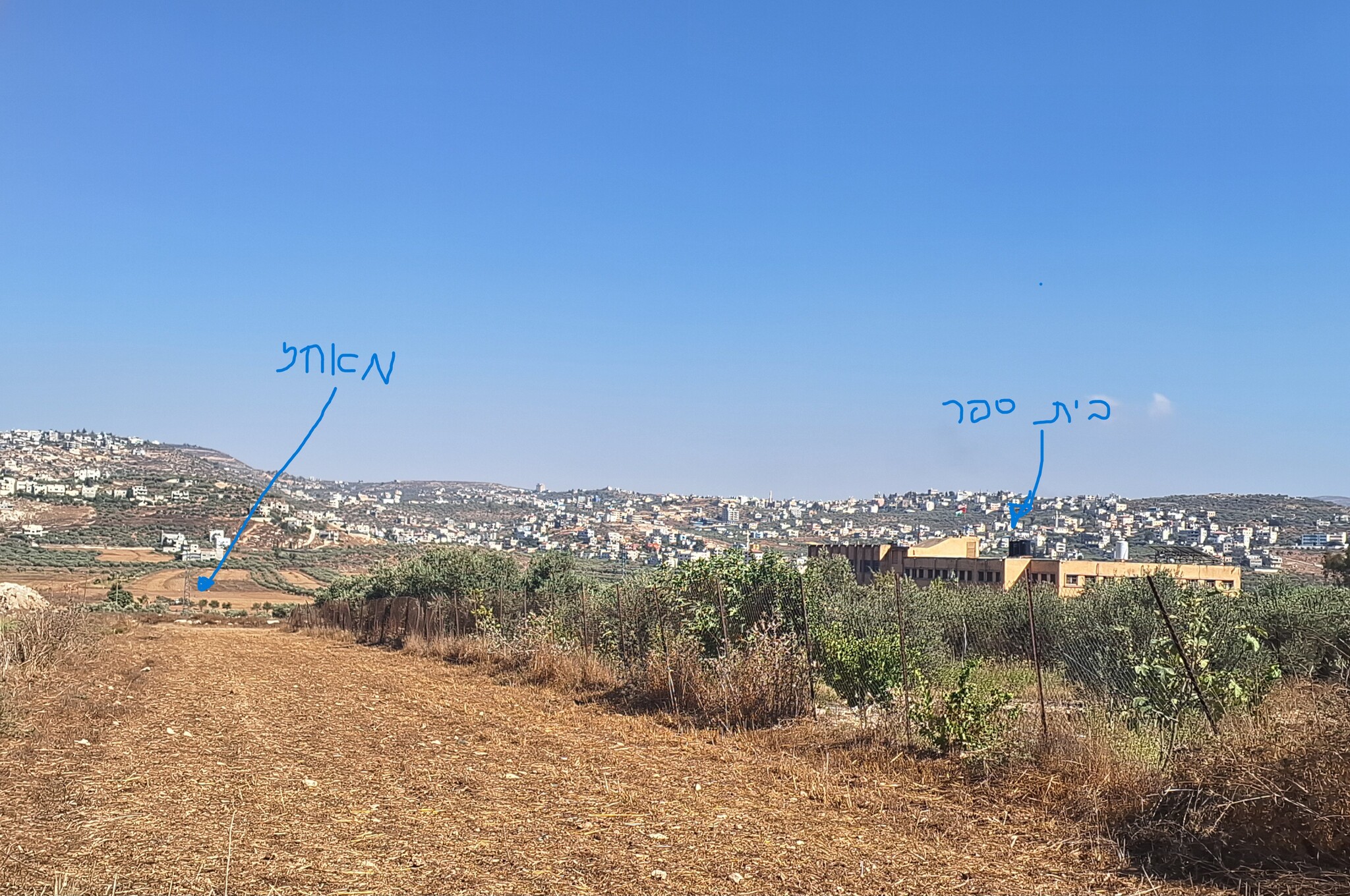 Ronit Dahan-RamatiAug-24-2026Huwara: The school on the outskirts of town and an outpost hidden among the trees
-
