
PM
JUBARA, Sunday 6 June 2004 PMObservers: Anna-Lin K., Haya A., Roni K.(reporting) color=red>At the school-children’s gate in Jubara a group of soldiers approached us and during the ensuing conversation they presented us with a leaflet from the Women in Green organization which had been distributed earlier at the checkpoint [ Women in Green is a right-wing, pro-settlements group whose name is based on that of the more veteran Women in Black, a left-wing group advocating an end to settlements and to the Israeli occupation of Palestinian lands]. The leaflet specifically warned soldiers of Machsomwatch and its activities [Women in Green members recently physically attacked Machsomwatch teams]. This, albeit from memory, is what it said, under the heading : ‘An Important Announcement to Soldiers’ — “We wish to warn you of the bizzare, miniscule group Machsomwatch and its activities. The women [of this group] like the Arabs and hate you and us. Theyare your enemy – our enemy. Do not let them disturb you. Ask them for ID cards and complain [about them].” At nearby Habla, the gatewas open; the schoolbuses had already left. The soldier at the gate gave two young boys permission to go off to Qalqiliya with the few goods they had to sell. But the real question was whether they would get there at all, because, as we were soon to learn in Qalqiliya, the so-called fruit roadblock,on the road to the city, has recently become almost impassable for Palestinians. Qalqiliya checkpoint was not in operation. Some Palestinian women that we met toldus that compared with the checkpoint, the fruit roadblock has become much more ofa burden on the population in their efforts to make a living. On our way back from Qalqiliya, Anna-Lin led us to a place until now unknown to us: a group of houses , or a neighbourhood, on the outskirts ofthe city, that used to be part of Qalqiliya and is now on the Israeli side ofthe new separation or “security” wall and Highway 6. There was an air of neglect about the place, with garbage scattered around. Gate 700 was open; and a line of trucks was waiting for the loading/unloading of merchandise. We approached the checkpoint commanderbut he refused to have anything to do anything with us. “I have nothing to tell you,” hesaid. Back at the Jubara checkpoint , there were two detainees when we arrived; and they were still there when we left (about three-and-a-half hours later ) and after that, too [they are detained so that their ID card details can be cross-checked by telephone against a list compiled and maintained by the General Security Services (GSS), also known by its Hebrew acronyms as the Shabak, or Shin Bet; the check, designed to weed out persons deemed to be “security risks” , can take anywhere from half-an-hour to several hours, as in this case]. At some stage, a woman, with a baby in her arms and with three other children, joined them; thesoldiers promised to release them in 10 – 20 minutes, and kept their word. Towards the end of our shift, eight more people were detained. We called K. of the District Coordinating Office (DCO) [the section of the army that deals with civilian matters and usually has a representative at the checkpoint, ostensibly to alleviate the lot of the Palestinians] and he promised to act. Movement from the northern end (the dirt road coming from Tulkarm)to the south was almost undisturbed, owing mainly to one quiet,well-behaved soldier.
Habla
See all reports for this place-
Habla CP (1393)
The Habla checkpoint (1393) was established on the lands of the residents of Qalqilya, on the short road that
connected it for centuries to the nearby town of Habla. The separation barrier intersects this road twice and cut off the residents of Qalqilya from their lands in the seam zone.(between the fence and the green line).
There is a passage under Road 55 that connects Qalqilya to the sabotage This agricultural barrier is used by the farmers and nursery owners established along Road 55 from the Green Line and on both sides of the kurkar road leading to the checkpoint.
This agricultural checkpoint serves the residents of Arab a-Ramadin al-Janoubi (detached from the West Bank), who pass through it to the West Bank and back to their homes. The opening hours (3 times a day) of this agricultural checkpoint are longer than usual, about an hour (recently shortened to 45 minutes), and are coordinated with the transportation hours of a-Ramadin children studying in the occupied in the West Bank.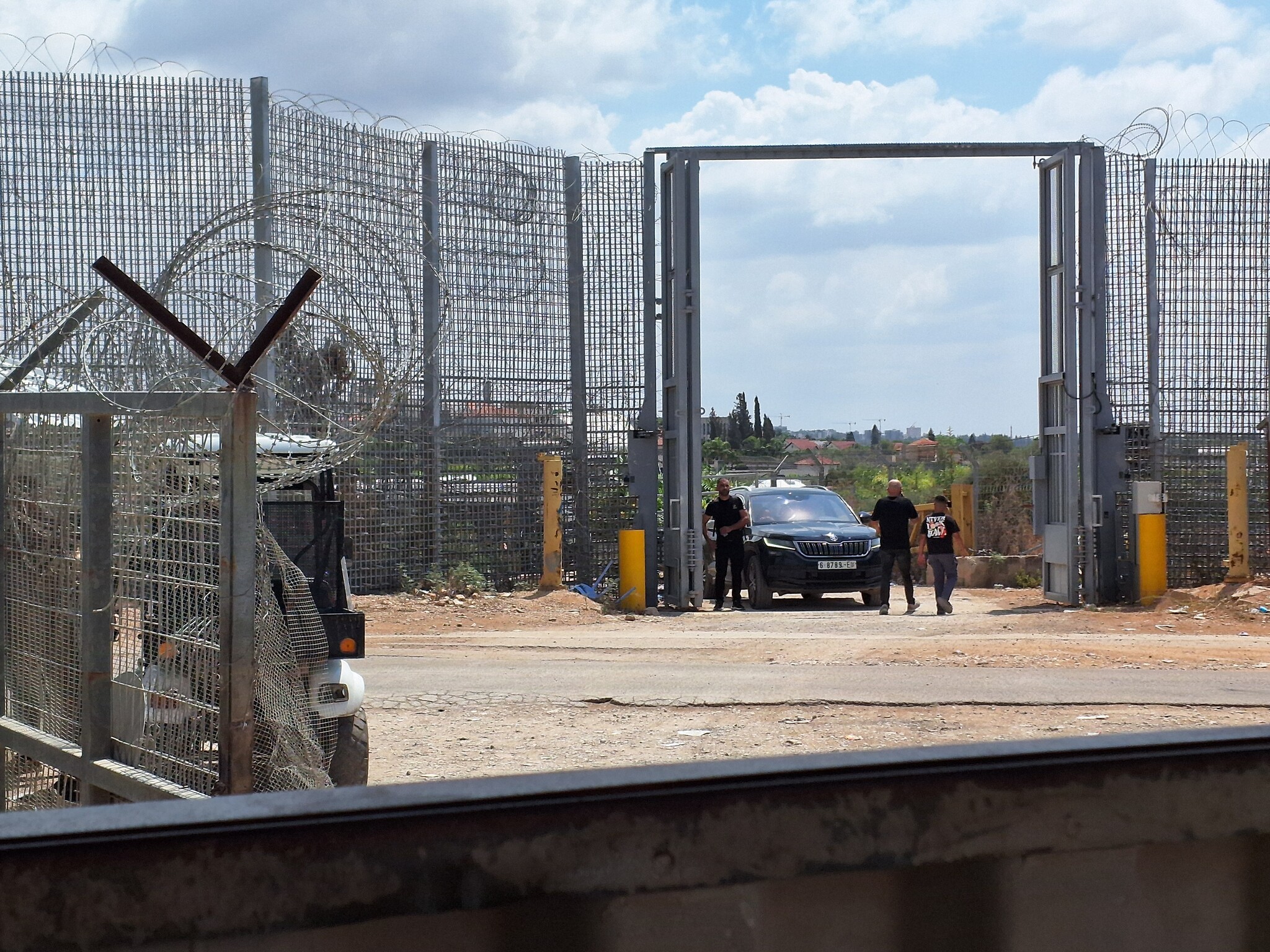 Ronit Dahan-RamatiAug-31-2026Habla. The gate is open
-
