
PM
HUWWARA,BEIT IBA, Tuesday 1 June 2004 PMObservers: Ada R., Petahia T., Biria L., Edna K., Ella H. (reporting) color=red>Are there differences in human conduct even under impossible conditions? Apparently yes. The present reservist unit which was completing its tour of duty at the Beit Iba checkpoint proved that flexibility, maturity and humanity can alleviate a situation. At Huwwara, we encountered the rigidity and authoritarianism of conscripts. There were no unannounced checkpoints en route.13:30– We drove past Jubara checkpoint which presented the usual sight of detained vehicles, women waiting in the sun and about five detainees. There was no shade and the sun was blazing hot.13:4 — There were no soldiers at the Einav (Anabta) checkpoint, where a yellow iron gate very effectively blocks the road between Nablus and Tulkarm. Dozens of vehicles, about 15 buses and two to three ambulances were stuck there unable to proceed. Passengers got out of the cars and walked round the gate to enter other cars and thus continue their journeys.14:15 — There was a very long line of cars and trucks bound for the Nablus road at Beit Iba checkpoint : the explanation we received was that ambulances and UN cars were blocking the road further on and couldn’t be moved. There were only a few pedestrians wanting to go in this direction, but there was a dense crowd trying to go in the opposite direction — dozens of people, young people (students who’d ended their school year), and mothers with small children and packages. The reservists were as flexible and humane as possible under the conditions. Encouraged by us, they opened an additional exit by moving the barbed wire and let pregnant women with small children go through without waiting in line.15:00– But at the Huwwara checkpoint, the soldiers were conscripts acting very tough towards the Palestinians. Bulldozers were straightening the regular detainees’ ditch, so we waited at the checkpoint in line beyond the concrete barriers.At Huwwara South, I was greeted by A., the driver of one of the bulldozers, with his usual patriotic curses and name-calling – traitor, helping the enemy, I’d like to shoot you, etc. Traffic of pedestrians and cars alike was relatively sparse, but there were many detainees. Some seven to 10 at Huwwara North and about 15-20 at Huwwara South. The policy was simple: anyone of the “forbidden” age [i.e. men aged between 16 and 35] who didn’t have a permit was detained for four hours. ID cards were left at the checkpoint and the details were not sent for checking to the General Security Services (GSS) [also known by the Hebrew acronym of Shabak or Shin Bet]. Various explanations for detention without checking were put forward: the checkpoint commander at Huwwara South said that the aim was “education and punishment”. If Palestinians were detained today, tomorrow they’d have the proper documents. When I told him it wasn’t his job to educate them but to maintain security, he changed his explanation and said that communication problems prevented them from sending ID numbers to the GSS [ where they would be checked against a central list of security suspects]. As usual, the soldiers and the detainees had different versions of the length of their detention. Some of the Palestinians said they’d been there more than four hours (perhaps there should be some kind of ‘time clock’ or suitable form specifying the time of confiscation??) Even the employer of one of the detainees who had come from Nablus to pick him up for work, and had proof that the man worked for the Public Works Department, was unsuccessful. R. at the District Coordinating Office (DCO) [the section of the army that deals with civilian matters and usually has representatives at the checkpoints, ostensibly to alleviate the lot of the Palestinians] promised to help.At about 16.30 we left Huwwara for Beit Iba and glimpsed the soldiers summoning the detainees to come over to the checking position. Did they release them? The detainees’ cellular telephones were not accessible. At Beit Iba we found that the line had been cleared.
Beit Iba
See all reports for this place-
A perimeter checkpoint west of the city of Nablus. Operated from 2001 to 2009 as one of the four permanent checkpoints closing on Nablus: Beit Furik and Awarta to the east and Hawara to the south. A pedestrian-only checkpoint, where MachsomWatch volunteers were present daily for several hours in the morning and afternoon to document the thousands of Palestinians waiting for hours in long queues with no shelter in the heat or rain, to leave the district city for anywhere else in the West Bank. From March 2009, as part of the easing of the Palestinian movement in the West Bank, it was abolished, without a trace, and without any adverse change in the security situation.
 Jun-4-2014Beit-Iba checkpoint 22.04.04
-
Huwwara
See all reports for this place-
The Huwwara checkpoint is an internal checkpoint south of the city of Nablus, at the intersection of Roads 60 and 5077 (between the settlements of Bracha and Itamar). This checkpoint was one of the four permanent checkpoints that closed on Nablus (Beit Furik and Awarta checkpoints to the east and the Beit Iba checkpoint to the west). It was a pedestrian-only barrier. As MachsomWatch volunteers, we watched therre since 2001 two shifts a day - morning and noon, the thousands of Palestinians leaving Nablus and waiting for hours in queues to reach anywhere else in the West Bank, from the other side of the checkpoint the destination could only be reached by public transport. In early June 2009, as part of the easing of Palestinian traffic in the West Bank, the checkpoint was opened to vehicular traffic. The passage was free, with occasional military presence in the guard tower. Also, there were vehicle inspections from time to time. Since the massacre on 7.10.2023, the checkpoint has been closed to Palestinians.
On February 26, 2023, about 400 settlers attacked the town's residents for 5 hours and set fire to property, such as houses and cars. Disturbances occurred in response to a shooting of two Jewish residents of Har Bracha by a Palestinian Terrorist. The soldiers stationed in the town did not prevent the arson and rescued Palestinian families from their homes only after they were set on fire. No one was punished and Finance Minister Smotrich stated that "the State of Israel should wipe out Hawara." Left and center organizations organized solidarity demonstrations and support actions for the residents of Hawara.Hawara continued to be in the headlines in all the months that followed: more pogroms by the settlers, attacks by Palestinians and a massive presence of the army in the town. It amounted to a de facto curfew of commerce and life in the center of the city. On October 5, 2023, MK Zvi established a Sukkah in the center of Hawara and hundreds of settlers backed the army blocked the main road and held prayers in the heart of the town all night and the next day. On Saturday, October 7, 23 The "Swords of Iron" war began with an attack by Hamas on settlements surrounding Gaza in the face of a poor presence of the IDF. Much criticism has been made of the withdrawal of military forces from the area surrounding Gaza and their placement in the West Bank, and in the Hawara and Samaria region in particular, as a shield for the settlers who were taking over and rioting.
On November 12, 2023, the first section of the Hawara bypass road intended for Israeli traffic only was opened. In this way, the settlers can bypass the road that goes through the center of Hawara, which is the main artery for traffic from the Nablus area to Ramallah and the south of the West Bank. For the construction of the road, the Civil Administration expropriated 406 dunams of private land belonging to Palestinians from the nearby villages. The settlers are not satisfied with this at the moment, and demand to also travel through Hawara itself in order to demonstrate presence and control.(updated November 2023)
.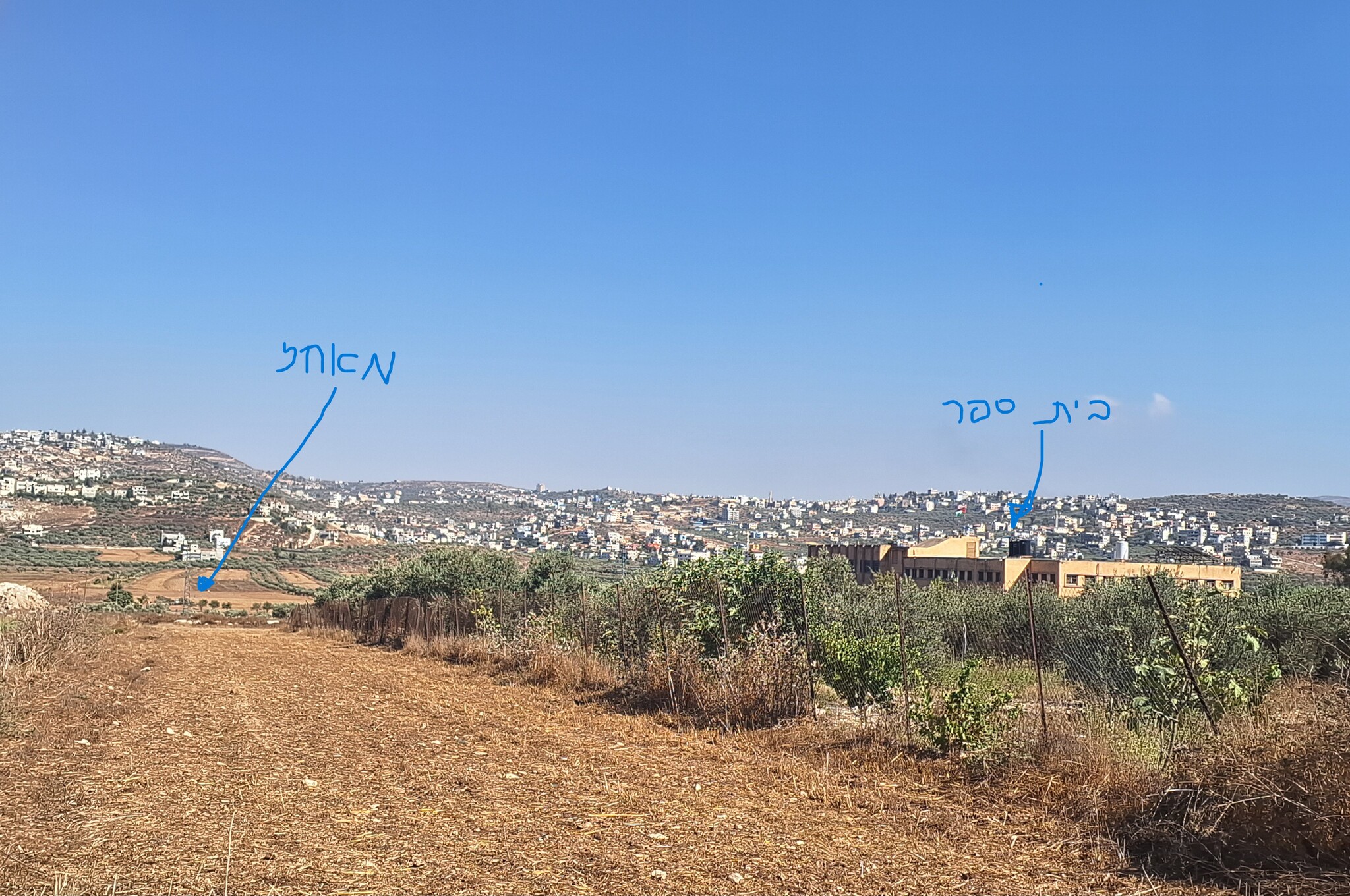 Ronit Dahan-RamatiAug-24-2026Huwara: The school on the outskirts of town and an outpost hidden among the trees
-
