
Qalandiya
It’s always the same story, the same callousness that ignores the other’s existence, silences and anonymizes them.
What should be self-evident, that a person released from hospital must return home to rest and recuperate, isn’t self-evident to the occupation authorities, and is therefore not self-evident to their subordinates.
This reality, in which persons who are ill and in pain must wait hours for crossing permits so they can continue home to Gaza, a journey lasting hours that concludes with the torture of the Erez crossing, requires us not only to see them but to mark them well, to recount their stories.
The devil, not god, is in the details.
The details that distinguish between the individual and the mass, the difference between one person and the next, their gestures, their pain, their illness, their wasted hours.
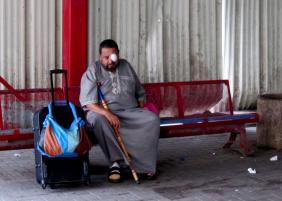
The man released this morning from the Ramallah hospital following an eye operation, helpless, cut off from his surroundings, sitting for three and a half hours at the checkpoint waiting for his wife to return from the DCL offices with a crossing permit.
He sits heavily, self-absorbed, occasionally lifting an arm, bending his head, cradling his forehead in his palm for a few seconds – perhaps to calm himself.
The woman who said her husband has been there for more than two hours, at the entrance to the offices, “He has cancer, very sick, very much tired.” She, who doesn’t know how to address the authorities, sits guarding their bags and suitcases and parcels loaded with goods bought in Ramallah for their family at home in Gaza’s prison.
The man who accompanied his wife, who has heart disease and didn’t want him to leave her even for an instant, she’s not used to being so far from home, her entire body trembling uncontrollably when the female soldier behind the security glass of the inspection booth punished her husband when he accompanied her into the inspection area, yelling “Wahad wahad I said,” making him move back out of his wife’s sight. Only when the soldier was satisfied did she reopen the metal barrier separating the couple.
“They implanted some device to strengthen her heart,” the husband said about the treatment his wife received at the Ramallah hospital.
There were others; I heard the taxi drivers and peddlers talking about them.
But they’d already been swallowed up behind the barriers and congregated around the windows and offices where those who decide their fate were seated.
And it’s always the same story, and they, who are responsible for issuing the permits, reply: “It’s not our fault; the Gaza DCL didn’t arrange for the permit,” as if any of the patients care who’s responsible for the delay, for the torture.
Qalandiya Checkpoint / Atarot Pass (Jerusalem)
See all reports for this place-
Click here to watch a video from Qalandiya checkpoint up to mid 2019 Three kilometers south of Ramallah, in the heart of Palestinian population. Integrates into "Jerusalem Envelope" as part of Wall that separates between northern suburbs that were annexed to Jerusalem in 1967: Kafr Aqab, Semiramis and Qalandiya, and the villages of Ar-Ram and Bir Nabala, also north of Jerusalem, and the city itself. Some residents of Kafr Aqab, Semiramis and Qalandiya have Jerusalem ID cards. A terminal operated by Israel Police has functioned since early 2006. As of August 2006, northbound pedestrians are not checked. Southbound Palestinians must carry Jerusalem IDs; holders of Palestinian Authority IDs cannot pass without special permits. Vehicular traffic from Ramallah to other West Bank areas runs to the north of Qalandiya. In February 2019, the new facility of the checkpoint was inaugurated aiming to make it like a "border crossing". The bars and barbed wire fences were replaced with walls of perforated metal panels. The check is now performed at multiple stations for face recognition and the transfer of an e-card. The rate of passage has improved and its density has generally decreased, but lack of manpower and malfunctions cause periods of stress. The development and paving of the roads has not yet been completed, the traffic of cars and pedestrians is dangerous, and t the entire vicinity of the checkpoint is filthy. In 2020 a huge pedestrian bridge was built over the vehicle crossing with severe mobility restrictions (steep stairs, long and winding route). The pedestrian access from public transport to the checkpoint from the north (Ramallah direction) is unclear, and there have been cases of people, especially people with disabilities, who accidentally reached the vehicle crossing and were shot by the soldiers at the checkpoint. In the summer of 2021, work began on a new, sunken entrance road from Qalandiya that will lead directly to Road 443 towards Jerusalem and Tel Aviv. At the same time, the runways of the old Atarot airport were demolished and infrastructure was prepared for a large bus terminal. (updated October 2021)
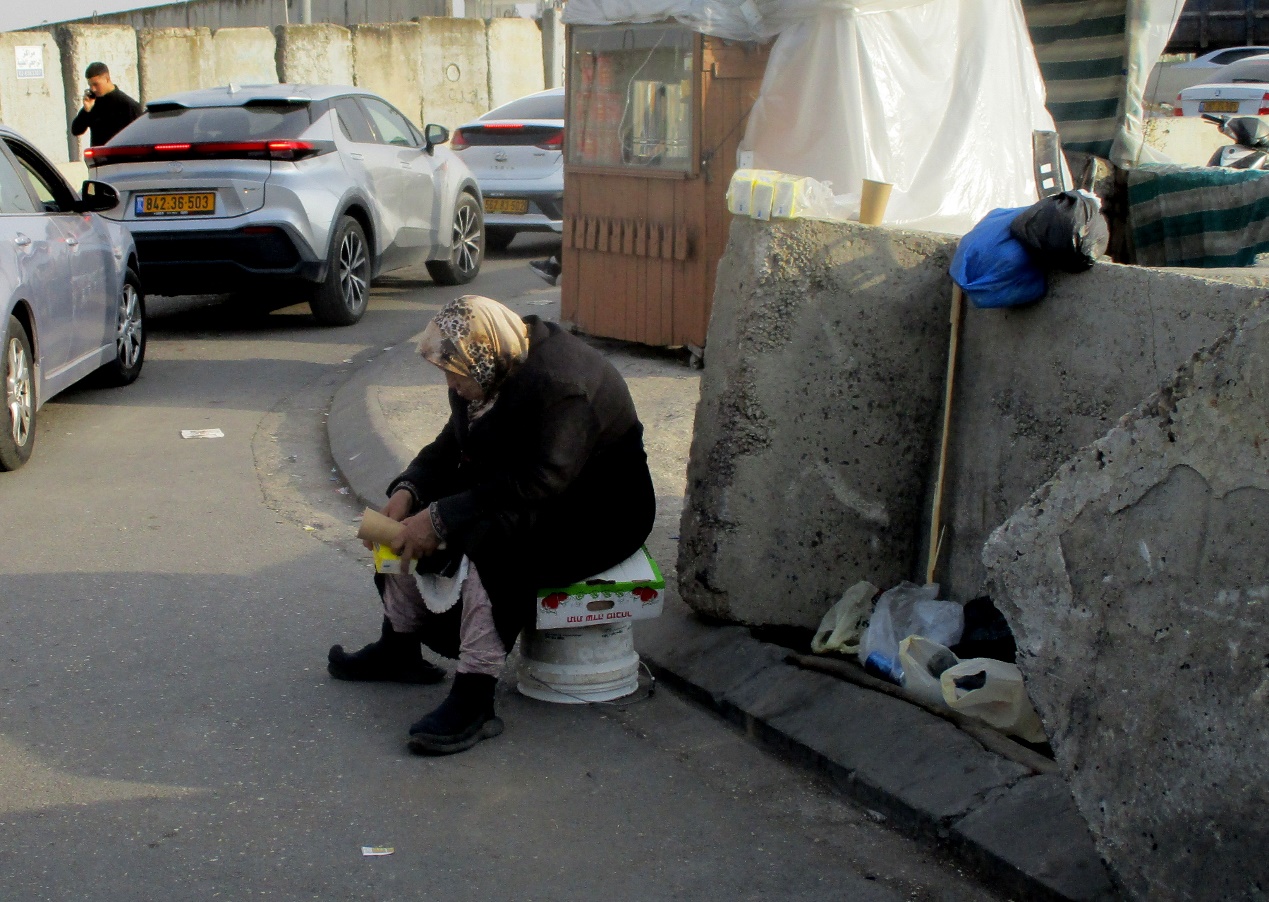 Tamar FleishmanOct-11-2026Qalandiya. Female Beggar
-
