
Qalandiya
The girl with the doll and her mother, and her 2 sisters, one whom was shaking from fever and broke out in tears every time she saw a soldier, were not allowed to go through the checkpoint and return home to Abu Ghosh.. Everything was according to instructions, everything was done according to orders and there was no divergence from rules. Just as they teach them and as they train them and as they accustom them to be obedient, without taking any personal responsibility or common sense.

Because that is good for them, and that is good for the system and that is the way to turn generation of children into obedient adults who obey instructions without questioning or doubting, neither their own deed nor their results.
The mother of the girl with the doll, who was born and raised in Ramallah, and who thus has a Palestinian ID, married a man from Abu Ghosh, an Israeli citizen. But the law of citizenship, at base a racist law which has nothing in common with such laws anywhere in the world, which determines that any Palestinian is a security risk to the State of Israel, and whose goal is to withdraw status from Palestinian spouses, is a law from the year 2002, an emergency law, which keeps being extended before it lapses. It does not allow a wife to be a permanent resident in the house where she shares her life with her husband and children, but rather she must be eternally linkied to what is called "a permit for temporary residence for the sake of family unity", which is, as it is called, temporary and can be withdrawn at any given moment.
But on this morning, the woman who traveled with her 3 daughters to visit her family in Ramallah, perhaps changed her bag, or perhaps forgot to check, or perhaps…In any case, only in the afternoon, only at the checkpoint, only on her way home did she realize that she only had a copy of the permit in her bag. But a copy is never good enough when you are a Palestinian, you need the original. And even if she had the original, she didn't have her ID and that is really bad. And those who were opposite her did not ask, the woman soldier and the policeman who was summoned, they could not determine her identity, since it is possible for anyone to check on the computer the ID number, or to check the biometric fingerprint, or many other possibilities.
But, in order to check this, you have to want to check it, and they didn't want to. So, they didn't check and, by telephone order from on high, from people of greater rank than theirs, they threw the trespasser out of the checkpoint, the girl with the doll and her mother and her 2 sisters, one of whom was shaking with fever and crying bitterly every time she saw a soldier in the area.
So don't let anybody tell me that the occupation doesn't stink to heaven..
Qalandiya Checkpoint / Atarot Pass (Jerusalem)
See all reports for this place-
Click here to watch a video from Qalandiya checkpoint up to mid 2019 Three kilometers south of Ramallah, in the heart of Palestinian population. Integrates into "Jerusalem Envelope" as part of Wall that separates between northern suburbs that were annexed to Jerusalem in 1967: Kafr Aqab, Semiramis and Qalandiya, and the villages of Ar-Ram and Bir Nabala, also north of Jerusalem, and the city itself. Some residents of Kafr Aqab, Semiramis and Qalandiya have Jerusalem ID cards. A terminal operated by Israel Police has functioned since early 2006. As of August 2006, northbound pedestrians are not checked. Southbound Palestinians must carry Jerusalem IDs; holders of Palestinian Authority IDs cannot pass without special permits. Vehicular traffic from Ramallah to other West Bank areas runs to the north of Qalandiya. In February 2019, the new facility of the checkpoint was inaugurated aiming to make it like a "border crossing". The bars and barbed wire fences were replaced with walls of perforated metal panels. The check is now performed at multiple stations for face recognition and the transfer of an e-card. The rate of passage has improved and its density has generally decreased, but lack of manpower and malfunctions cause periods of stress. The development and paving of the roads has not yet been completed, the traffic of cars and pedestrians is dangerous, and t the entire vicinity of the checkpoint is filthy. In 2020 a huge pedestrian bridge was built over the vehicle crossing with severe mobility restrictions (steep stairs, long and winding route). The pedestrian access from public transport to the checkpoint from the north (Ramallah direction) is unclear, and there have been cases of people, especially people with disabilities, who accidentally reached the vehicle crossing and were shot by the soldiers at the checkpoint. In the summer of 2021, work began on a new, sunken entrance road from Qalandiya that will lead directly to Road 443 towards Jerusalem and Tel Aviv. At the same time, the runways of the old Atarot airport were demolished and infrastructure was prepared for a large bus terminal. (updated October 2021)
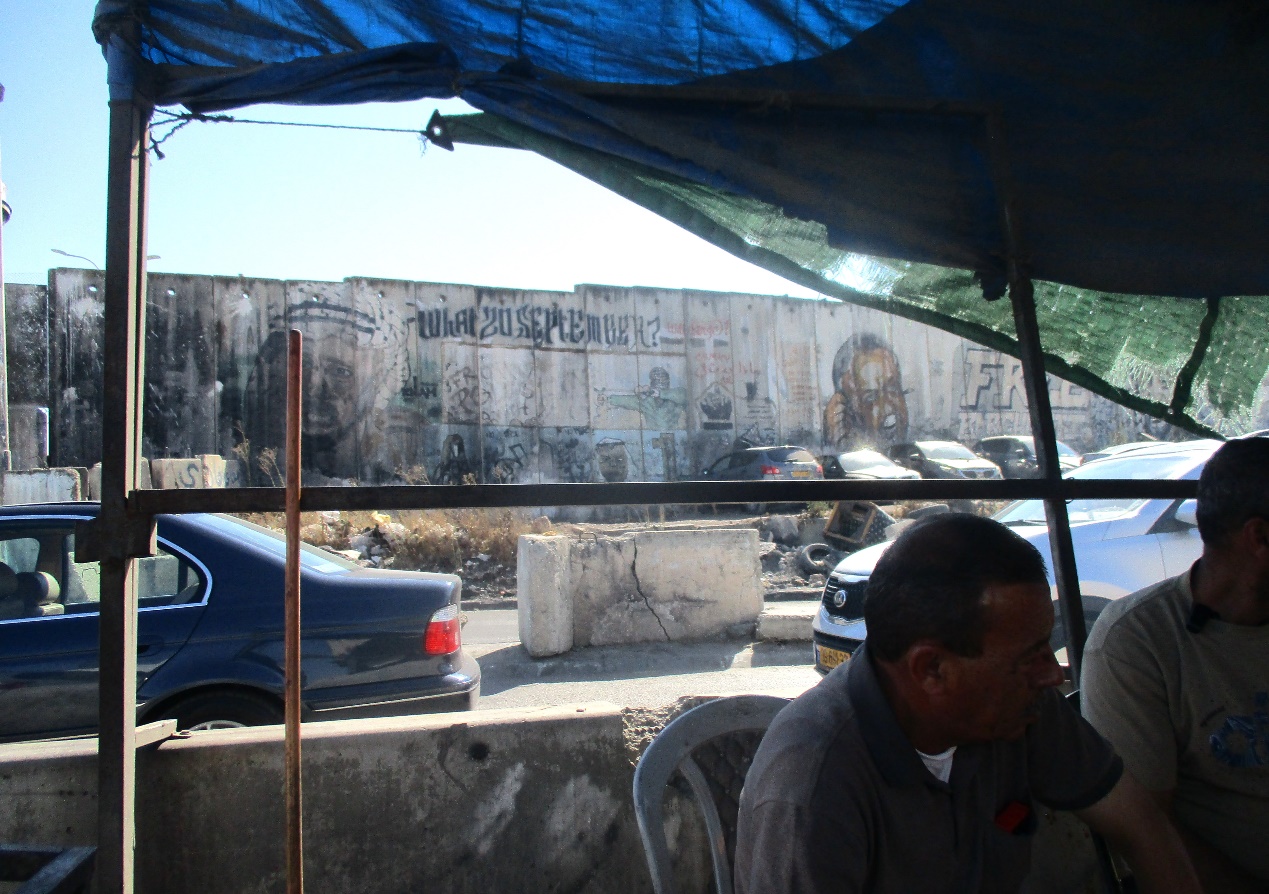 Tamar FleishmanJul-21-2026Qalandiya. Conversation in the shadow of the wall
-
