
Qalandiya
At the Qalandiya checkpoint
The same scene, walls in a single shade of gray, horizonless, the same procedures, the same bureaucracy, the same uniforms and the same guns.
The differences are in the human beings, in the victims, in the individuals.
These are people on the way to the hospital. Their hospital, not ours. By right, not by sufferance.
Two were detained at the entrance and waited. Two people made to suffer longer because of the procedures.
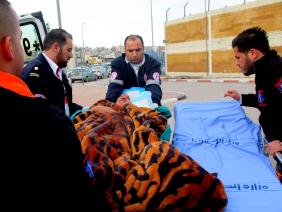
The first who arrived was the first to go through (because there’s order, and there must be order) – an ambulance from Jenin transporting a woman with a bleeding growth in her brain.
The ambulance waited more than twenty minutes at the checkpoint entrance. More than twenty minutes of waiting by a woman for whom a bleeding growth in the brain isn’t a minor matter. A physician accompanied her. “I’m a specialist at the Jenin hospital” he said to me after the woman had been transferred to the ambulance that took her to Makassed Hospital in East Jerusalem.
And the physician and I stood talking about ambulances and about waiting and about growths in the head and in the brain.
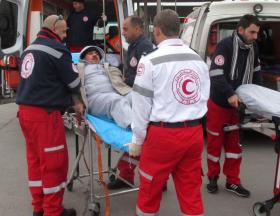
At the same time, but for a longer time, an ambulance that had arrived from Qalqilya. It carried a man with cancer in his head. He waited almost an hour at the checkpoint entrance. He was also sent to Makassed Hospital for an operation to remove the growth, after which he’ll be transferred to Augusta Victoria for treatment.
Nor, through all this, was it possible to overlook the sergeant in charge of everything and everyone who also raged and yelled and threatened to arrest me and file a complaint because I’m photographing which is prohibited and he has the authority and he can and he… Only a policeman was able to calm the sergeant. And when his back had disappeared it was as though he had left his voice behind, which provided the medical personal with a bit of comic relief as he shouted: “She’s the reason our buses get blown up!”… It was worth it to me.
At Shu’afat
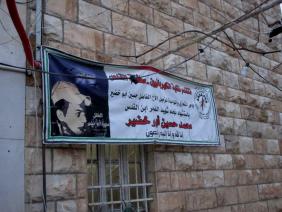
When on Saturday I saw a photograph that Hussein Abu-Khadir had taken of the memorial, near his house, to his son Muhammad who’d been set afire, which was covered with snow, my heart ached again and remembered the mother’s face growing gray as the days and sleepless nights passed, and I remembered what the father had told me, and I knew the rain and snow have no power to extinguish that conflagration,
And these lines echoed inside me:
Rain falls on the faces of my companions
On my live companions, who
Cover their heads with the blanket –
And on the faces of my dead companions, who
Cover nothing at all. (Y. Amichai)
And even though I knew they’d driven to Jericho, I came and stood at the steps where he had been kidnapped and at the memorial to the boy and entered the Abu-Khadir family’s inner courtyard and saw on the wall the placard with the face of the boy who hadn’t grown since then and will grow no older.
And I spoke with neighbors, and saw the burned train stop, and heard that since that day the ground has been seething, that the train has been stoned, that regular and undercover police forces are always there.
And at the same time, right across town, the mayor’s bodyguard prevented the death of a young Palestinian who’d stabbed a Jew, when he seized and neutralized him and didn’t obey the order of the Police Minister to execute him.
Qalandiya Checkpoint / Atarot Pass (Jerusalem)
See all reports for this place-
Click here to watch a video from Qalandiya checkpoint up to mid 2019 Three kilometers south of Ramallah, in the heart of Palestinian population. Integrates into "Jerusalem Envelope" as part of Wall that separates between northern suburbs that were annexed to Jerusalem in 1967: Kafr Aqab, Semiramis and Qalandiya, and the villages of Ar-Ram and Bir Nabala, also north of Jerusalem, and the city itself. Some residents of Kafr Aqab, Semiramis and Qalandiya have Jerusalem ID cards. A terminal operated by Israel Police has functioned since early 2006. As of August 2006, northbound pedestrians are not checked. Southbound Palestinians must carry Jerusalem IDs; holders of Palestinian Authority IDs cannot pass without special permits. Vehicular traffic from Ramallah to other West Bank areas runs to the north of Qalandiya. In February 2019, the new facility of the checkpoint was inaugurated aiming to make it like a "border crossing". The bars and barbed wire fences were replaced with walls of perforated metal panels. The check is now performed at multiple stations for face recognition and the transfer of an e-card. The rate of passage has improved and its density has generally decreased, but lack of manpower and malfunctions cause periods of stress. The development and paving of the roads has not yet been completed, the traffic of cars and pedestrians is dangerous, and t the entire vicinity of the checkpoint is filthy. In 2020 a huge pedestrian bridge was built over the vehicle crossing with severe mobility restrictions (steep stairs, long and winding route). The pedestrian access from public transport to the checkpoint from the north (Ramallah direction) is unclear, and there have been cases of people, especially people with disabilities, who accidentally reached the vehicle crossing and were shot by the soldiers at the checkpoint. In the summer of 2021, work began on a new, sunken entrance road from Qalandiya that will lead directly to Road 443 towards Jerusalem and Tel Aviv. At the same time, the runways of the old Atarot airport were demolished and infrastructure was prepared for a large bus terminal. (updated October 2021)
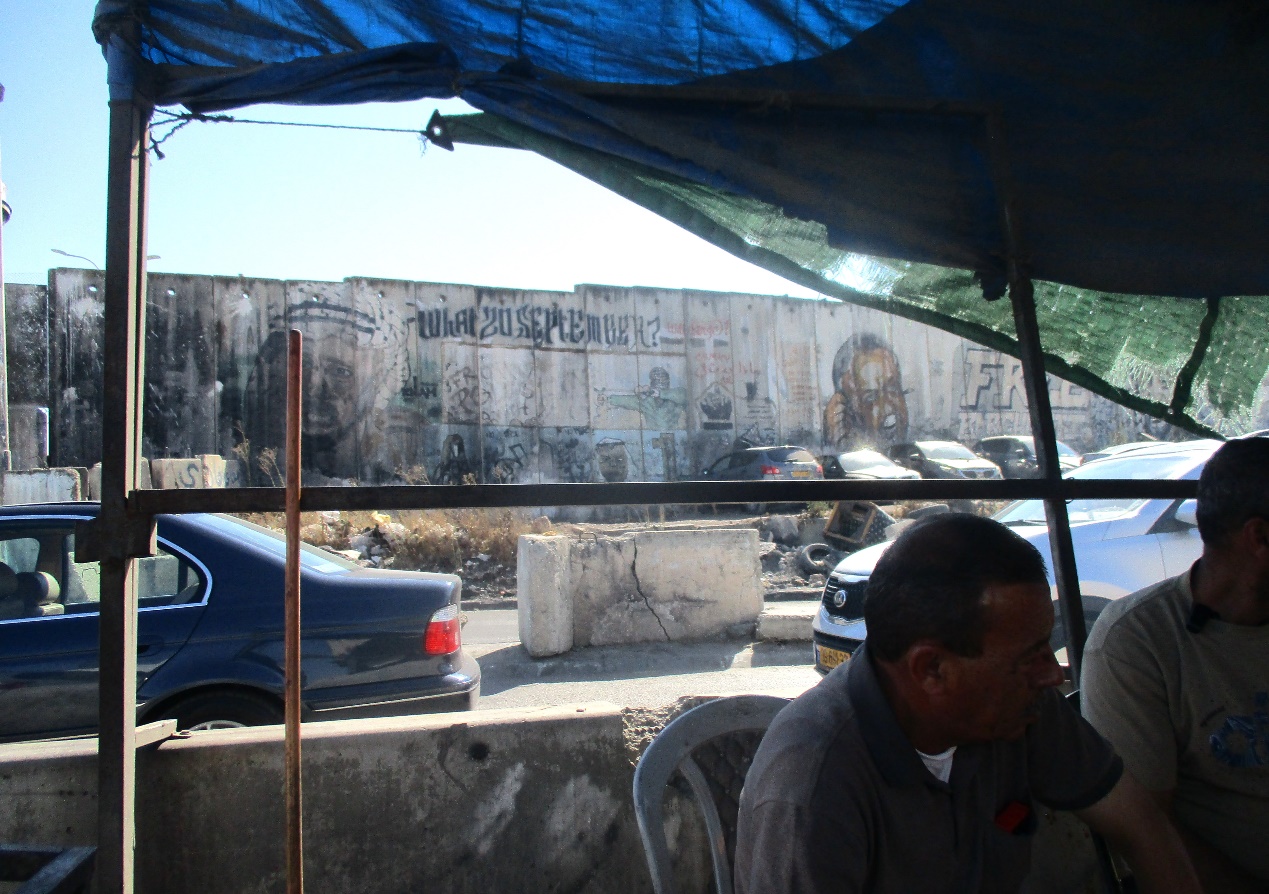 Tamar FleishmanJul-21-2026Qalandiya. Conversation in the shadow of the wall
-
