
Qalandiya
It's the beginning of the Hebrew month Nissan. Flowers are blooming in an abundance of colors. It's freezing cold.
The checkpoint is unusually quiet and people are crossing fast and smoothly until 5:45. In spite of the early hour, two turnstiles are working. Later on a third one opens. The restrooms are open. People enter them. Evidently the pipes that were stolen have been replaced (according to a soldier, two weeks ago).
Towards 6 o'clock the number of people has grown. The line is getting longer and stretches on to the parking. Some young people start pushing. The older people move back. In the crowd some minor injuries are caused (one person shows us that he has been injured by the cage). One person asks us why we come if we cannot help. We explain and talk. It seems to me that the fact that two grandmothers get up at 4 o'clock in the morning in order to be at the checkpoint does have an impact. I've watched this checkpoint for two months already, but I haven't gotten used to the horrible sight of people being squeezed together into the cages. What a difference between the workers being crammed together and the free birds singing between the barbed wire-fences. The police woman is worried about the cats suffering from a skin disease. She asks us when Marsha is coming. (Marsha "takes care" of the animals and brings food to the cats) – who worries about the people? On one of the poles there is a notice about a missing beautiful wolf-dog.
The humanitarian gate opens on time. A 55 year old man tells us that he intends to check if indeed people above the age of 50 are permitted to cross without papers. He is fantasizing about a café, about praying on the Temple Mount and about visiting Jerusalem. He is waiting for the line to get shorter. Close to 7 o'clock, before he leaves for Jerusalem he takes the time to tell us that he is yearning for peace. So are we.
Qalandiya Checkpoint / Atarot Pass (Jerusalem)
See all reports for this place-
Click here to watch a video from Qalandiya checkpoint up to mid 2019 Three kilometers south of Ramallah, in the heart of Palestinian population. Integrates into "Jerusalem Envelope" as part of Wall that separates between northern suburbs that were annexed to Jerusalem in 1967: Kafr Aqab, Semiramis and Qalandiya, and the villages of Ar-Ram and Bir Nabala, also north of Jerusalem, and the city itself. Some residents of Kafr Aqab, Semiramis and Qalandiya have Jerusalem ID cards. A terminal operated by Israel Police has functioned since early 2006. As of August 2006, northbound pedestrians are not checked. Southbound Palestinians must carry Jerusalem IDs; holders of Palestinian Authority IDs cannot pass without special permits. Vehicular traffic from Ramallah to other West Bank areas runs to the north of Qalandiya. In February 2019, the new facility of the checkpoint was inaugurated aiming to make it like a "border crossing". The bars and barbed wire fences were replaced with walls of perforated metal panels. The check is now performed at multiple stations for face recognition and the transfer of an e-card. The rate of passage has improved and its density has generally decreased, but lack of manpower and malfunctions cause periods of stress. The development and paving of the roads has not yet been completed, the traffic of cars and pedestrians is dangerous, and t the entire vicinity of the checkpoint is filthy. In 2020 a huge pedestrian bridge was built over the vehicle crossing with severe mobility restrictions (steep stairs, long and winding route). The pedestrian access from public transport to the checkpoint from the north (Ramallah direction) is unclear, and there have been cases of people, especially people with disabilities, who accidentally reached the vehicle crossing and were shot by the soldiers at the checkpoint. In the summer of 2021, work began on a new, sunken entrance road from Qalandiya that will lead directly to Road 443 towards Jerusalem and Tel Aviv. At the same time, the runways of the old Atarot airport were demolished and infrastructure was prepared for a large bus terminal. (updated October 2021)
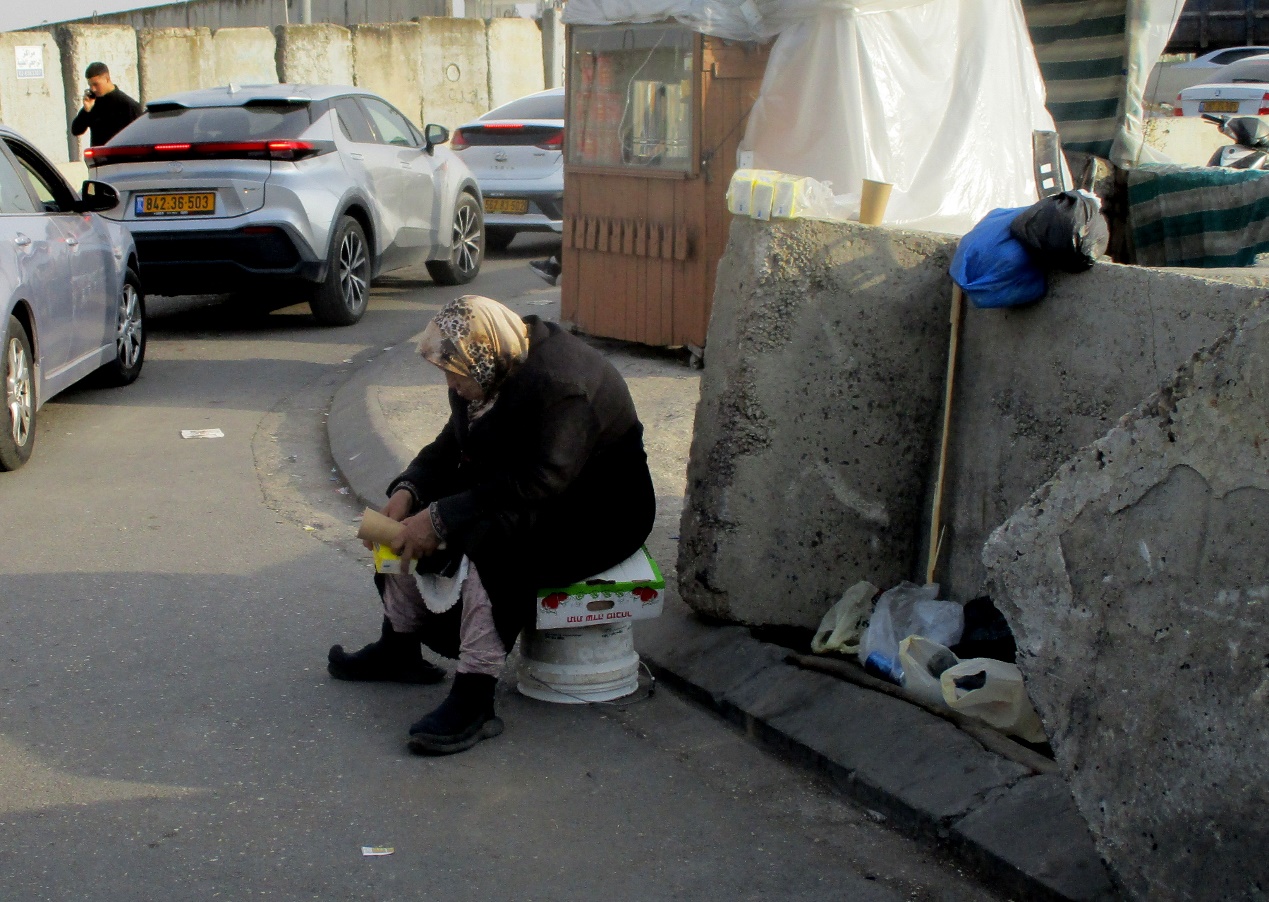 Tamar FleishmanOct-11-2026Qalandiya. Female Beggar
-
