Back to reports search page
Donate
Qalandiya
Observers: Marcia L. and Ronny P.
We arrived at 5am and there was a long line that proceeded in an "orderly" fashion after we notified the DCO that the soldier who opens the turnstile was virtually playing a cat and mouse play with the people on line by opening just one of the 3 turnstiles or by letting only 5 people through.
By 6am there was a long line by the humanitarian gate. The DCO officer arrived at 6.30.
That is where the meaning of universal concepts translate differently in occupation reality:
1. Humanitarian gate at Qalandiya
This gate only opens at 6am and there is always a lot of pushing in the narrow access to this gate. The officers don't always arrive at 6 and no explanation is ever given for the delay. Humanitarian at Qalandiya means that people who go through can spend 30-40 minutes completing the whole security check process instead of 40 plus going through the regular turnstile and checking process.
The humanitarian case: people queue here in front of the gate and 30 meters further they queue again in front of the security check booth /window. Who qualifies as a humanitarian case? Sick people, pupils, women and workers above the age of 60. What is the work of the humanitarian DCO officer at the humanitarian gate? To see that no worker below the age of 60 gets through. That a WAQF school principal doesn't sqeeze through because his permit does not literally state he is a teacher. And a teacher's ID is not valid here.
2. Humanitarian aid
On the photo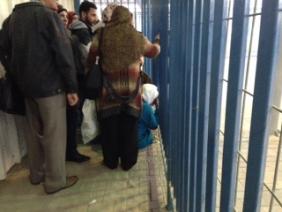 is a very old and sick woman waiting for the gate to open . The advice of the policeman was that until he decides when to open the gate she should sit on the bench in the waiting hall behind and then push and sqeeze to return to the gate before she gets to the security check gate. One could envisage a situation when the gentle woman DCO officer could open the gate for the sick lady and accompany her right to the beginning of the second line at security check window.
is a very old and sick woman waiting for the gate to open . The advice of the policeman was that until he decides when to open the gate she should sit on the bench in the waiting hall behind and then push and sqeeze to return to the gate before she gets to the security check gate. One could envisage a situation when the gentle woman DCO officer could open the gate for the sick lady and accompany her right to the beginning of the second line at security check window.3. religious worship
Both Jews and Palestinians engage in religious worship and prayer at Qalandiya and it is a far cry from what one understans by the concept of spiritual worship. The Jewish soldier – On the bad photo below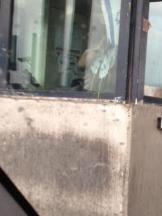 there is a soldier at the vehicle checkpoint laying tfillin and praying while controlling the Palestinian traffic from Ramallah to Jerusalem. The Palestinian worker – In the vestibule in front of the turnstiles leading to security check people step out of the line, put cardboard sheets on the floor and pray the morning prayer and then return to the queue and sqeeze through the very narrow turnstile on the way to the security check which they often fail because of an invalid finger print check – a common feature of people who are manual workers. Once you are diqualified you lose at least one day of work in order to renew your finger print testing.
there is a soldier at the vehicle checkpoint laying tfillin and praying while controlling the Palestinian traffic from Ramallah to Jerusalem. The Palestinian worker – In the vestibule in front of the turnstiles leading to security check people step out of the line, put cardboard sheets on the floor and pray the morning prayer and then return to the queue and sqeeze through the very narrow turnstile on the way to the security check which they often fail because of an invalid finger print check – a common feature of people who are manual workers. Once you are diqualified you lose at least one day of work in order to renew your finger print testing.That was our experience and our thoughts this morning.
Qalandiya Checkpoint / Atarot Pass (Jerusalem)
See all reports for this place-
Click here to watch a video from Qalandiya checkpoint up to mid 2019 Three kilometers south of Ramallah, in the heart of Palestinian population. Integrates into "Jerusalem Envelope" as part of Wall that separates between northern suburbs that were annexed to Jerusalem in 1967: Kafr Aqab, Semiramis and Qalandiya, and the villages of Ar-Ram and Bir Nabala, also north of Jerusalem, and the city itself. Some residents of Kafr Aqab, Semiramis and Qalandiya have Jerusalem ID cards. A terminal operated by Israel Police has functioned since early 2006. As of August 2006, northbound pedestrians are not checked. Southbound Palestinians must carry Jerusalem IDs; holders of Palestinian Authority IDs cannot pass without special permits. Vehicular traffic from Ramallah to other West Bank areas runs to the north of Qalandiya. In February 2019, the new facility of the checkpoint was inaugurated aiming to make it like a "border crossing". The bars and barbed wire fences were replaced with walls of perforated metal panels. The check is now performed at multiple stations for face recognition and the transfer of an e-card. The rate of passage has improved and its density has generally decreased, but lack of manpower and malfunctions cause periods of stress. The development and paving of the roads has not yet been completed, the traffic of cars and pedestrians is dangerous, and t the entire vicinity of the checkpoint is filthy. In 2020 a huge pedestrian bridge was built over the vehicle crossing with severe mobility restrictions (steep stairs, long and winding route). The pedestrian access from public transport to the checkpoint from the north (Ramallah direction) is unclear, and there have been cases of people, especially people with disabilities, who accidentally reached the vehicle crossing and were shot by the soldiers at the checkpoint. In the summer of 2021, work began on a new, sunken entrance road from Qalandiya that will lead directly to Road 443 towards Jerusalem and Tel Aviv. At the same time, the runways of the old Atarot airport were demolished and infrastructure was prepared for a large bus terminal. (updated October 2021)
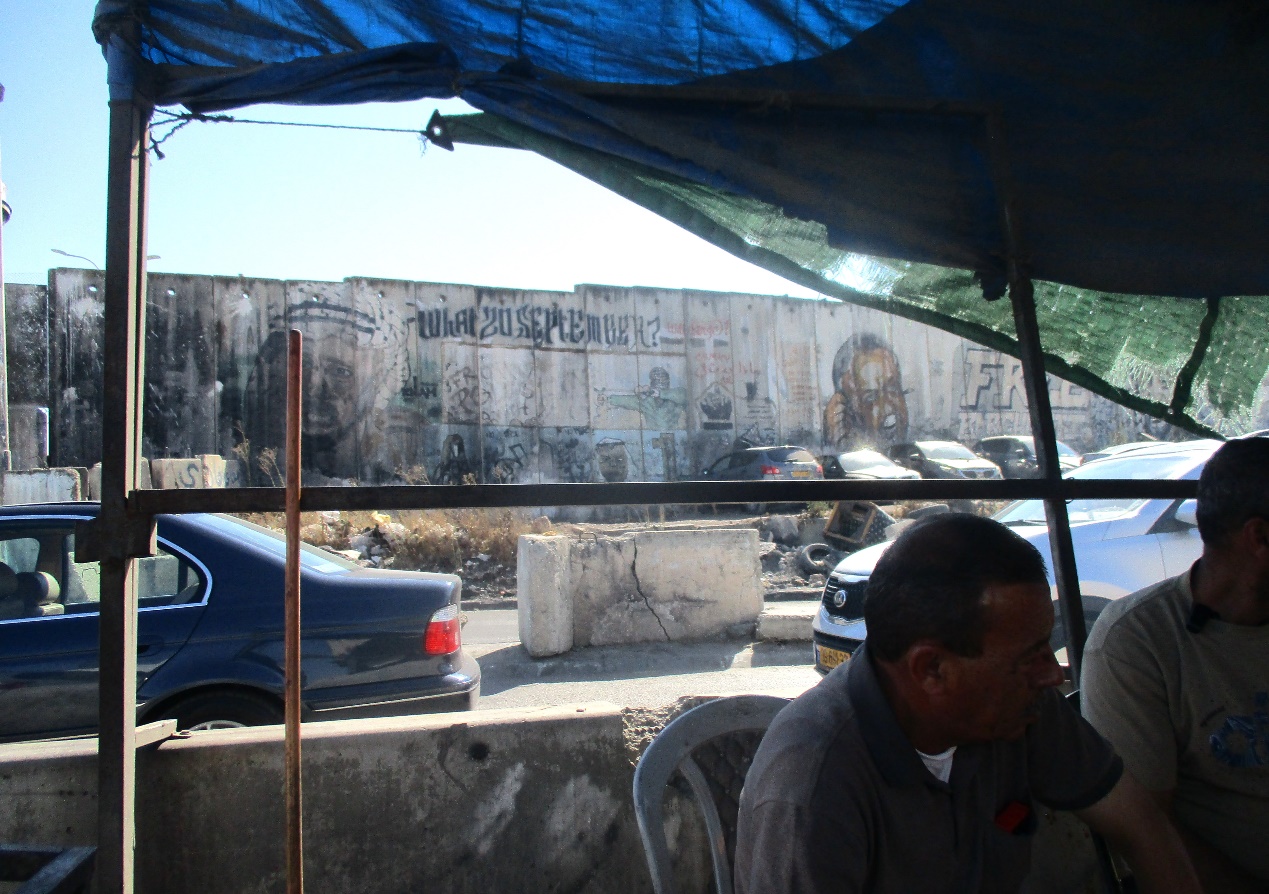 Tamar FleishmanJul-21-2026Qalandiya. Conversation in the shadow of the wall
-