
Qalandiya
The police have overall authority for the checkpoint.
The MP’s are subject to the police, responsible for inspecting those coming from Palestine to Jerusalem. Staff of Modi’in Ezrahi are also subject to the police – it’s the civilian security company which is one of the privatized tentacles spreading throughout the country, responsible for guarding the soldiers and the police officers.
Security staff carry guns like the soldiers, wear ceramic body armor like the soldiers, and their uniforms are so similar to those of the soldiers that an untrained eye may confuse the two. The similarity is probably not accidental.
Given that soldiers have rifles and police have pistols, it’s a strange decision to deploy a duplicate armed force to confront civilians.

Usually the guards can be seen shadowing a soldier or a policeman.
But they also may exceed their mandate and impose their authority on Palestinians.
That’s what happened when the police decided to close to vehicle traffic the lane from Jerusalem to Palestine and blocked it with movable metal barriers, opened the military gate in the separation wall between A-Ram and Qalandiya and diverted all the vehicles through it. The police explained it was done to regulate the heavy traffic, though what it actually accomplishes is to move the heavy traffic to a location where it’s less visible, at least to them. And when the route to the vehicle checkpoint was empty of cars, one Palestinian woman managed to squeeze her car between the metal barriers and had already reached the middle of the checkpoint, next to where the soldiers were stationed, when one of the guards noticed her. He sprang toward her, stopped her, reprimanded her, confiscated her ID, ordered her to turn back and returned the ID only after he saw she’d obeyed – in other words, made a u-turn and drove back whence she came.
Something similar occurred when a guard accompanying the policeman directing traffic toward the open gate noticed a person on foot who’d arrived from the other side of the wall and walked holding his small son’s hand, and just when the two of them were about to cross the border between there and here, between A-Ram and Qalandiya, the guard hurried toward them and chased them back whence they’d come.
# # # # # # # # #
On the main road, about fifty meters before Adam Plaza, on the road from Qalandiya to Highway 60, Border Police soldiers conducted what’s called in military parlance Interrupting the routine, or making them feel persecuted.
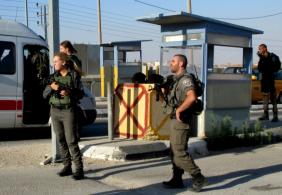
They stopped vehicles, ordered the drivers to the roadside, and if a taxi happened to be selected one of the soldiers entered and collected the passengers’ IDs.
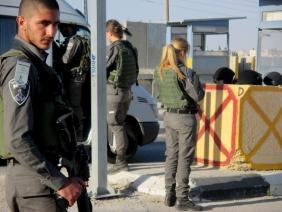
There didn’t seem to be a standard procedure, and watching from the side we weren’t able to predict who’s next. “I’m prohibited from telling you; it’s secret” said Shmuel, the officer commanding the unit.

Shmuel transmitted to someone over the radio the ID numbers of the people whose IDs were collected, and waited.
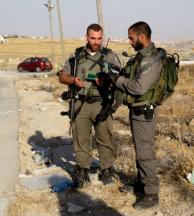
When he received an answer from the person on the other end Shmuel gave the stack of IDs to one of his soldiers who then returned to the detained vehicle and gave the IDs back to their owners and allowed the driver to continue.

Drivers of private cars weren’t exempt, nor were residents of Jerusalem whose vehicles bore yellow license plates. In such cases the vehicle as well as the IDs was confiscated and its interior was comprehensively inspected.
Qalandiya Checkpoint / Atarot Pass (Jerusalem)
See all reports for this place-
Click here to watch a video from Qalandiya checkpoint up to mid 2019 Three kilometers south of Ramallah, in the heart of Palestinian population. Integrates into "Jerusalem Envelope" as part of Wall that separates between northern suburbs that were annexed to Jerusalem in 1967: Kafr Aqab, Semiramis and Qalandiya, and the villages of Ar-Ram and Bir Nabala, also north of Jerusalem, and the city itself. Some residents of Kafr Aqab, Semiramis and Qalandiya have Jerusalem ID cards. A terminal operated by Israel Police has functioned since early 2006. As of August 2006, northbound pedestrians are not checked. Southbound Palestinians must carry Jerusalem IDs; holders of Palestinian Authority IDs cannot pass without special permits. Vehicular traffic from Ramallah to other West Bank areas runs to the north of Qalandiya. In February 2019, the new facility of the checkpoint was inaugurated aiming to make it like a "border crossing". The bars and barbed wire fences were replaced with walls of perforated metal panels. The check is now performed at multiple stations for face recognition and the transfer of an e-card. The rate of passage has improved and its density has generally decreased, but lack of manpower and malfunctions cause periods of stress. The development and paving of the roads has not yet been completed, the traffic of cars and pedestrians is dangerous, and t the entire vicinity of the checkpoint is filthy. In 2020 a huge pedestrian bridge was built over the vehicle crossing with severe mobility restrictions (steep stairs, long and winding route). The pedestrian access from public transport to the checkpoint from the north (Ramallah direction) is unclear, and there have been cases of people, especially people with disabilities, who accidentally reached the vehicle crossing and were shot by the soldiers at the checkpoint. In the summer of 2021, work began on a new, sunken entrance road from Qalandiya that will lead directly to Road 443 towards Jerusalem and Tel Aviv. At the same time, the runways of the old Atarot airport were demolished and infrastructure was prepared for a large bus terminal. (updated October 2021)
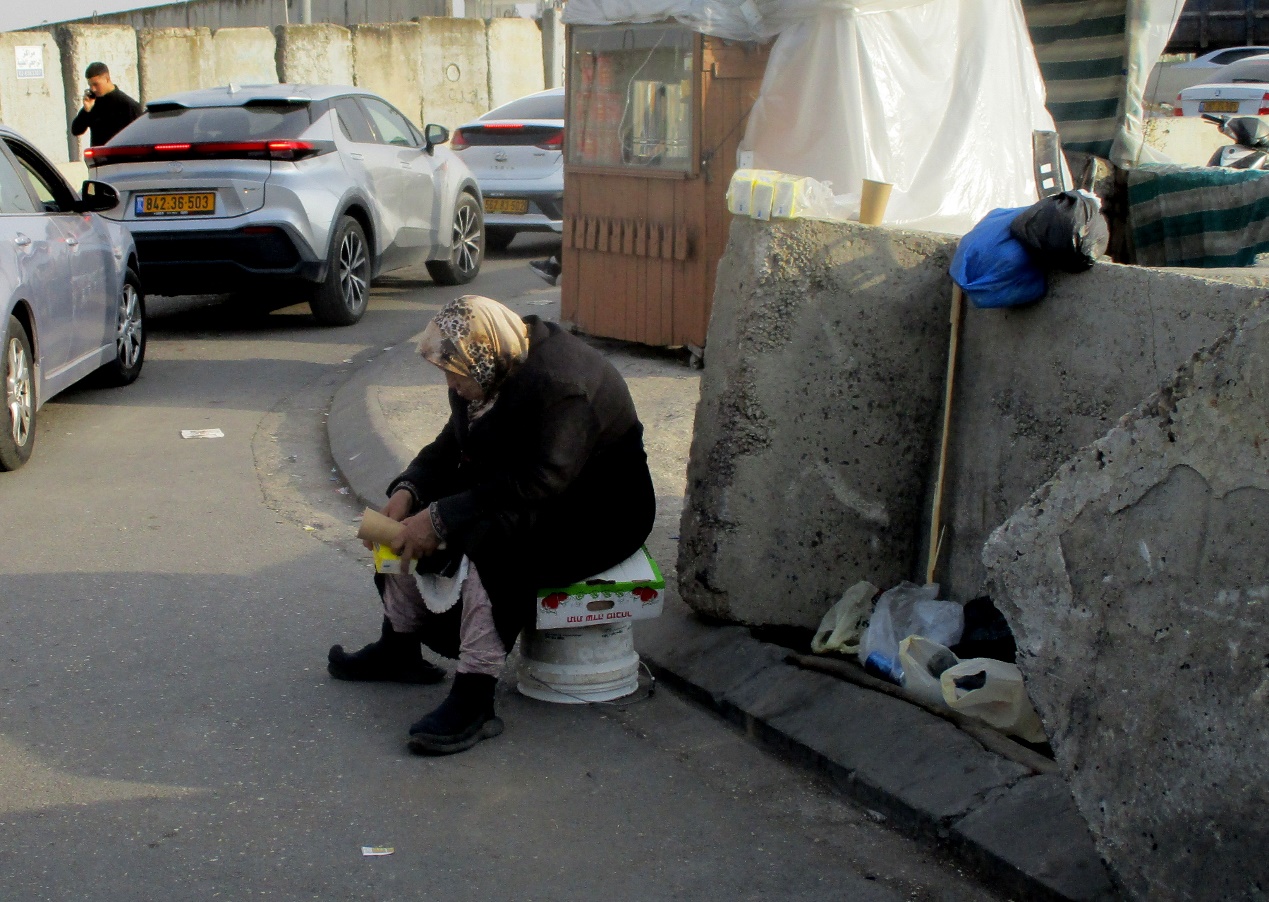 Tamar FleishmanOct-11-2026Qalandiya. Female Beggar
-
