Qalandiya
A busy morning at the Qalandiya CP
The Qalandiya CP reverts to its evil ways. When we arrived at the CP,after we parked at the Israeli side, we were met with long queues which extended into the parking lot. The 5 posts were already open at 5:15, but perhaps some were opened just now. At the posts there weren't many people, but the girl soldier in the aquarium let only a few persons enter by the three enclosures and the turnstiles. This caused a situation where each time the turnstiles were opened, pushing, shoving and screaming ensued, and people tried to succeed in squeezing their way into the enclosures and approach their turn to pass by the turnstiles (so as to be able to wait in the queue for another turnstile in front of the post, and another 2 beyond it…)
From time to time it seemed that the queues would again turn into a heap of humanity at the entrance to the enclosures as it happens sometimes. Luckily this didn't happen this time. The presence of women who came to the beginning of the queue at the entrance to the enclosures, helped to calm the atmosphere down. The men stopped the pushing and let them integrate into the queue, and then they to stood in an orderly queue.
At a certain stage it seemed that the girl-soldier in the aquarium had fallen asleep, or perhaps she only bowed her head towards the smartphone in her lap. In any case a relatively long time passed and she didn't lift her head and didn't open the turnstiles. The queues near the checking posts were almost finished. People began shouting but nothing happened. We already began dialing to the DCO, when suddenly the girls soldier lifted her head and opened the turnstiles. Later she did this frequently and for a moment we could see the end of the queues beyond the shed…
Some time after 05: 30 a policewoman and a policeman arrived and the rate of the opening of the turnstiles accelerated. The queues began becoming shorter. The cake and beigele vendors work as usual, the coffee stand is open, and next to it a mobile stand for dialing cards. The beigele vendor says that he too doesn't know why just today there is such a pressure. Yesterday it was calm, he says. We went outside and saw the sun shining on Qalandiya from the direction of the desert. At the parking lot there is a placard announcing in English and in Arabic that the parking lot will be closed from 15.6, depending on the parking. Preparations for the Ramadan. The traffic in the square is already busling and the car horns are heard from the direction of the vehicle CP.
We met our acquaintance H., who tells us that the national insurance fixed his disability as 14% only, as a result of the injury to his hand in a work accident. He will receive a compensation of about 17,000 NIS. Although the movement of his fingers is still limited he has long ago returned to work. He too tells us that at the beginning of the week the situation at the queues was better.
Again "our forces" in the aquarium became engrossed in their smart phones and the queues again overflowed to the parking lot. When they lifted their heads and opened the turnstiles, they announced on the loudspeaker that all the post were open and directed the people to the free post no. 5.
At a certain stage we saw the policeman going to the phone inside the aquarium, holding the papers who was probably rejected by the checking post. We did not manage to see what happened with him in the end, whether he was allowed to pass or whether he was returned. In the meantime there was a changing of guards of the soldiers in the aquarium. We saw the father who usually arrives with his three children, but today he was with his big girl only. The small one probably already were on vacation. They go to the humanitarian gate and are immediately joined by other people. A bit after 6 P., the non-commissioned officer from the DCO arrives, and opens the humanitarian gate. The regular queues became shorter in the meantime, and are no in the shed only. But inside there are long queues, near all the five posts.
Then the queues became again longer, near the humanitarian gate too, and after they had opened the gate several time before a long queue accumulates. An old man and woman, leaning on their canes, are also in the queue. "Our forces" in the aquarium now comprise a girl soldier in her shift, a policeman, a policewoman, P. from the DCO and a security officer. In spite of this it takes time until they again open the humanitarian gate. A number of the men are sent to the regular queue which again overflows our ot the shed. In one of the queue a noisy dispute breaks out in one of the queues and for a moment it seems that it will become a real skirmish. The friends of the quarreling men calm them down and prevent a flare up.
6.35 – the queues diminished. When the turnstiles are opened the queue is reduced to the enclosures. We join one of the queues, and after 10 minutes we came out.
We were unable to fathom what caused such long queues just today. It seemed that the work of the checking posts was carried out efficiently (this is not always the case) and even so long queues were formed.
Outside we see a group of border policemen explaining to somebody the occurrences. When we approached we saw that there were there a man and a womdn from "Blue and White Human Rights". It's a long time we haven't seen them here, and as far as we knew today too they were not at the Palestinian side and didn't see the long queues (in the past we met them frequently in the shed).
Qalandiya Checkpoint / Atarot Pass (Jerusalem)
See all reports for this place-
Click here to watch a video from Qalandiya checkpoint up to mid 2019 Three kilometers south of Ramallah, in the heart of Palestinian population. Integrates into "Jerusalem Envelope" as part of Wall that separates between northern suburbs that were annexed to Jerusalem in 1967: Kafr Aqab, Semiramis and Qalandiya, and the villages of Ar-Ram and Bir Nabala, also north of Jerusalem, and the city itself. Some residents of Kafr Aqab, Semiramis and Qalandiya have Jerusalem ID cards. A terminal operated by Israel Police has functioned since early 2006. As of August 2006, northbound pedestrians are not checked. Southbound Palestinians must carry Jerusalem IDs; holders of Palestinian Authority IDs cannot pass without special permits. Vehicular traffic from Ramallah to other West Bank areas runs to the north of Qalandiya. In February 2019, the new facility of the checkpoint was inaugurated aiming to make it like a "border crossing". The bars and barbed wire fences were replaced with walls of perforated metal panels. The check is now performed at multiple stations for face recognition and the transfer of an e-card. The rate of passage has improved and its density has generally decreased, but lack of manpower and malfunctions cause periods of stress. The development and paving of the roads has not yet been completed, the traffic of cars and pedestrians is dangerous, and t the entire vicinity of the checkpoint is filthy. In 2020 a huge pedestrian bridge was built over the vehicle crossing with severe mobility restrictions (steep stairs, long and winding route). The pedestrian access from public transport to the checkpoint from the north (Ramallah direction) is unclear, and there have been cases of people, especially people with disabilities, who accidentally reached the vehicle crossing and were shot by the soldiers at the checkpoint. In the summer of 2021, work began on a new, sunken entrance road from Qalandiya that will lead directly to Road 443 towards Jerusalem and Tel Aviv. At the same time, the runways of the old Atarot airport were demolished and infrastructure was prepared for a large bus terminal. (updated October 2021)
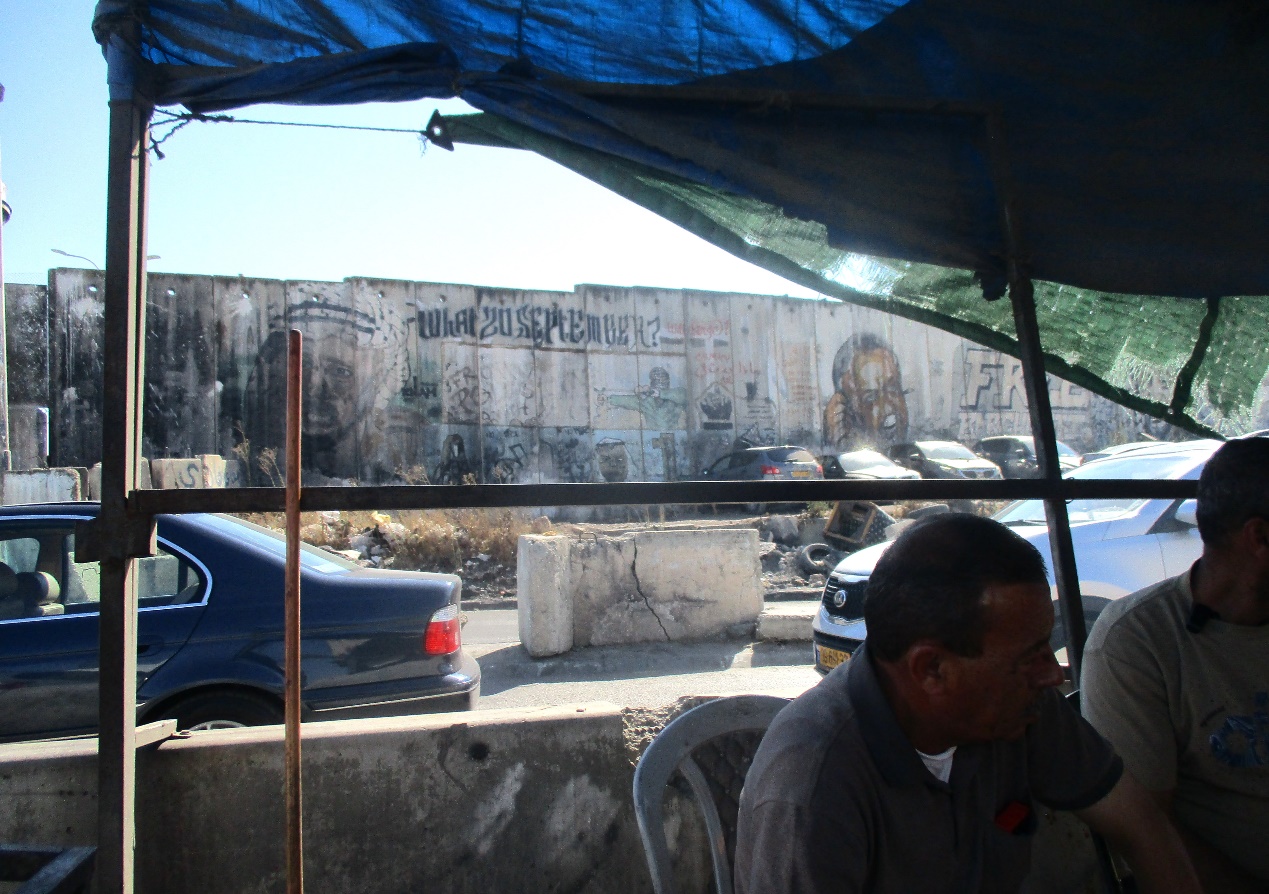 Tamar FleishmanJul-21-2026Qalandiya. Conversation in the shadow of the wall
-