
Back to reports search page

Donate
Qalandiya
Observers: Vivi S., Roni H., Tamar F., Shosh and Gordon, guests from Australia; Translator: Judith Green
The fourth Friday of Ramadan
At the checkpoint, they are trying to understand who is allowed and who is forbidden and whether or not the IDF still, or once again, cares about how it looks.
A very complex system of permits and refusals results from the "I decide" approach, "I enforce all the adsubdities, I change my mind according to ridiculous criteria and my rather narrow and instinctual understanding".
The price is on you, the Palestinians. You have to obey, to submit, to be harassed and humiliated, because that is how things are; Jerusalem is mine and the mosque is in my hands, and you have just a paper in your hands which I issued and I determined if the numbers on it find favor in my eyes.
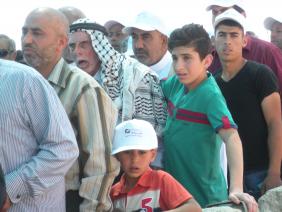
The price is high. Thousands of women, children, babies and older people arrive, totally worn out after a long journey, shoved up to the point of mortal danger between the cement barriers and the barbed wire fences and the sewage channel and piles of garbage. There are also young boys and girls in the line, with the small hope that perhaps the channeling system will fall apart, just for a moment or will make a mistake. On the faces of all of them, an expression of deep distress and anxiety.
The rules – permitted to women over 30, men over 50, little girls under 16, boys under 12, women between 16-30 only with a permit; men between 18-30 even without a permit, children of the correct ago only with showing their ID. Handicapped people only escorted by the Red Cross, a man escorting his elderly mother will be sent away at a distance where there is passage for men, quite far away, and – god wiling – they will meet up afterward.
This system of rules is applied for hours. Naturally, families which arrive together, and have members of different ages, are separated. The mothers are worried about their daughter, how she will manage alone all day in Ramallah, while she is really from a different area, or they are very upset about their bag which has in it everything they will need during the day and was left behind with the daughter or son. We heard a lot of "I need my suitcase!" If you say to her, "go back to take it", she will answer "but I will never succeed to get through again because of the crowding."
After several hours, around 12:00, the system in fact does break down a bit, and afterward it totally disintegrates. And those who had patience and stamina and didn't give in or collapse go through as though there was no checkpoint at all.
The checkpoint, with all its contingencies, is very very close to the Kalandia refugee camp where families are mourning their sons who left the house to the checkpoint, or to a demonstration, and didn't return and are now present on the posters on the walls and fences, like many other places in the West Bank.
Qalandiya Checkpoint / Atarot Pass (Jerusalem)
See all reports for this place-
Click here to watch a video from Qalandiya checkpoint up to mid 2019 Three kilometers south of Ramallah, in the heart of Palestinian population. Integrates into "Jerusalem Envelope" as part of Wall that separates between northern suburbs that were annexed to Jerusalem in 1967: Kafr Aqab, Semiramis and Qalandiya, and the villages of Ar-Ram and Bir Nabala, also north of Jerusalem, and the city itself. Some residents of Kafr Aqab, Semiramis and Qalandiya have Jerusalem ID cards. A terminal operated by Israel Police has functioned since early 2006. As of August 2006, northbound pedestrians are not checked. Southbound Palestinians must carry Jerusalem IDs; holders of Palestinian Authority IDs cannot pass without special permits. Vehicular traffic from Ramallah to other West Bank areas runs to the north of Qalandiya. In February 2019, the new facility of the checkpoint was inaugurated aiming to make it like a "border crossing". The bars and barbed wire fences were replaced with walls of perforated metal panels. The check is now performed at multiple stations for face recognition and the transfer of an e-card. The rate of passage has improved and its density has generally decreased, but lack of manpower and malfunctions cause periods of stress. The development and paving of the roads has not yet been completed, the traffic of cars and pedestrians is dangerous, and t the entire vicinity of the checkpoint is filthy. In 2020 a huge pedestrian bridge was built over the vehicle crossing with severe mobility restrictions (steep stairs, long and winding route). The pedestrian access from public transport to the checkpoint from the north (Ramallah direction) is unclear, and there have been cases of people, especially people with disabilities, who accidentally reached the vehicle crossing and were shot by the soldiers at the checkpoint. In the summer of 2021, work began on a new, sunken entrance road from Qalandiya that will lead directly to Road 443 towards Jerusalem and Tel Aviv. At the same time, the runways of the old Atarot airport were demolished and infrastructure was prepared for a large bus terminal. (updated October 2021)
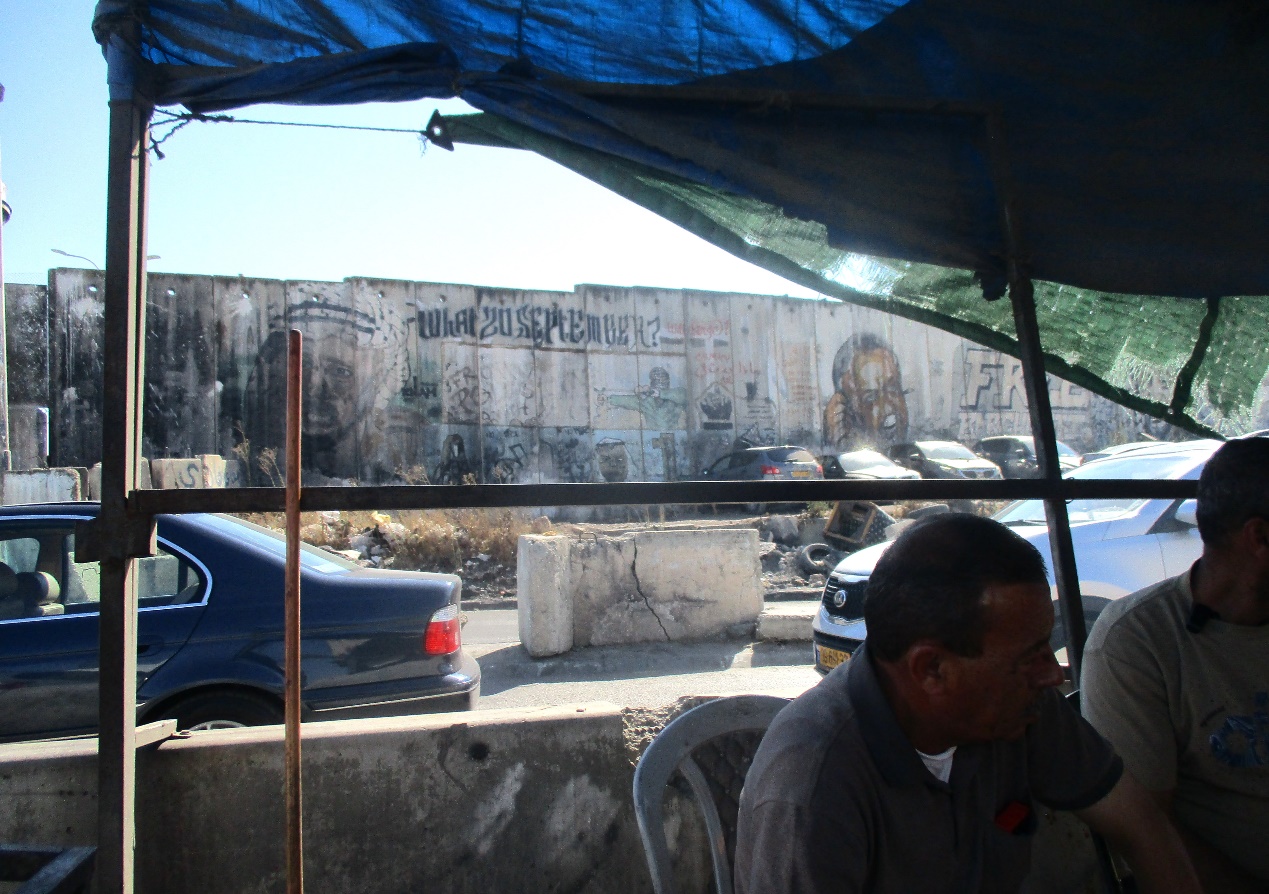 Tamar FleishmanJul-21-2026Qalandiya. Conversation in the shadow of the wall
-
