
Qalandiya
After a week of debilitating heat, we found the CP filthy and depressing. It’s difficult to describe how disgusting and neglected the CP looks when every breath of passing breeze sends a jumble of plastic bags flying aloft. When we reached Qalandiya (at about 3:40 PM), three passageways were operating but a few people were standing in line only in Passageway No. 1 while the others stood empty. The “unemployed” soldiers in the empty passageways spent their time playing with their cell phones. Passageway 5, to the DCL offices, was still open but had very few customers. We met two men who were waiting for their papers and chose to do so in the main CP shed. At 4:15 PM a soldier came from the DCL offices, looking for another man who had requested a permit to travel to Gaza. The soldier searched for him all over the CP, calling his name, but he couldn’t be found.
An ambulance from the Palestinian Authority arrived at the CP and waited for approximately 20 minutes in the blazing heat until a second ambulance arrived from Jerusalem. Only then did the soldiers perform a security check before allowing the Palestinian ambulance to cross the CP and enter the parking lot to transfer the patient.
At 4:45 PM the two “empty” passageways shut down leaving only Passageway No.1 open to serve the public. The soldiers had gone to their “supper break.” The line in the open passageway began to grow exponentially as this is the hour when students and workers return from their work and studies. Much to our surprise, another passageway opened just a few minutes later, dividing the waiting time in half.
Qalandiya Checkpoint / Atarot Pass (Jerusalem)
See all reports for this place-
Click here to watch a video from Qalandiya checkpoint up to mid 2019 Three kilometers south of Ramallah, in the heart of Palestinian population. Integrates into "Jerusalem Envelope" as part of Wall that separates between northern suburbs that were annexed to Jerusalem in 1967: Kafr Aqab, Semiramis and Qalandiya, and the villages of Ar-Ram and Bir Nabala, also north of Jerusalem, and the city itself. Some residents of Kafr Aqab, Semiramis and Qalandiya have Jerusalem ID cards. A terminal operated by Israel Police has functioned since early 2006. As of August 2006, northbound pedestrians are not checked. Southbound Palestinians must carry Jerusalem IDs; holders of Palestinian Authority IDs cannot pass without special permits. Vehicular traffic from Ramallah to other West Bank areas runs to the north of Qalandiya. In February 2019, the new facility of the checkpoint was inaugurated aiming to make it like a "border crossing". The bars and barbed wire fences were replaced with walls of perforated metal panels. The check is now performed at multiple stations for face recognition and the transfer of an e-card. The rate of passage has improved and its density has generally decreased, but lack of manpower and malfunctions cause periods of stress. The development and paving of the roads has not yet been completed, the traffic of cars and pedestrians is dangerous, and t the entire vicinity of the checkpoint is filthy. In 2020 a huge pedestrian bridge was built over the vehicle crossing with severe mobility restrictions (steep stairs, long and winding route). The pedestrian access from public transport to the checkpoint from the north (Ramallah direction) is unclear, and there have been cases of people, especially people with disabilities, who accidentally reached the vehicle crossing and were shot by the soldiers at the checkpoint. In the summer of 2021, work began on a new, sunken entrance road from Qalandiya that will lead directly to Road 443 towards Jerusalem and Tel Aviv. At the same time, the runways of the old Atarot airport were demolished and infrastructure was prepared for a large bus terminal. (updated October 2021)
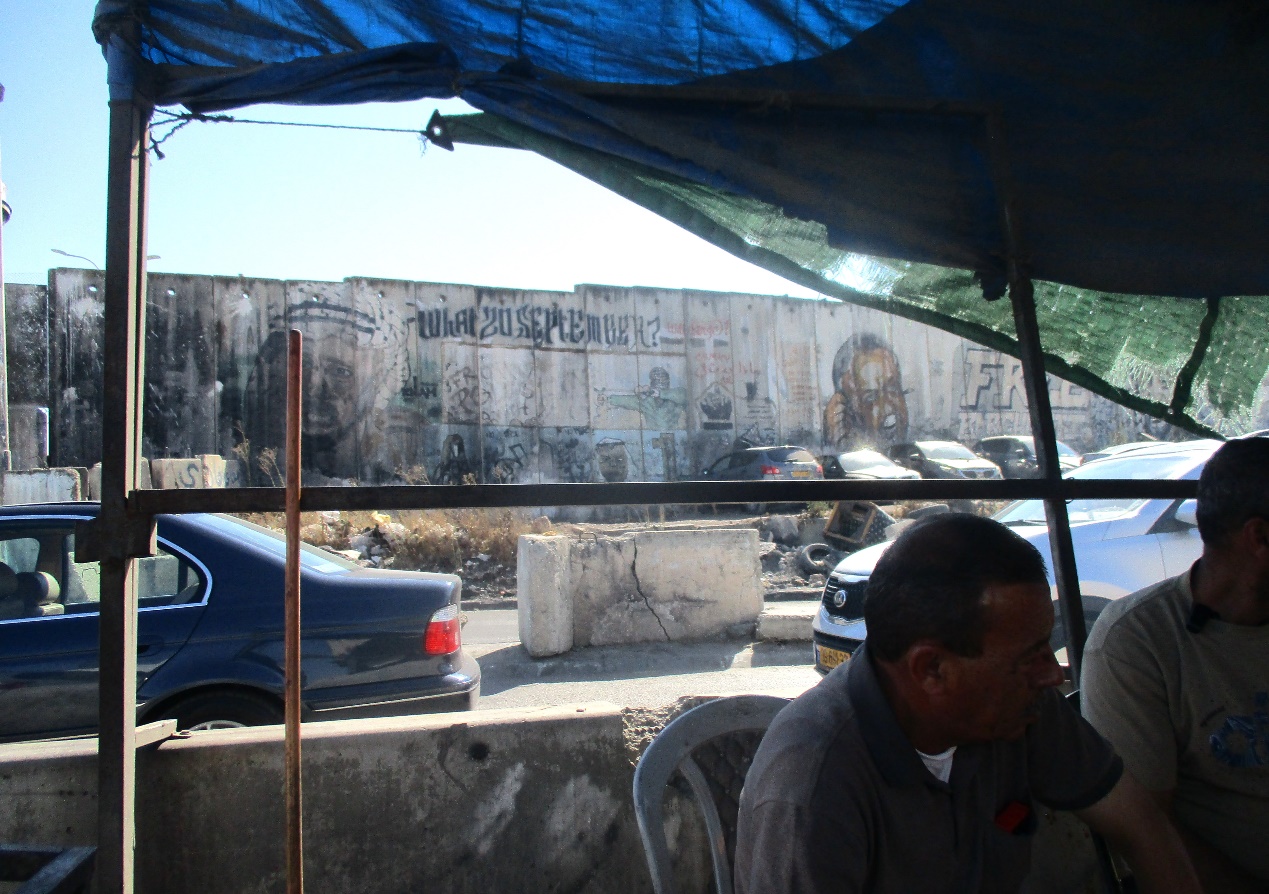 Tamar FleishmanJul-21-2026Qalandiya. Conversation in the shadow of the wall
-
