
Qalandiya
At the terminal, as usual, there’s an inside and an outside.
For years I’ve been trying to decide which is which, without success.
Maybe because it depends on one’s perspective, where you’re coming from, where you’re going.
But there are always two sides, also at Qalandiya.
One side overflowing with garbage
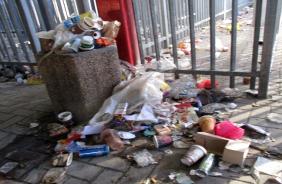
And one side clean and gleaming.

And in between, people who must cross. They arrive at a terminal with the required valid documents, and at a terminal are always those whose job it is to inspect the documents’ validity, and when they see they’re valid and authorized – the people go through. That’s how it is at a terminal.
But at this terminal, Qalandiya, it doesn’t work like that. At Qalandiya the unexpected is normal.
The unexpected landed on the old man who presented to the soldier conducting inspection his green ID card and his signed, valid crossing permit and the soldier looked at it, looked at it again and checked on the computer and lifted his head and said “Blacklisted.”
And even though the man’s home is in Gaza, and even though he’d received authorization to leave the Gaza Strip and even though he also has an authorization to go back to Gaza, he’s not allowed to return.
The media reports the city of Ramallah has been closed off since Monday morning. The military spokesman claimed it’s not punishment for Sunday’s shooting incident at the VIP checkpoint at the entrance to Ramallah, but because there’s information about planned attacks coming from the city.
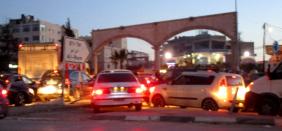
Even if you believe the military spokesman that it’s not punishment, how is it possible to explain the fact that immediately after the shooting incident, already on the evening prior to the putative urgent alert, the main traffic arteries throughout the Ramallah area had already been closed?
‘Im’ad said there’s no point driving to Jaba, the checkpoint is closed. We drove there anyway and received a tiny taste of the torture thousands of Palestinians suffered on the roads, the traffic creeping, crowded and congested, not trying to move forward but to find a place within the four lanes of traffic on a road wide enough for only one, driving across a rocky field to reach the entrance to A-Ram (we weren’t able to get to Jaba) and returning at the same rate of no progress to where we started an hour and a half earlier. A mile and a half in an hour and a half.
While it’s true we’re not allowed to throw rocks at soldiers or to curse them, we are permitted to pass through a place that by no act of verbal legerdemain can be called a terminal. The checkpoint is a checkpoint that prevents an entire nation from breathing the air of hope and freedom, while we’re allowed to return to our down comforter, and no one will come at night to break down our door.
The carpet merchants by the Qalandiya checkpoint crowded around a fire they’d built to chase away the cold and light the darkness and the child peddlers ran among the cars, trying to grab the day’s end and earn a few more shekels.
As we waited in the line of vehicles at the entrance to the checkpoint, a child’s small hand knocked at the car window. Isma’il wanted to say hello. I rolled down the window, cupped his hand in mine and felt as if I were holding a chunk of ice. I wanted to warm the cold hand but the soldier waved me forward and Isma’il back and both the hand and the boy vanished.
Qalandiya Checkpoint / Atarot Pass (Jerusalem)
See all reports for this place-
Click here to watch a video from Qalandiya checkpoint up to mid 2019 Three kilometers south of Ramallah, in the heart of Palestinian population. Integrates into "Jerusalem Envelope" as part of Wall that separates between northern suburbs that were annexed to Jerusalem in 1967: Kafr Aqab, Semiramis and Qalandiya, and the villages of Ar-Ram and Bir Nabala, also north of Jerusalem, and the city itself. Some residents of Kafr Aqab, Semiramis and Qalandiya have Jerusalem ID cards. A terminal operated by Israel Police has functioned since early 2006. As of August 2006, northbound pedestrians are not checked. Southbound Palestinians must carry Jerusalem IDs; holders of Palestinian Authority IDs cannot pass without special permits. Vehicular traffic from Ramallah to other West Bank areas runs to the north of Qalandiya. In February 2019, the new facility of the checkpoint was inaugurated aiming to make it like a "border crossing". The bars and barbed wire fences were replaced with walls of perforated metal panels. The check is now performed at multiple stations for face recognition and the transfer of an e-card. The rate of passage has improved and its density has generally decreased, but lack of manpower and malfunctions cause periods of stress. The development and paving of the roads has not yet been completed, the traffic of cars and pedestrians is dangerous, and t the entire vicinity of the checkpoint is filthy. In 2020 a huge pedestrian bridge was built over the vehicle crossing with severe mobility restrictions (steep stairs, long and winding route). The pedestrian access from public transport to the checkpoint from the north (Ramallah direction) is unclear, and there have been cases of people, especially people with disabilities, who accidentally reached the vehicle crossing and were shot by the soldiers at the checkpoint. In the summer of 2021, work began on a new, sunken entrance road from Qalandiya that will lead directly to Road 443 towards Jerusalem and Tel Aviv. At the same time, the runways of the old Atarot airport were demolished and infrastructure was prepared for a large bus terminal. (updated October 2021)
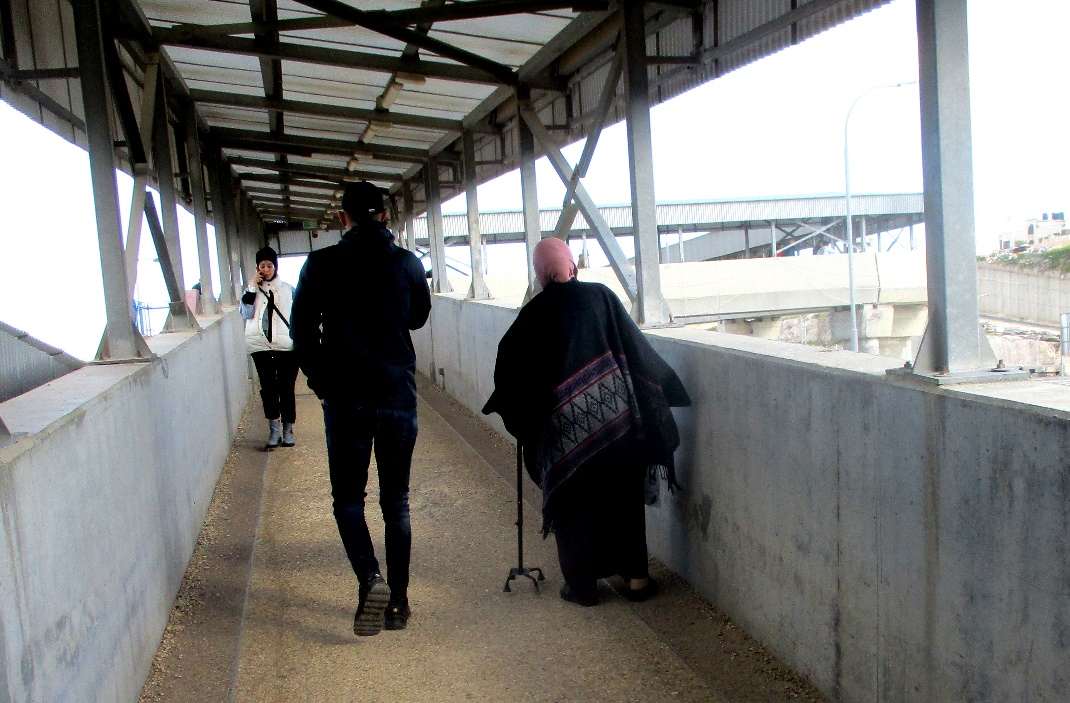 Tamar FleishmanJun-28-2026Qalandiya. The bridge leading from Jerusalem to the Qalandiya checkpoint
-