
Qalandiya
Eek, Rats!
Actually, we saw one rat. But where there’s one there are others, and this one was seeking his prey by the Humanitarian Gate! We reported this finding to the Civil Administration officer when he arrived afterward, and he replied that he would pass on the information to the cleaning crew. The question is whether that will suffice or the services of an exterminator are required.
The good news is that the Humanitarian Gate is back, complete with hinges. The Civil Administration officer arrived at 6:10, opened it at 6:20, and continued to do so each time a handful of people gathered by it.
All five checking stations were open when we arrived at 5:30. The lines were short (not extending beyond the kerb into the parking lot). Soon enough, however, we discovered that the turnstile at the end of the right-hand “cage” was not working. Since we could not communicate with the soldier in the “Aquarium,” we called the D.C.O. line and asked the soldier who answered to contact her colleague on the spot and tell him to announce from time to time that the turnstile there was broken – just as he announced from time to time that the x-ray machine in one of the checking stations was out of order and people carrying articles should not use that station — so that newcomers would not fill the cage only to find they could not move forward. Until that message was conveyed – one time, only – we stood by the entrance to the cage to inform people of the situation. Not everyone believed us; some entered the cage anyway. After the Civil Administration officer arrived, we asked him to tell the soldier in the Aquarium to repeat the announcement, but no announcement followed from this request.
We learned, however, that we did not give sufficient credit to resourcefulness of men determined to get to work on time. One of them, who entered the empty cage and found the turnstile closed, played with it, moving it back and forth, until he created a gap wide enough to squeeze his body through. And in his wake, others followed suit.
Apropos announcements, due to the volume of the speaker system, it’s nigh impossible to make out what the soldier is saying. The shed of the Qalandiya checkpoint is hardly New York’s Grand Central Station, and it would be beneficial to lower the volume a number of decibels for the sake of getting the message across.
The lines remained relatively short throughout the morning, and at 7:15 we joined one of them and exited the security check 20 minutes later.
Qalandiya Checkpoint / Atarot Pass (Jerusalem)
See all reports for this place-
Click here to watch a video from Qalandiya checkpoint up to mid 2019 Three kilometers south of Ramallah, in the heart of Palestinian population. Integrates into "Jerusalem Envelope" as part of Wall that separates between northern suburbs that were annexed to Jerusalem in 1967: Kafr Aqab, Semiramis and Qalandiya, and the villages of Ar-Ram and Bir Nabala, also north of Jerusalem, and the city itself. Some residents of Kafr Aqab, Semiramis and Qalandiya have Jerusalem ID cards. A terminal operated by Israel Police has functioned since early 2006. As of August 2006, northbound pedestrians are not checked. Southbound Palestinians must carry Jerusalem IDs; holders of Palestinian Authority IDs cannot pass without special permits. Vehicular traffic from Ramallah to other West Bank areas runs to the north of Qalandiya. In February 2019, the new facility of the checkpoint was inaugurated aiming to make it like a "border crossing". The bars and barbed wire fences were replaced with walls of perforated metal panels. The check is now performed at multiple stations for face recognition and the transfer of an e-card. The rate of passage has improved and its density has generally decreased, but lack of manpower and malfunctions cause periods of stress. The development and paving of the roads has not yet been completed, the traffic of cars and pedestrians is dangerous, and t the entire vicinity of the checkpoint is filthy. In 2020 a huge pedestrian bridge was built over the vehicle crossing with severe mobility restrictions (steep stairs, long and winding route). The pedestrian access from public transport to the checkpoint from the north (Ramallah direction) is unclear, and there have been cases of people, especially people with disabilities, who accidentally reached the vehicle crossing and were shot by the soldiers at the checkpoint. In the summer of 2021, work began on a new, sunken entrance road from Qalandiya that will lead directly to Road 443 towards Jerusalem and Tel Aviv. At the same time, the runways of the old Atarot airport were demolished and infrastructure was prepared for a large bus terminal. (updated October 2021)
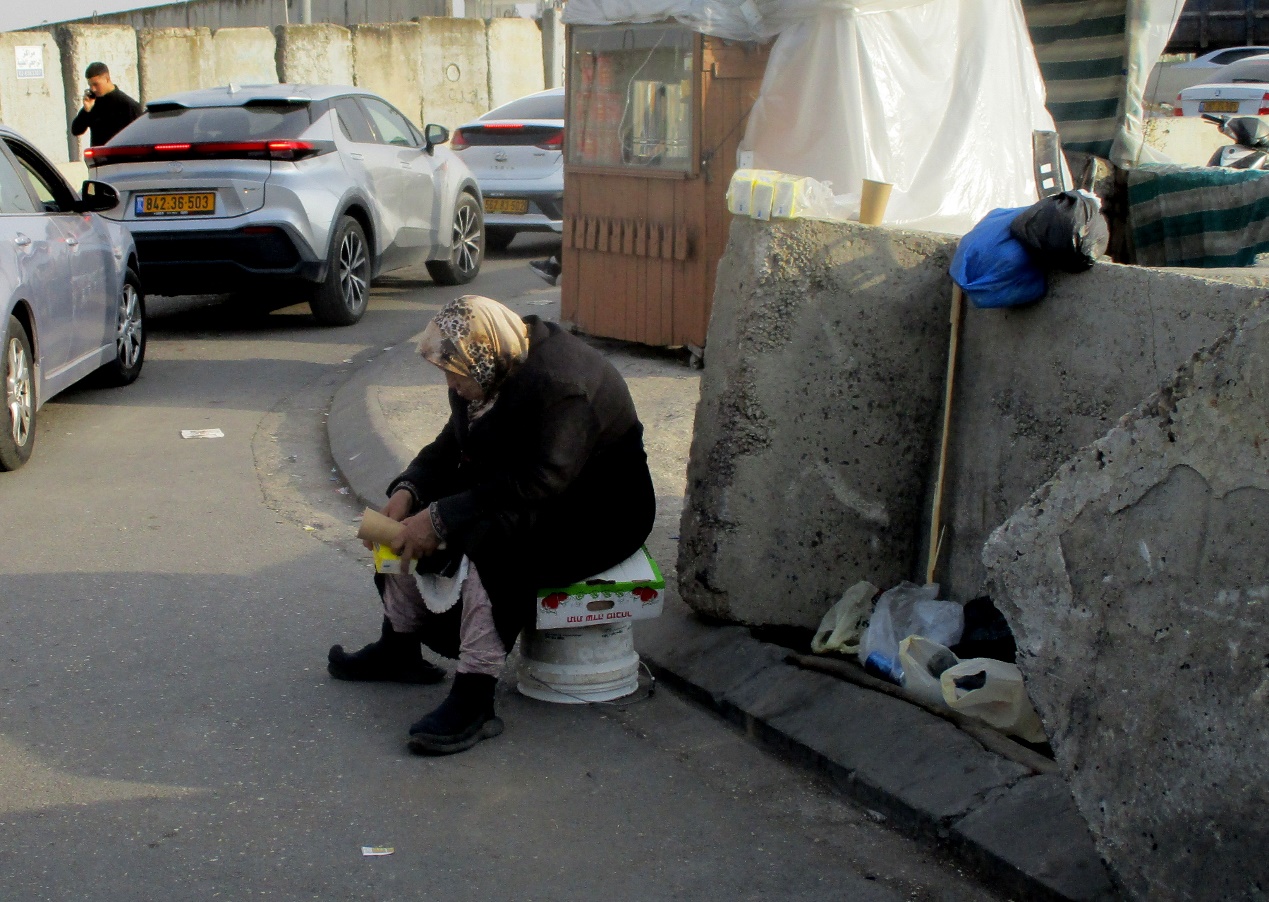 Tamar FleishmanOct-11-2026Qalandiya. Female Beggar
-
