
Qalandiya
It’s about a girl who is still a baby, called Iman – one of a group of patients returning home to Gaza after hospitalization in the West Bank – that I wish to tell this time.
Iman is 3-years old, and lives in Beit Hanoun in the northern Gaza Strip.
She’s not the youngest and sickest of those who left the checkpoint under armed guard. There were those who were younger and sicker.
Perhaps it was those wispy arms she held out to me, or the tiny hand that held mine that made this child the one who symbolizing the many, those few whose exit from the Gaza Strip has been approved by the Sovereign (Israeli authorities) for medical treatment, and the countless ones who have been denied such access.
Iman suffers serious burns in her upper body. Much of her scalp is scarred and most of her head hair has been removed, her face is scarred as is part of her neck.
Beside the treatments and ointments it is crucial not to expose the injured parts to the sun and to provide a sterile environment. Both are absent in Qalandiya Checkpoint’s reality, and who knows what will happen to her later, in the Gaza Strip…
Whenever the patients’ transport takes off and I wave to the people looking through the windows and waving back at me, comes the heavy-hearted moment and the question where am I sending them off to, why do I help them board the vehicle, why do I carry their bags and suitcases?
True, they’re in a hurry to get home, but perhaps the opposite should be done – stall them here where they’re not targeted for shooting nor sniping, here where the water is not polluted.
Perhaps just not there, not to Gaza.
The next day, the radio said that the Israeli Air Force bombed the northern part of the Gaza Strip. Think of them, the children, think about Iman of Beit Hanoun in the northern Gaza Strip.
There was also a not-so-young fellow after undergoing surgery at a Nablus hospital, who took up a conversation with me and said that among those boarding the transport vehicle are people who are poor and hungry, and those who cannot afford even the cost of the journey (70 shekels per person) and need the kindness of strangers.
“We have nothing more to lose in Gaza”, he said.
“You have life”, I tried.
“No, not even life. We don’t need empathy. We don’t need solidarity. May all Israelis go to hell.”

Qalandiya Checkpoint / Atarot Pass (Jerusalem)
See all reports for this place-
Click here to watch a video from Qalandiya checkpoint up to mid 2019 Three kilometers south of Ramallah, in the heart of Palestinian population. Integrates into "Jerusalem Envelope" as part of Wall that separates between northern suburbs that were annexed to Jerusalem in 1967: Kafr Aqab, Semiramis and Qalandiya, and the villages of Ar-Ram and Bir Nabala, also north of Jerusalem, and the city itself. Some residents of Kafr Aqab, Semiramis and Qalandiya have Jerusalem ID cards. A terminal operated by Israel Police has functioned since early 2006. As of August 2006, northbound pedestrians are not checked. Southbound Palestinians must carry Jerusalem IDs; holders of Palestinian Authority IDs cannot pass without special permits. Vehicular traffic from Ramallah to other West Bank areas runs to the north of Qalandiya. In February 2019, the new facility of the checkpoint was inaugurated aiming to make it like a "border crossing". The bars and barbed wire fences were replaced with walls of perforated metal panels. The check is now performed at multiple stations for face recognition and the transfer of an e-card. The rate of passage has improved and its density has generally decreased, but lack of manpower and malfunctions cause periods of stress. The development and paving of the roads has not yet been completed, the traffic of cars and pedestrians is dangerous, and t the entire vicinity of the checkpoint is filthy. In 2020 a huge pedestrian bridge was built over the vehicle crossing with severe mobility restrictions (steep stairs, long and winding route). The pedestrian access from public transport to the checkpoint from the north (Ramallah direction) is unclear, and there have been cases of people, especially people with disabilities, who accidentally reached the vehicle crossing and were shot by the soldiers at the checkpoint. In the summer of 2021, work began on a new, sunken entrance road from Qalandiya that will lead directly to Road 443 towards Jerusalem and Tel Aviv. At the same time, the runways of the old Atarot airport were demolished and infrastructure was prepared for a large bus terminal. (updated October 2021)
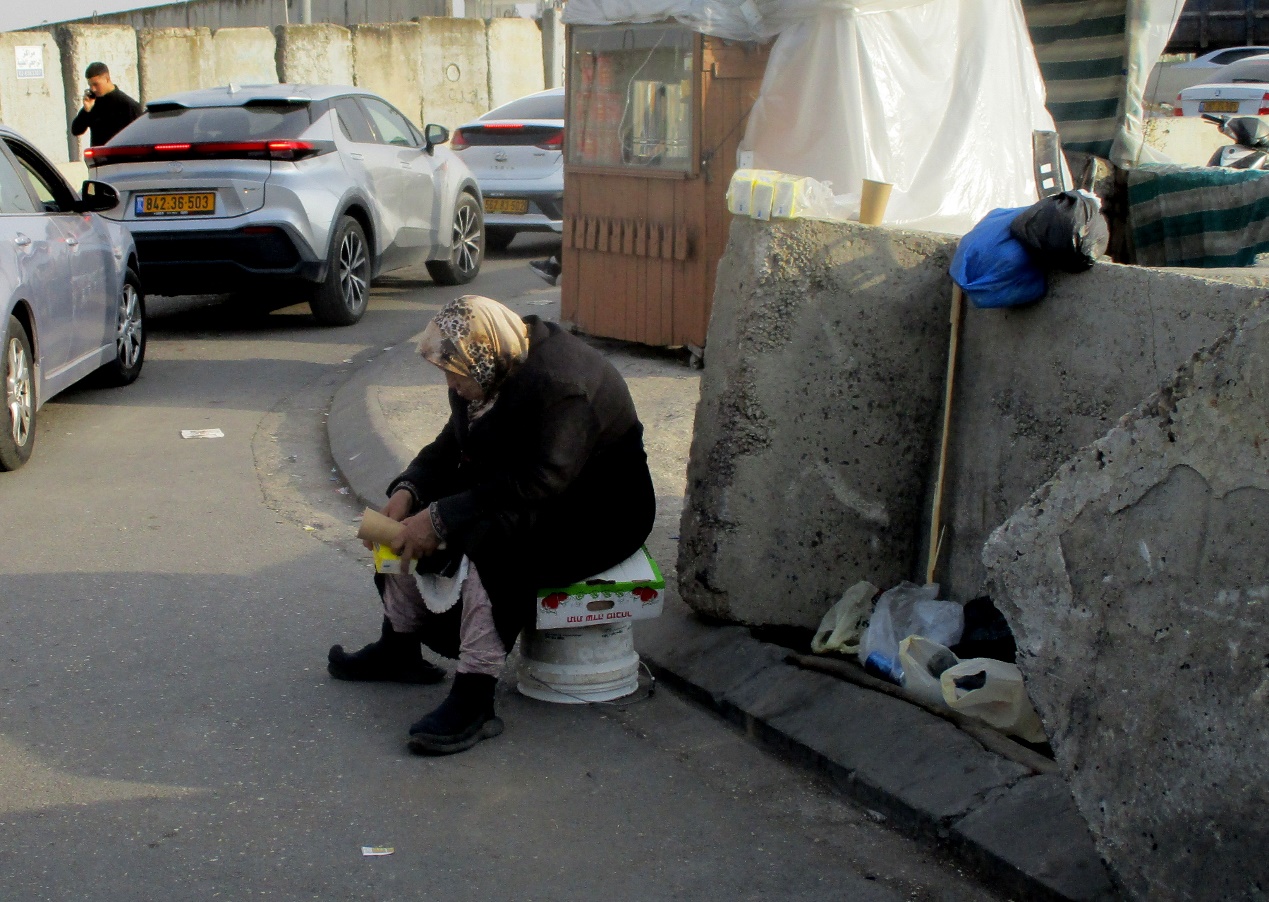 Tamar FleishmanOct-11-2026Qalandiya. Female Beggar
-
