Qalandiya
05.15. Three lines extended as far as the new traffic roundabout. All five checking stations were open. The soldier operating the turnstiles did so frequently and let a large number of people through each time he opened them. He announced that checking station no. 2 was open only for people without packages. His replacement at 6 o’clock continued working in this efficient way. No doubt this was responsible for the quiet, relaxed atmosphere. (It is amazing how different the conditions can be from day to day.)
The humanitarian gate opened late, though. At 6.15, by which time a group had gathered there, including a young mother with her toddler in a stroller, we phoned the authorities. Though the answer was “I’m opening,” the young mother crossed over to the entrance to the nearest regular line, where the men helped her fold the stroller and let her and her child join. This was a wise step, because the line in the cage advanced quickly, while the humanitarian gate was opened only ten minutes later, at 6.25, by two security guards. No D.C.O. soldier appeared, but the guards were still managing the gate when we ourselves joined a regular queue at 7 o’clock. By this time the lines were well within the shed.
It took us 25 minutes to pass.
Qalandiya Checkpoint / Atarot Pass (Jerusalem)
See all reports for this place-
Click here to watch a video from Qalandiya checkpoint up to mid 2019 Three kilometers south of Ramallah, in the heart of Palestinian population. Integrates into "Jerusalem Envelope" as part of Wall that separates between northern suburbs that were annexed to Jerusalem in 1967: Kafr Aqab, Semiramis and Qalandiya, and the villages of Ar-Ram and Bir Nabala, also north of Jerusalem, and the city itself. Some residents of Kafr Aqab, Semiramis and Qalandiya have Jerusalem ID cards. A terminal operated by Israel Police has functioned since early 2006. As of August 2006, northbound pedestrians are not checked. Southbound Palestinians must carry Jerusalem IDs; holders of Palestinian Authority IDs cannot pass without special permits. Vehicular traffic from Ramallah to other West Bank areas runs to the north of Qalandiya. In February 2019, the new facility of the checkpoint was inaugurated aiming to make it like a "border crossing". The bars and barbed wire fences were replaced with walls of perforated metal panels. The check is now performed at multiple stations for face recognition and the transfer of an e-card. The rate of passage has improved and its density has generally decreased, but lack of manpower and malfunctions cause periods of stress. The development and paving of the roads has not yet been completed, the traffic of cars and pedestrians is dangerous, and t the entire vicinity of the checkpoint is filthy. In 2020 a huge pedestrian bridge was built over the vehicle crossing with severe mobility restrictions (steep stairs, long and winding route). The pedestrian access from public transport to the checkpoint from the north (Ramallah direction) is unclear, and there have been cases of people, especially people with disabilities, who accidentally reached the vehicle crossing and were shot by the soldiers at the checkpoint. In the summer of 2021, work began on a new, sunken entrance road from Qalandiya that will lead directly to Road 443 towards Jerusalem and Tel Aviv. At the same time, the runways of the old Atarot airport were demolished and infrastructure was prepared for a large bus terminal. (updated October 2021)
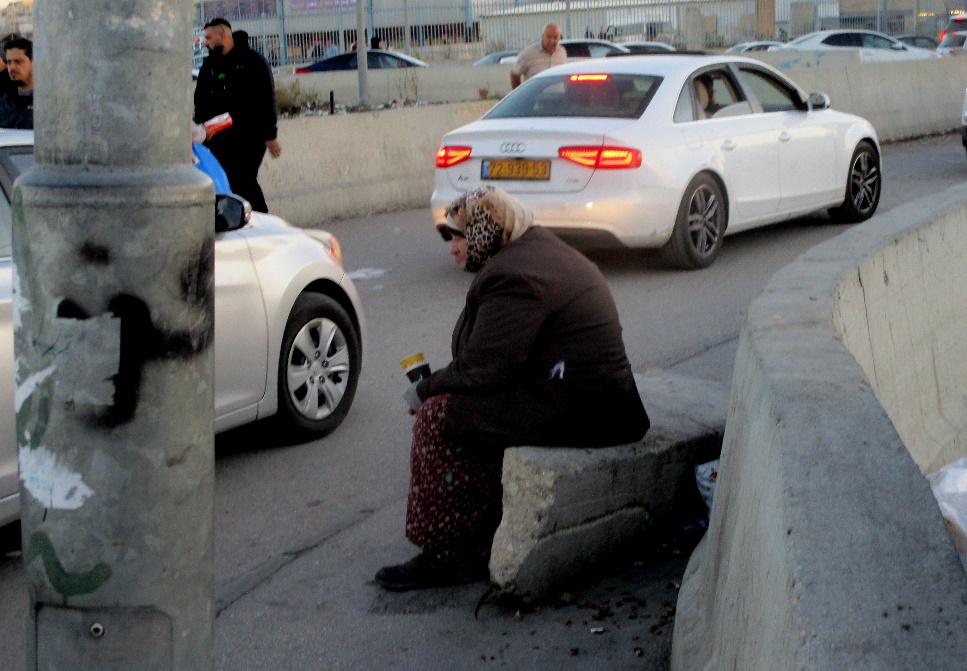 Tamar FleishmanNov-10-2026Qalandiya: The beggar woman
-