Qalandiya


On our way to the checkpoint, it is still dark and despite all the work they have done and are doing on the access roads there is still a section where the street lighting does not work. As we approached the parking area we saw that white metal fences had been placed on both sides of the road leading to the square in front of the checkpoint. A section of the sidewalk is also blocked. On the way back, when it was already light, we took pictures. It turns out that workers also work in the middle part between the road to the checkpoint and the road from it to the west, and also in the area south of the road and the parking lot.
We parked and advanced on foot towards the square (which was destroyed as part of the work being done in the area) and saw that because of barriers if a vehicle stopped near the exit to the west (and many stop there and wait to pick up workers) it could not be bypassed. On the square itself, which we saw the last time was demolished, lanes were paved, but they are blocked for travel. We saw cars standing there, probably so as not to stand in the square and block traffic. When we returned most of them were no longer there, as photographed from the bridge, now in the light.
We crossed the bridge to the Palestinian side. The situation at the checkpoint seems calm. A lot of people come, but there were no unusual queues. We were happy to see that they did not block the entrance to the compound from the direction of Qalandiya where one can now pass under the fence where, as we saw the last time, it was cut. A lot of people came from that direction and saved themselves the roundabout way to the entrance from the east.
We went to the east side to visit our friend Abu Ramzi, the beigel seller. The previous time we were delayed on the Israeli side due to the demonstration of the residents of Kfar Akev, and by the time we arrived Abu Ramzi had already left. This time we found him, but his condition is not so good. He suffers from pain in his leg and has difficulty standing. So he brought a chair with him and most of the time he sits. He says that many times one of the grandchildren comes with him to help him (and miss school) He brings less merchandise than before and when it’s all over he leaves, but he has to work to make a living.
Abu Ramzi would usually stand in front of the kiosk, on the corner in front of the entrance to the checkpoint. This time he was located a little further down, closer to the main road, and the falafel and food stands were a little further up. I wonder if there will be another stall later.
We returned to the checkpoint building. People come all the time but usually, there are no queues in the shed outside the entrances to the slalom. Some of the time, not all three entrances were open, but later they were all opened. Around 7 we entered the queue at the eastern entrance of the three. The waiting area inside was filled to capacity (not exactly recommended in the Corona era …) and it was not so clear where the queue for the two entrances to check the bags starts. The partition separating this part of the hall from the other parts, which are reached from the other entrances, was closed. We could not see what was happening there, but we assumed that the situation was no different. Later a security guard came and opened the partitions and then there were people who moved to the other halls, but overall it seems that the situation there was similar.
After a few moments of standing still, the queue began to move forward, and very quickly it was our turn to pass. After the bag checking and the magnetometer, we move on to the document checking area. We, who do not have a magnetic card that allows us to pass through automatic gates like the Palestinians, went to a position manned by a soldier.
On the way back we photographed the public transport complex below the pedestrian bridge. When we arrived and it was still dark, there were buses right next to the bridge and we have a feeling that the works in this area crowded the public transport area, but we may be wrong.
On the way back to our car we again saw that they had opened the gate in the wall, apparently for the trucks entering the work sites. At first, they did not let ordinary cars pass but later allowed drivers to get in from there and save themselves time standing in traffic jams.
It seems that in the near future every time we visit the environment will look different due to the works.
Qalandiya Checkpoint / Atarot Pass (Jerusalem)
See all reports for this place-
Click here to watch a video from Qalandiya checkpoint up to mid 2019 Three kilometers south of Ramallah, in the heart of Palestinian population. Integrates into "Jerusalem Envelope" as part of Wall that separates between northern suburbs that were annexed to Jerusalem in 1967: Kafr Aqab, Semiramis and Qalandiya, and the villages of Ar-Ram and Bir Nabala, also north of Jerusalem, and the city itself. Some residents of Kafr Aqab, Semiramis and Qalandiya have Jerusalem ID cards. A terminal operated by Israel Police has functioned since early 2006. As of August 2006, northbound pedestrians are not checked. Southbound Palestinians must carry Jerusalem IDs; holders of Palestinian Authority IDs cannot pass without special permits. Vehicular traffic from Ramallah to other West Bank areas runs to the north of Qalandiya. In February 2019, the new facility of the checkpoint was inaugurated aiming to make it like a "border crossing". The bars and barbed wire fences were replaced with walls of perforated metal panels. The check is now performed at multiple stations for face recognition and the transfer of an e-card. The rate of passage has improved and its density has generally decreased, but lack of manpower and malfunctions cause periods of stress. The development and paving of the roads has not yet been completed, the traffic of cars and pedestrians is dangerous, and t the entire vicinity of the checkpoint is filthy. In 2020 a huge pedestrian bridge was built over the vehicle crossing with severe mobility restrictions (steep stairs, long and winding route). The pedestrian access from public transport to the checkpoint from the north (Ramallah direction) is unclear, and there have been cases of people, especially people with disabilities, who accidentally reached the vehicle crossing and were shot by the soldiers at the checkpoint. In the summer of 2021, work began on a new, sunken entrance road from Qalandiya that will lead directly to Road 443 towards Jerusalem and Tel Aviv. At the same time, the runways of the old Atarot airport were demolished and infrastructure was prepared for a large bus terminal. (updated October 2021)
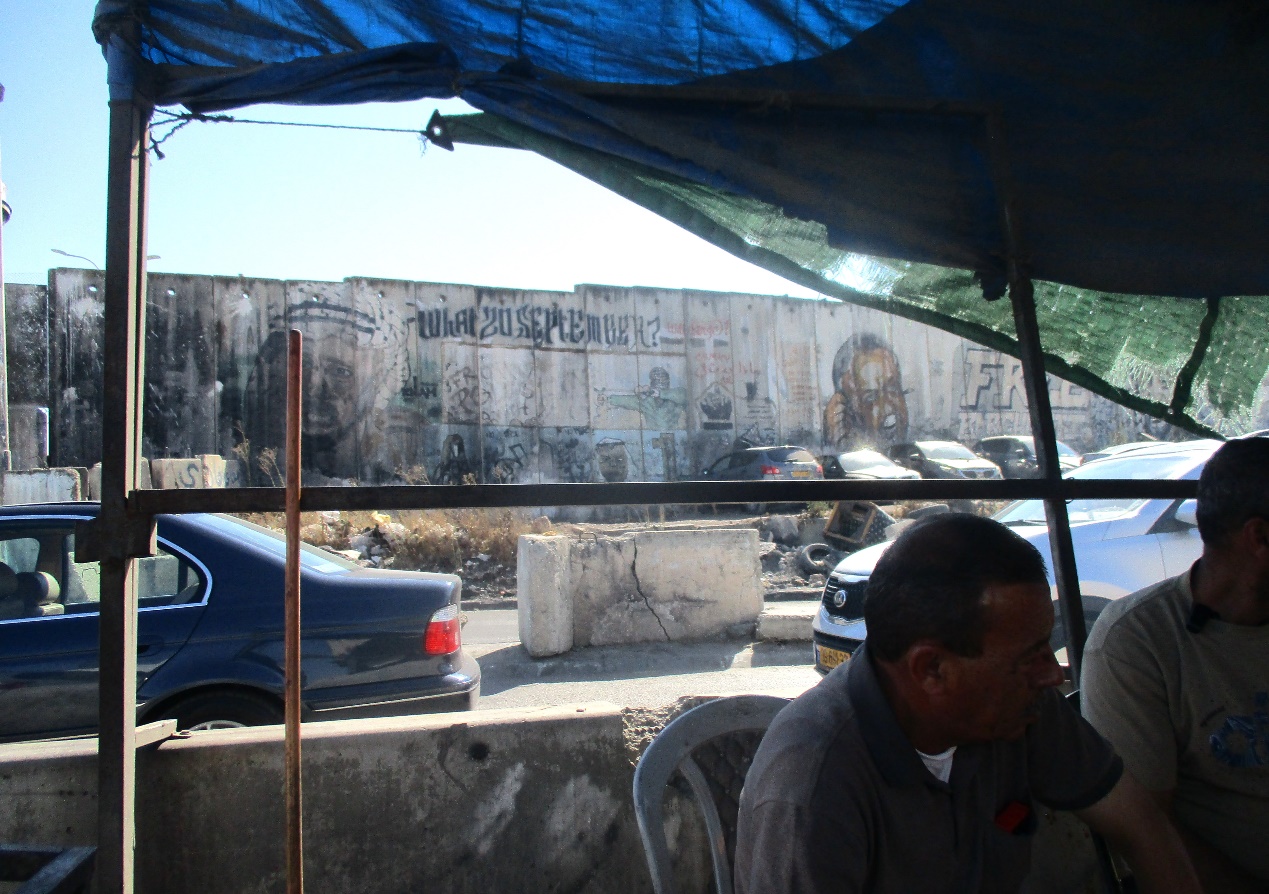 Tamar FleishmanJul-21-2026Qalandiya. Conversation in the shadow of the wall
-