
Qalandiya

Where all the world’s troubles convene
After spending considerable time on the Palestinian side of the checkpoint, after filling my basket with the season’s fruit whose fragrance and taste are of yesteryear, after meeting and photographing old and new acquaintances near the refugee camp, while returning through the labyrinth known as the checkpoint, a man turned to me and asked me to join him at the DCO (Civil Administration) offices.
He said that perhaps in my presence they would notice his distress and let him have – today – the permit to pass his daughter over to St. John Hospital in East Jerusalem
and perhaps, ‘God willing’ said he, she would immediately enter surgery as the doctors had recommended.
I tried in vain to lower his expectations as to my influence on the powers that be.
The man hurried me and others standing in line in front of the checking posts to make way for “my daughter needs to undergo urgent surgery today”, as he said.
His wife and daughter were waiting in a taxi outside the checkpoint, its driver ready to ignite the car and bring the girl and her mother to the hospital as soon as the father was back with the required permits.
The procedure is that anyone whose name is called must enter where the announcement indicates, close the door behind him, and find himself standing opposite a secured window behind which sits a soldier handling his case.
This is what order 947 section 2 of the DCO says:
The Civil Administration will manage the civil matters in the area according to this ordinance, at the ease and welfare of the local population and supply the public services needed, considering the need to conduct proper administration and public order. **
From my many years of experience, I have learned that these words are but laundered cliches, and that neither the ease nor welfare of the population concern the Civil Administration staff.

The DCO office was filled with people waiting silently and with infinite patience for their turn and verdict. All the world’s troubles seem to convene in those few, crowded meters.
The man I was with paced helplessly, not knowing where to turn to. I managed to attract the attention of a girl-soldier and asked that anyone of the staff in the inside rooms take care of this man. Consequently, he was directed to an unmanned room. I entered with him.
A soldier arrived at the post opposite us.
“I need an urgent permit, my daughter needs to get to the hospital for surgery,” said the man.
“Too late,” the soldier said. “We closed down half an hour ago. Why didn’t you come earlier?”
“I come from far away, near Nablus,” said the man.
“Too late.”
“But… Please… Do us a favor,” the request became a plea.
“Why are you here?” The soldier suddenly turned to me.
“She is with me,” the man said.
The soldier demanded that I leave. I left and hoped for the best.
After many minutes, the man came out and said that not only did he not get what he asked for, but was also reprimanded for bringing me with him.
The man hurried to his family and I was left with my broken heart and thoughts about the injustice perpetrated by those trusted with the ‘ease and welfare’ of Palestinians.
** https://he.wikipedia.org/wiki/%D7%94%D7%9E%D7%A0%D7%94%D7%9C_%D7%94%D7%90%D7%96%D7%A8%D7%97%D7%99#cite_note-%D7%94%D7%A4%D7%A8%D7%A7%D7%9C%D7%99%D7%98%D7%95%D7%AA-1
Qalandiya Checkpoint / Atarot Pass (Jerusalem)
See all reports for this place-
Click here to watch a video from Qalandiya checkpoint up to mid 2019 Three kilometers south of Ramallah, in the heart of Palestinian population. Integrates into "Jerusalem Envelope" as part of Wall that separates between northern suburbs that were annexed to Jerusalem in 1967: Kafr Aqab, Semiramis and Qalandiya, and the villages of Ar-Ram and Bir Nabala, also north of Jerusalem, and the city itself. Some residents of Kafr Aqab, Semiramis and Qalandiya have Jerusalem ID cards. A terminal operated by Israel Police has functioned since early 2006. As of August 2006, northbound pedestrians are not checked. Southbound Palestinians must carry Jerusalem IDs; holders of Palestinian Authority IDs cannot pass without special permits. Vehicular traffic from Ramallah to other West Bank areas runs to the north of Qalandiya. In February 2019, the new facility of the checkpoint was inaugurated aiming to make it like a "border crossing". The bars and barbed wire fences were replaced with walls of perforated metal panels. The check is now performed at multiple stations for face recognition and the transfer of an e-card. The rate of passage has improved and its density has generally decreased, but lack of manpower and malfunctions cause periods of stress. The development and paving of the roads has not yet been completed, the traffic of cars and pedestrians is dangerous, and t the entire vicinity of the checkpoint is filthy. In 2020 a huge pedestrian bridge was built over the vehicle crossing with severe mobility restrictions (steep stairs, long and winding route). The pedestrian access from public transport to the checkpoint from the north (Ramallah direction) is unclear, and there have been cases of people, especially people with disabilities, who accidentally reached the vehicle crossing and were shot by the soldiers at the checkpoint. In the summer of 2021, work began on a new, sunken entrance road from Qalandiya that will lead directly to Road 443 towards Jerusalem and Tel Aviv. At the same time, the runways of the old Atarot airport were demolished and infrastructure was prepared for a large bus terminal. (updated October 2021)
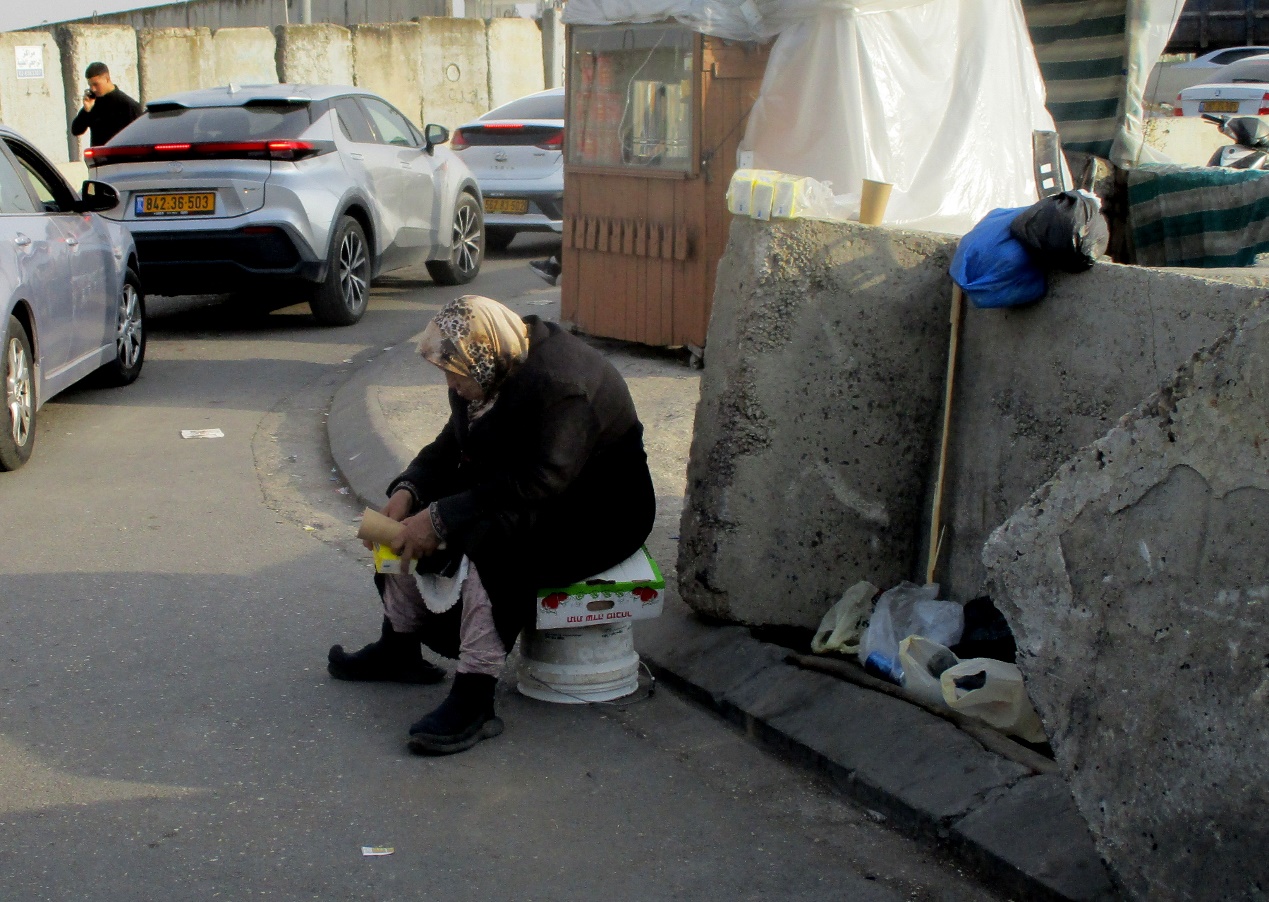 Tamar FleishmanOct-11-2026Qalandiya. Female Beggar
-
