
Qalandiya
The closure began at 18:00; residents of the West Bank are forbidden entry to Israel, except for residents of Jerusalem and holders of special permits.
Workers in the Atarot industrial zone are among those allowed entry. But make no mistake: it’s not because of concern for their livelihood and welfare that they receive permits. The ustated reason for this “benefit” is the desire not to harm the profits of their Israeli employers, the factory owners.
People crossed through the checkpoint slowly, starting at six. They all know the rules: how to extend the hand holding the document, how to remove shoes and belt, and place metal objects and bags in the plastic trays. The soldiers glance sleepily at the document, compare the photo to the face of the person standing before them and weakly wave them toward the exit of the inspection area. One laborer on his way to work violates this dreary routine. He was a sole exception to the file of those with blue/privileged ID cards – the green ID he presented, along with a crossing permit, delayed the process and confused the soldier who spent a long time inspecting what was printed on the document and consulting his superiors as to its legitimacy.
While he waited the man told us he’s employed at a poultry slaughterhouse in Atarot, that his work day is, essentially, a night – from evening until dawn, 12 hours a day, five days a week, earning NIS 4000 a month. No, he doesn’t receive benefits. But the alternative – unemployment – is worse.
Two of his children are students; he’s mortgaged his present on behalf of their future. And when he finally exited the inspection area he lifted the hand holding the permit, saying “This is worth everything.”
Against the backdrop of the closure imposed for the day commemorating those who died in Israel’s wars and Independence Day which follows; the sight of men, women and children waiting patiently at the checkpoint; the neglect and poverty which are a daily reality throughout Palestine; the occupation’s laws that discriminate between people on the basis of their religion and their ethnicity – I hear the Prime Minister’s words echoing in my mind, his greeting to the participants in the Bible Quiz, and particularly to the winner who, like others, came from abroad: “The Land of Israel belongs to you – it belongs to Jews everywhere.” Thus, in a single breath, as by his policies, he appropriates this country, from the Jordan to the sea, solely for Jews, dispossessing of their land and their human rights all who are not members of the covenant.
Qalandiya Checkpoint / Atarot Pass (Jerusalem)
See all reports for this place-
Click here to watch a video from Qalandiya checkpoint up to mid 2019 Three kilometers south of Ramallah, in the heart of Palestinian population. Integrates into "Jerusalem Envelope" as part of Wall that separates between northern suburbs that were annexed to Jerusalem in 1967: Kafr Aqab, Semiramis and Qalandiya, and the villages of Ar-Ram and Bir Nabala, also north of Jerusalem, and the city itself. Some residents of Kafr Aqab, Semiramis and Qalandiya have Jerusalem ID cards. A terminal operated by Israel Police has functioned since early 2006. As of August 2006, northbound pedestrians are not checked. Southbound Palestinians must carry Jerusalem IDs; holders of Palestinian Authority IDs cannot pass without special permits. Vehicular traffic from Ramallah to other West Bank areas runs to the north of Qalandiya. In February 2019, the new facility of the checkpoint was inaugurated aiming to make it like a "border crossing". The bars and barbed wire fences were replaced with walls of perforated metal panels. The check is now performed at multiple stations for face recognition and the transfer of an e-card. The rate of passage has improved and its density has generally decreased, but lack of manpower and malfunctions cause periods of stress. The development and paving of the roads has not yet been completed, the traffic of cars and pedestrians is dangerous, and t the entire vicinity of the checkpoint is filthy. In 2020 a huge pedestrian bridge was built over the vehicle crossing with severe mobility restrictions (steep stairs, long and winding route). The pedestrian access from public transport to the checkpoint from the north (Ramallah direction) is unclear, and there have been cases of people, especially people with disabilities, who accidentally reached the vehicle crossing and were shot by the soldiers at the checkpoint. In the summer of 2021, work began on a new, sunken entrance road from Qalandiya that will lead directly to Road 443 towards Jerusalem and Tel Aviv. At the same time, the runways of the old Atarot airport were demolished and infrastructure was prepared for a large bus terminal. (updated October 2021)
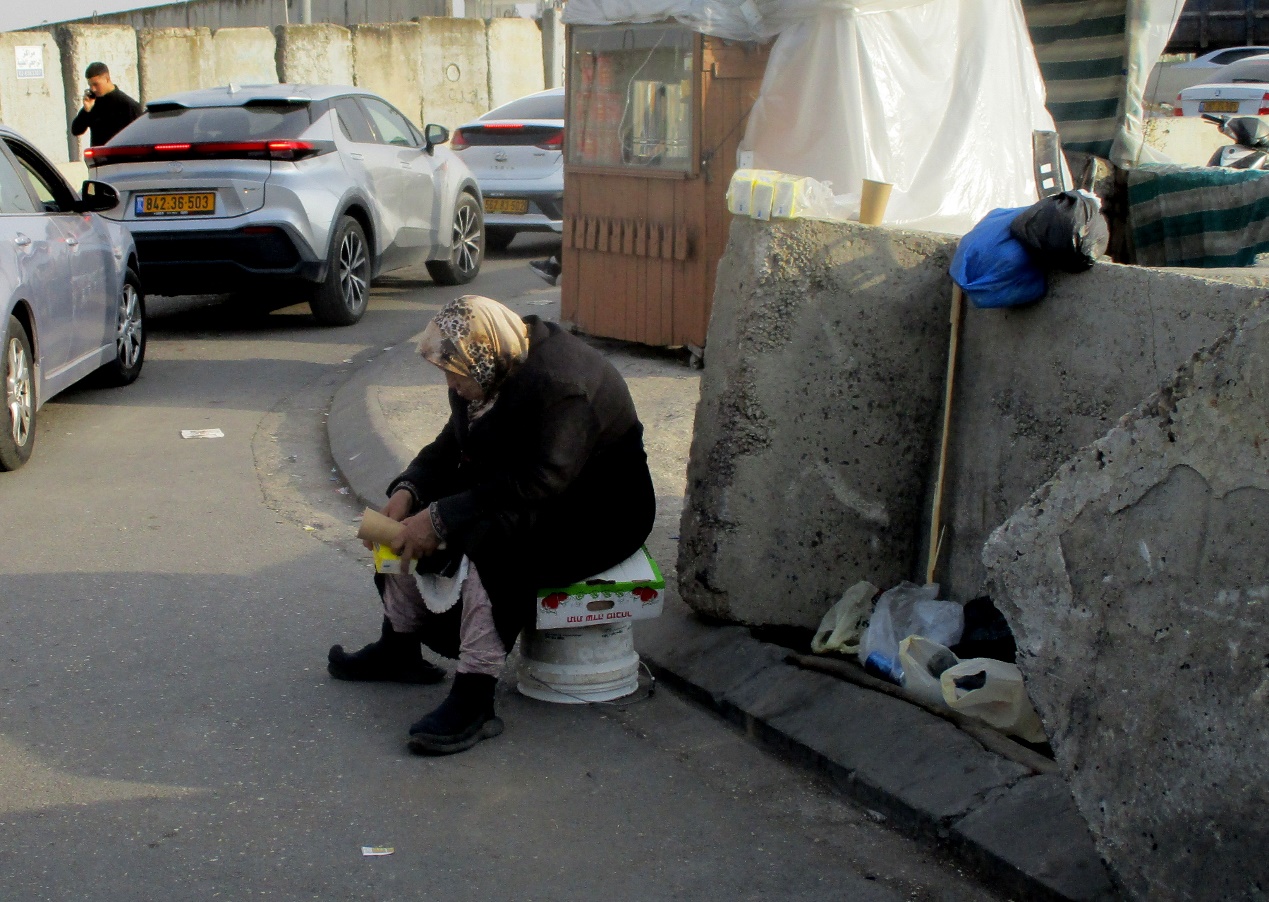 Tamar FleishmanOct-11-2026Qalandiya. Female Beggar
-
