Qalandiya
I don’t know whether the Occupation has a rule book, but I do know that arbitrariness is common to all the Occupation rules.
Knowledge of all laws and rules and regulations and edicts that the army – the sovereign – imposes upon Palestinians is a difficult-to-impossible mission both because they are so numerous and keep multiplying, and especially because one can hardly recognize their logic.
Arbitrary is also the law stipulating that a male resident of the Occupied Territories over fifty-five years of age does not need a permit to enter Jerusalem.
Why fifty-five? Why not twenty-give? Or eighty-five?
Why is anyone not residing in the Occupied Territories allowed to enter Israel without a permit, just as anyone living in Israel is allowed into the West Bank without a permit?
Palestinians living under Israeli Occupation may not have read this rule book that may or may not exist, but any one of them, anyone who wishes to go on living, knows all the rules for the sake of his own survival.
The fifty-five law was also familiar to the man I met, and because he is already fifty-six, and is looking for a source of livelihood, he habitually enters Jerusalem to collect empty bottles which he sells at 30 Agorot (equal to “cents” of the Israeli Shekel) a piece.
The day before we met, the man was walking around Jerusalem as he is wont, this time in the Musrara neighborhood, rummaging in dumpsters, collecting bottles.
Because he is fifty-six years old, he was not concerned to see a police car approach, and even as this police car stopped next to him and policemen got out he did not suspect a thing nor think that he was in any danger.
But the policemen had other things in mind. After all, policemen always know better and they are the law even when the law is not on their side.
-“Your ID”, they said.
When a policeman says “Your ID” it is not a request. It is an order masking a threat.
The man handed them his ID. “I am fifty-six, I am allowed…”
-“Take off your jacket, empty your pockets”, they instructed him. He took it off, emptied his pockets.
-“Your phone too”, they continued. He handed over the phone.
-“Put everything on the ground”. He did.
Moments later the man found himself shackled inside the police car and driven to the Russian Compound (Jerusalem’s police headquarters, holding cells and courts).
The man spent the entire night sitting on a chair, trembling with cold and fear.
He sat and waited and didn’t know what he was waiting for. Even when the time passed when he was supposed to take the medication prescribed for his illness, he kept waiting. His pills were left with the rest of his pockets’ contents on the ground in Musrara.
The night was over and the man continued to wait.
At 9 (a.m.) they came and took him. “For interrogation”, they said.
In the interrogation room sat the investigator with some papers. He didn’t ask the man anything, nor interrogated him. He read whatever was written in those papers and when done, he told the policemen: “Release him”.
Once more the man found himself driven in the police car, unshackled this time.
They delivered him to the A-Za’im Checkpoint, and let him out there.
When the policemen left the man returned to Jerusalem, to Musrara, hoping he might find some of the belongings he had left there on the ground the previous day, but found nothing.
When I met him at Qalandiya Checkpoint he was still shaking – perhaps from the trauma, or because of his illness.
His freedom was returned to him, but not his jacket nor the phone with photos of his children or the medication he kept in a bag in his pant-pockets, pills that had cost him 130 Shekels.
There is no moral to this story of one victimized man, but there is a visible point of view that joins many other points of view, creating a thick black line of reality of the lives of Palestinians living under the rule of constant terror.
Qalandiya Checkpoint / Atarot Pass (Jerusalem)
See all reports for this place-
Click here to watch a video from Qalandiya checkpoint up to mid 2019 Three kilometers south of Ramallah, in the heart of Palestinian population. Integrates into "Jerusalem Envelope" as part of Wall that separates between northern suburbs that were annexed to Jerusalem in 1967: Kafr Aqab, Semiramis and Qalandiya, and the villages of Ar-Ram and Bir Nabala, also north of Jerusalem, and the city itself. Some residents of Kafr Aqab, Semiramis and Qalandiya have Jerusalem ID cards. A terminal operated by Israel Police has functioned since early 2006. As of August 2006, northbound pedestrians are not checked. Southbound Palestinians must carry Jerusalem IDs; holders of Palestinian Authority IDs cannot pass without special permits. Vehicular traffic from Ramallah to other West Bank areas runs to the north of Qalandiya. In February 2019, the new facility of the checkpoint was inaugurated aiming to make it like a "border crossing". The bars and barbed wire fences were replaced with walls of perforated metal panels. The check is now performed at multiple stations for face recognition and the transfer of an e-card. The rate of passage has improved and its density has generally decreased, but lack of manpower and malfunctions cause periods of stress. The development and paving of the roads has not yet been completed, the traffic of cars and pedestrians is dangerous, and t the entire vicinity of the checkpoint is filthy. In 2020 a huge pedestrian bridge was built over the vehicle crossing with severe mobility restrictions (steep stairs, long and winding route). The pedestrian access from public transport to the checkpoint from the north (Ramallah direction) is unclear, and there have been cases of people, especially people with disabilities, who accidentally reached the vehicle crossing and were shot by the soldiers at the checkpoint. In the summer of 2021, work began on a new, sunken entrance road from Qalandiya that will lead directly to Road 443 towards Jerusalem and Tel Aviv. At the same time, the runways of the old Atarot airport were demolished and infrastructure was prepared for a large bus terminal. (updated October 2021)
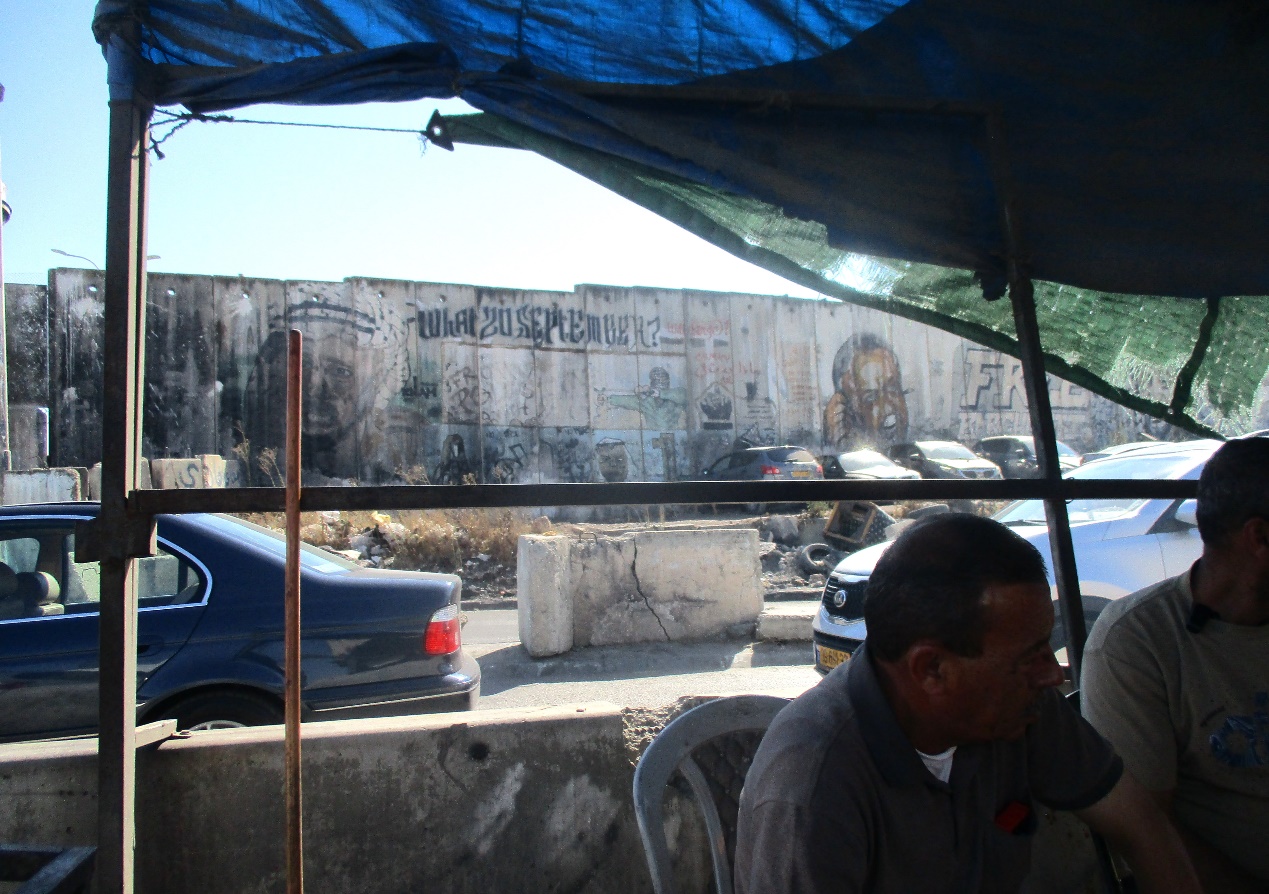 Tamar FleishmanJul-21-2026Qalandiya. Conversation in the shadow of the wall
-