
Qalandiya
Crowded morning despite attempts to run the checkpoint properly
All five checking stations were open when we arrived at 5:30 a.m. but the lines already extended to the second row of cars in the parking lot despite the fact that the lines leading into the checking stations were quite short. The pace of progress into the checking stations was also slow. At 5:50 a policeman arrived and began directing the opening of the turnstiles at the end of the three “cages,” in an attempt to hasten the pace. And he continued to direct the soldier working the turnstiles throughout the morning, though to a large degree unfortunately the damage had already been done. At 6:00, for example, the lines had only grown longer. And at 6:45 we began to follow a man from the end of one of the lines until he entered the checking station. It took him 37 minutes to do so. Imagine him experiencing this every morning.
There was, however, a welcome change at the Humanitarian Gate. The soldier in charge arrived at 6:00 and began immediately checking the permits of those waiting at the gate to determine who was entitled to pass through it. Once the initial group had passed through as a group, the soldier opened the gate to each person who arrived at it when he or she arrived at it. This is a very positive change because the drip, so to speak, of people via the gate eased the pressure on the lines waiting to enter the checking areas. We could not tell whether it is a change in “policy” regarding the operation of the Humanitarian Gate, or a decision by the soldier on duty this morning, or perhaps an experiment to examine the effect of this change on the pace forward of all the lines. We favor continuing this manner of operating the gate for the welfare of all concerned.
One of the security guards, whom we had not met before, approached us, of his own volition, to tell us how important it is, in his eyes, to treat the Palestinians at checkpoints with politeness and respect. From this gesture, together with the active stance of the policeman and the change in the operation of the Humanitarian Gate, one could gain the impression of a concerted effort to project goodwill toward those waiting on line – perhaps as a result of directions from above.
On the other hand, it’s not clear that this message (if there was one) reached the soldiers operating the checking booths, as all morning there was a feeling that the pace there was slow. At 7:25 we joined a line at a point inside one of the cages, but it nonetheless took us 25 minutes to exit the checkpoint. When the first of us reached the checking station window at which we show our identity cards, she was met by a soldier engrossed in the screen of her cell phone. The wait for her attention was probably no more than 10-15 seconds. But for a person who has already been standing on line let’s say for an average of half an hour, that is naturally annoying in the extreme — and to no small degree erases the positive impression created by the other soldiers and police operating the checkpoint that morning.
Qalandiya Checkpoint / Atarot Pass (Jerusalem)
See all reports for this place-
Click here to watch a video from Qalandiya checkpoint up to mid 2019 Three kilometers south of Ramallah, in the heart of Palestinian population. Integrates into "Jerusalem Envelope" as part of Wall that separates between northern suburbs that were annexed to Jerusalem in 1967: Kafr Aqab, Semiramis and Qalandiya, and the villages of Ar-Ram and Bir Nabala, also north of Jerusalem, and the city itself. Some residents of Kafr Aqab, Semiramis and Qalandiya have Jerusalem ID cards. A terminal operated by Israel Police has functioned since early 2006. As of August 2006, northbound pedestrians are not checked. Southbound Palestinians must carry Jerusalem IDs; holders of Palestinian Authority IDs cannot pass without special permits. Vehicular traffic from Ramallah to other West Bank areas runs to the north of Qalandiya. In February 2019, the new facility of the checkpoint was inaugurated aiming to make it like a "border crossing". The bars and barbed wire fences were replaced with walls of perforated metal panels. The check is now performed at multiple stations for face recognition and the transfer of an e-card. The rate of passage has improved and its density has generally decreased, but lack of manpower and malfunctions cause periods of stress. The development and paving of the roads has not yet been completed, the traffic of cars and pedestrians is dangerous, and t the entire vicinity of the checkpoint is filthy. In 2020 a huge pedestrian bridge was built over the vehicle crossing with severe mobility restrictions (steep stairs, long and winding route). The pedestrian access from public transport to the checkpoint from the north (Ramallah direction) is unclear, and there have been cases of people, especially people with disabilities, who accidentally reached the vehicle crossing and were shot by the soldiers at the checkpoint. In the summer of 2021, work began on a new, sunken entrance road from Qalandiya that will lead directly to Road 443 towards Jerusalem and Tel Aviv. At the same time, the runways of the old Atarot airport were demolished and infrastructure was prepared for a large bus terminal. (updated October 2021)
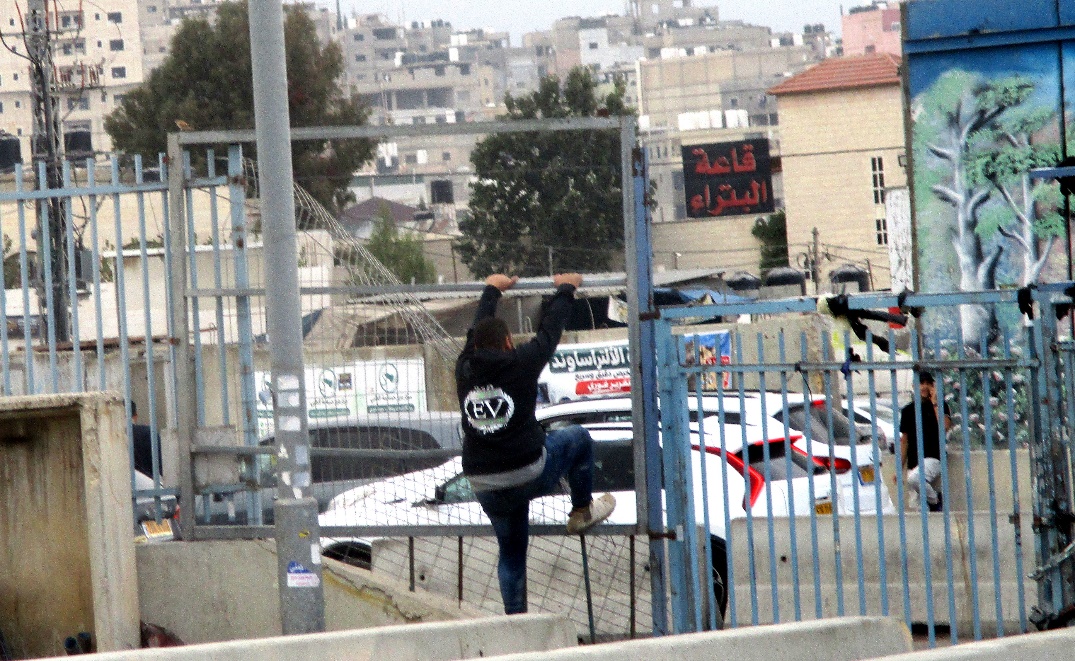 Tamar FleishmanOct-27-2026Qalandiya. Closure – Climbing over the fence
-
