
Qalandiya - a morning of smiles after the new checkpoint was opened
A Morning of Smiles and Thumbs Up
First of all the good news: the new pedestrian checkpoint at Qalandiya was opened on 20.2.19 and the people who pass through it are pleased.
Throughout our shift, people walked past us with smiles on their faces and thumbs up in our direction. Even before we reached the new checkpoint, as we passed by the full and swift flow of people exiting it, they expressed to us their satisfaction with the new arrangements, along with their hope that it would last. Then we walked through the tunnel-like passage to the northern side of the checkpoint and turned right along the road to the new checkpoint immediately adjoining the old one.
Our first top was a visit with the bagel seller. Unfortunately, his situation has worsened — together with that of the man selling falafel and other merchandise — because they are now standing in an wide-open area (across the road from the new building) and are ravaged by the cold and strong wind that is typical of this high spot (not to mention the winter rains). Albeit, this sweet man is philosophical about his setback, but it breaks one’s heart that of all the people who have gained by the new situation, he actually suffers from it more than before.
Then we walked up the checkpoint’s broad steps to the new “shack” – that is, a plaza with a roof over it but is otherwise open to the elements. We stood there from 5:25 to 6:30, essentially with little to do beyond returning the good wishes of the many people who shared their upbeat feelings with us and made congratulatory gestures in our direction. One man approached us for information on contacting Sylvia’s team, and we gave him the card we hand out for this purpose. But except for that, we just stood there and smiled back at everyone — though I admit to pangs of sorrow that on this of all days, Virginia, my Qalandiya partner for the better part of a decade, was at work abroad and could not share this experience with me.
A brief description: In addition to the Herodian-like steps leading up to the checkpoint, there is a ramp for people who arrive in wheelchairs or push children in carriages and strollers (one elderly woman also took advantage of this route). On the right side of the “plaza,” we saw a sign for bathrooms but could not find them there (or anywhere nearby). Further in are three passages built like slaloms that fill the role of the “cages” in the old checkpoint. But instead of bars, thank Heavens, they are made up of dark, thin walls that even have a white decoration on them. Above the entrance to each of these slaloms is a sign in Arabic only. We assumed that they direct newcomers on which of the three passages to enter, depending on differing conditions inside (for example, whether or not they have a biometric card that jibes with the advanced technology and thus speeds their way through the checking station). But since we could not read the signs, and did not want to delay anyone to translate them for us, we postponed solving this conundrum for a later date. We did stop one of our frequent interlocutors, who always passed through the Humanitarian Gate in the old checkpoint, to ask whether such a gate exists inside the new one, as well. But as he had no need for a special accommodation in the new facility, he did not know. We will return to this question, too, in the future.
We also allowed ourselves a short visit to the old checkpoint, directly adjoining the new one, primarily to show it to our guest. For “sentimental” reasons, we also photographed it, dark and empty. What can we say? It’s very pleasing to see a closed checkpoint.
After standing for an hour in the wind and the cold, we too entered a slalom – the one in the middle – and zigzagged our way forward until we came up against a locked turnstile at the entrance to the hall containing the security stations. We confess to a kvetch in our stomachs at the sight of a turnstile. But what can you do? Apparently you can’t run an Occupation without them. Three men were already standing before this one, but it opened almost immediately after our arrival. We entered a wide hall with five glassed-in checking stations that closely resembled the halls in which one goes through Immigration in large airports. As we were preparing to approach the glassed-in checking station closest to us, the soldiers within signaled us to keep moving to the right until we reached the last station in the hall. We understood that we were directed there because the soldiers immediately identified us as people who lacked the biometric cards that work with the new technology, and it would be a pity for us to hold up the many people who do hold these cards.
When we reached our station, first we placed our backpack on an x-ray machine, then walked through a metal detector, then through the second turnstile of the morning and, after retrieving the backpack, showed our documents to the soldiers in the glass booth (who were also in a good mood). As we stood facing them, it would have been possible to prevent us from continuing to move forward and out of the checkpoint, had some problem arisen with our documents or the contents of our backpack – but not in the form of a locked turnstile. After the document check, we exited the checkpoint via the same corridor that led out of the old checkpoint. The entire procedure, from the moment we entered the slalom, took no more than 5 minutes and undoubtedly takes less for people equipped with magnetic cards. Thus the profusion of smiles.
One must congratulate all the people involved – within the system and outside it – for this accomplishment. And that includes the journalists who repeatedly wrote on this subject (none more than Amira Hass) and filmed the harrowing conditions at checkpoints such as Qalandia and Bethlehem (with much credit going to Yoram Cohen and Ohad Hemo in recent years). Added to this list, if we may be allowed to note, are our colleagues in MachsomWatch, who for 18 years have been documenting all that has gone on in these checkpoints and many others, from north to south — and in so doing, one must add, inadvertently served as the eyes and ears of the IDF, the Civil Administration and the Police while bringing to the attention of the public, in Israel and abroad, the daily ordeal created by the checkpoints.
Finally, we ended the shift in high spirits. Only on the way home did we come to reflect on the parallel between this new checkpoint and the situation that Michael Sfard describes in his fascinating book The Wall and the Gate. Sfard writes of the gap that sometimes exists between what a lawyer and human rights activist wants to achieve from the judicial system and the expectations and desires of the people he represents. As an example, he writes about an appeal to the High Court of Justice regarding a section of the Separation Barrier that prevented Palestinians farmers from reaching and working their land. Sfard intended to argue against the barrier in principle and to demand at least to move the section of its route that impaired the free movement of his clients. But the Palestinian farmers were more modest in their aspirations and asked to make do with building a gate in the barrier through which they could pass to reach their lands on the other side.
The new checkpoint at Qalandiya, which so improves the plight of those passing through it, is effectively the “gate” that eases the lives of those Palestinians who manage to acquire a permit to pass through it. But the “wall,” the Occupation, which requires obtaining permits, and the entire Via Dolorosa bound up in the permits regime, not to mention Israel’s control of all the other aspects of Palestinian life – still stands, and millions of people live in its shadow. That can’t be forgotten, even on a festive morning.
Qalandiya Checkpoint / Atarot Pass (Jerusalem)
See all reports for this place-
Click here to watch a video from Qalandiya checkpoint up to mid 2019 Three kilometers south of Ramallah, in the heart of Palestinian population. Integrates into "Jerusalem Envelope" as part of Wall that separates between northern suburbs that were annexed to Jerusalem in 1967: Kafr Aqab, Semiramis and Qalandiya, and the villages of Ar-Ram and Bir Nabala, also north of Jerusalem, and the city itself. Some residents of Kafr Aqab, Semiramis and Qalandiya have Jerusalem ID cards. A terminal operated by Israel Police has functioned since early 2006. As of August 2006, northbound pedestrians are not checked. Southbound Palestinians must carry Jerusalem IDs; holders of Palestinian Authority IDs cannot pass without special permits. Vehicular traffic from Ramallah to other West Bank areas runs to the north of Qalandiya. In February 2019, the new facility of the checkpoint was inaugurated aiming to make it like a "border crossing". The bars and barbed wire fences were replaced with walls of perforated metal panels. The check is now performed at multiple stations for face recognition and the transfer of an e-card. The rate of passage has improved and its density has generally decreased, but lack of manpower and malfunctions cause periods of stress. The development and paving of the roads has not yet been completed, the traffic of cars and pedestrians is dangerous, and t the entire vicinity of the checkpoint is filthy. In 2020 a huge pedestrian bridge was built over the vehicle crossing with severe mobility restrictions (steep stairs, long and winding route). The pedestrian access from public transport to the checkpoint from the north (Ramallah direction) is unclear, and there have been cases of people, especially people with disabilities, who accidentally reached the vehicle crossing and were shot by the soldiers at the checkpoint. In the summer of 2021, work began on a new, sunken entrance road from Qalandiya that will lead directly to Road 443 towards Jerusalem and Tel Aviv. At the same time, the runways of the old Atarot airport were demolished and infrastructure was prepared for a large bus terminal. (updated October 2021)
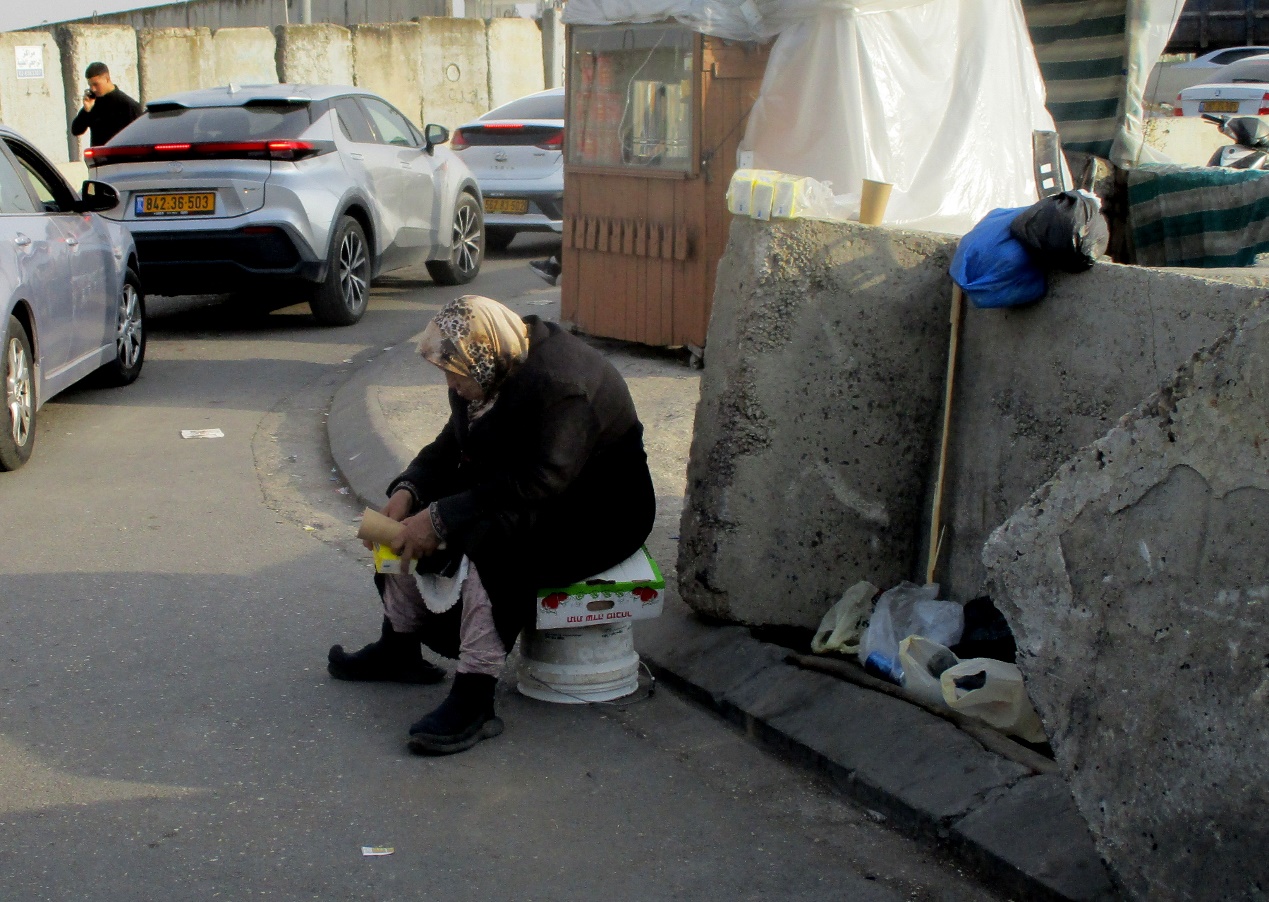 Tamar FleishmanOct-11-2026Qalandiya. Female Beggar
-
