
Qalandiya - again queues and a slow passage at the new checkpoint
Already Ruining the New Qalandiya
As soon as we arrived at the new checkpoint at 6:20 a.m., we saw a situation clearly different from what we had come to expect after the previous weeks. First, in addition to the people walking straight into the “slaloms” leading into the checkpoint, small groups of men were gathered around on the porch-like area leading to those three entrances and delaying their entry. Second, for the first time we saw lines built up within the three “slaloms.” Finally, above the three entrances we noticed, again for the first time, lights (designed to look like traffic lights) that changed from red to green each time the line by that entrance began to move forward – that is, each time the turnstile at the end of the slalom opened.
We were a bit taken aback by this change, which was painfully reminiscent of the standard at the old checkpoint.
We tried to figure out what made this morning different from all other mornings. It was the second day of Ramadan, but in the past Ramadan did not exert much of influence on the workings of the checkpoint one way or another. It was also the last day before a two-day closure on the West Bank (due to Israel marking Memorial Day and Independence Day), so perhaps more people than usual were entering East Jerusalem to prepare for this situation during Ramadan (shopping, visiting family, etc.). One man approached us and said that this morning it wasn’t enough for workers with biometric permits to go through the electronic check; they also had to show the soldiers their printed permits – which, if true, would certainly delay the process quite a bit. But that sounded rather odd.
In the meanwhile, during the hour we stood outside we met two members of the new delegation from the EAPPI. They knew, from conversations with the secretary of the previous group, that we were considering changing our work schedule at Qalandiya and Bethlehem, due to the improvements there, and requested detailed information so that they could coordinate shifts. We promised to keep them informed when we had a new schedule. Then one of the EAPPI people saw a man coming back out of the checkpoint and approached him to find out why he wasn’t allowed through. The young man was on his way to the American consulate equipped with a paper showing he had an appointment but, for reasons unknown, he had not obtained a permit to enter Israel. He said that the soldier who met him inside tore up the appointment paper and sent him back. We, of course, did not witness this event but we were puzzled by the fact that a Civil Administration soldier (who comes into physical contact with a Palestinian at the new checkpoint, in contrast to the soldiers inside glass booths) would tear up any kind of document. That’s not how we have seen Civil Administration soldiers behave. Thus we noted this incident, too, as odd.
At 7:15 we joined the line in one of the slaloms and after a short wait reach the “lobby” before the security-check hall and a second turnstile. Here again we had a short wait before passing through the area of the scanner (of bags and backpacks) and metal detector, continuing through a third turnstile, and entering the main security-check hall. And there we understood at least part of the reason for the delay this morning. For whom did we meet there if not one of the premier celebrities of the old checkpoint, Policeman M., who is famed for appropriating the tasks of soldiers whose performance is above reproach, complicating otherwise simple and efficient procedures, behaving uncivilly to Palestinians, and leaving a trail of antagonism behind him. That’s how he behaved by the Humanitarian Gate in the old checkpoint and so again this morning by appointing himself to conduct a “pre-check check” of the documents of people passing through the checkpoint just a few steps before these very same documents are checked again by the soldiers appointed to this task. In our case, a young security guard (or perhaps policeman?) standing next to him asked to see our identity cards, perused them carefully, and then announced to Policeman M. (with a sneer): “They are Israelis!” To his credit, M. identified us as “Watch Women’” (the Hebrew sobriquet for MachsomWatch members) and told the security guard to return our identity cards and let us through. Then he turned to check the passport and visa of our guest. And then we three walked a few steps forward and repeated the same operation with the soldiers in the glass booth, where we were immediately passed through.
So what did we have here? Who needs two document checks within a few feet of each other? Millions of shekels were invested in the new checkpoint and the army has been boasting about its cutting-edge technology, designed not only to ensure a swift and easy passage but to avoid, as much as possible, contact between Palestinians and Israeli soldiers and policemen – for the benefit of both sides. And now here stands an Israeli policeman gumming up the works, sabotaging the system. Why?
Perhaps we are being unfair to the man. Could it be that he was just following orders from above (the internal security minister? The prime minister?) to lessen the Palestinians’ relief over the advantages of the new system, and especially during Ramadan, in retaliation for the recent hail of rockets out of Gaza? Cynics have other explanations. We will spare you them.
Qalandiya Checkpoint / Atarot Pass (Jerusalem)
See all reports for this place-
Click here to watch a video from Qalandiya checkpoint up to mid 2019 Three kilometers south of Ramallah, in the heart of Palestinian population. Integrates into "Jerusalem Envelope" as part of Wall that separates between northern suburbs that were annexed to Jerusalem in 1967: Kafr Aqab, Semiramis and Qalandiya, and the villages of Ar-Ram and Bir Nabala, also north of Jerusalem, and the city itself. Some residents of Kafr Aqab, Semiramis and Qalandiya have Jerusalem ID cards. A terminal operated by Israel Police has functioned since early 2006. As of August 2006, northbound pedestrians are not checked. Southbound Palestinians must carry Jerusalem IDs; holders of Palestinian Authority IDs cannot pass without special permits. Vehicular traffic from Ramallah to other West Bank areas runs to the north of Qalandiya. In February 2019, the new facility of the checkpoint was inaugurated aiming to make it like a "border crossing". The bars and barbed wire fences were replaced with walls of perforated metal panels. The check is now performed at multiple stations for face recognition and the transfer of an e-card. The rate of passage has improved and its density has generally decreased, but lack of manpower and malfunctions cause periods of stress. The development and paving of the roads has not yet been completed, the traffic of cars and pedestrians is dangerous, and t the entire vicinity of the checkpoint is filthy. In 2020 a huge pedestrian bridge was built over the vehicle crossing with severe mobility restrictions (steep stairs, long and winding route). The pedestrian access from public transport to the checkpoint from the north (Ramallah direction) is unclear, and there have been cases of people, especially people with disabilities, who accidentally reached the vehicle crossing and were shot by the soldiers at the checkpoint. In the summer of 2021, work began on a new, sunken entrance road from Qalandiya that will lead directly to Road 443 towards Jerusalem and Tel Aviv. At the same time, the runways of the old Atarot airport were demolished and infrastructure was prepared for a large bus terminal. (updated October 2021)
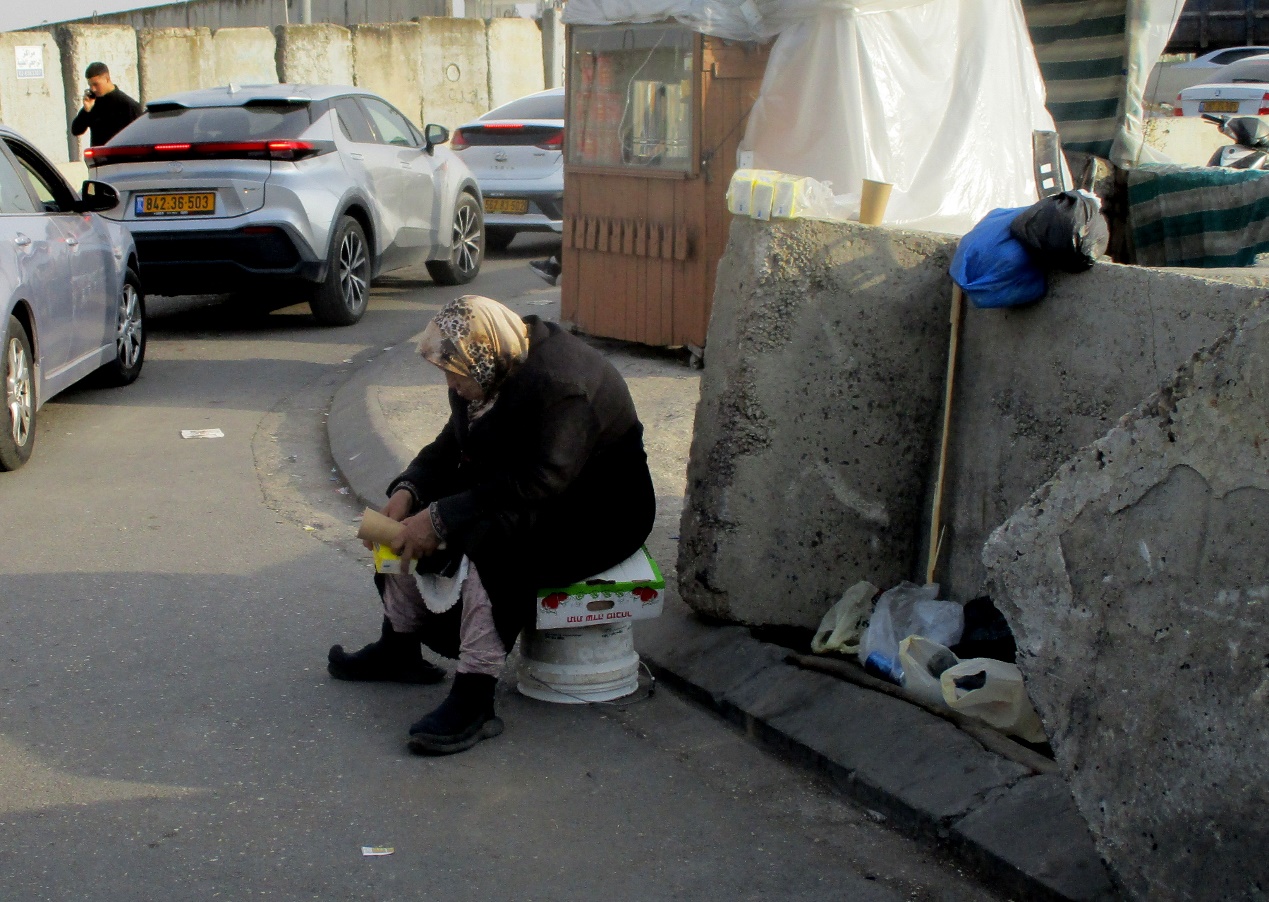 Tamar FleishmanOct-11-2026Qalandiya. Female Beggar
-
