
Qalandiya - 'back-to-back' practices regard people as goods
Two ‘back-to-back’ procedures were conducted at the designated spot.
Two inhuman procedures that treat people as if they were wares.
Procedures which their executors claim are conducted “by the book” and that “I only follow orders”.
At this place, the armed fill racist laws that have nothing to do with humaneness and justice.
Although I have witnessed and reported hundreds or thousands of ‘back-to-back’ procedures, because I believe that a human being is human, I see it my duty to be there, photograph, tell, shout.

1.
First an ambulance arrived from the West Bank, with five persons crowded in its narrow insides. That’s because there are not enough ambulances in the West Bank, the driver explained.
There were two mothers with their ill toddler children, and with them a young man whose leg surgery did not succeed and now, his foot swollen like a balloon about to explode, he is being returned to the hospital where he was operated.
They were all headed for the Makassed Hospital in East Jerusalem.
The wait for the two ambulances to meet was long. Roads are full, inspections to verify the patients and their accompaniers take time, one must check whether the proper coordination has taken place (i.e. whether the secret services approved of the patients and accompaniers crossing the checkpoint), and all the IDs must be photographed. What else do we have here? Soldiers, security guards and lots of guns.
When time passed, we learned that the children’s permits were in order, but the young man did not have a coordination document.
- But I have a transit permit (tasreekh)
-
But no coordination document (tanseek)
-
He should cross the checkpoint at the pedestrian gate, not here. Here it’s only with coordination.
But the man cannot step on his injured foot and didn’t think that he needed two permits… No way. The procedure is halted. Not entry, no exit.
After more time passed and phone calls were made to hotlines and others, coordination was made by phone. And not only did time pass, but the soldiers’ shift did too and those who had checked and photographed the documents and certificates had left. More checks, photographs, validating everyone’s data. And only when all of the soldiers were satisfied, and nodded their heads in consent, did the patients leave the spot.
2.
For a long time, the Jerusalem ambulance waited for its counterpart from the West Bank who had gotten tied up in heavy traffic.
In the meantime, it got dark and cold everywhere, for everyone.
After over a half an hour wait, the two ambulances met and their human cargo, a cardiac patient sent to Makassed Hospital for catheterizationwas passed over to the ambulance for which he had waited.
I banged the ambulance doors shut and parted from its travelers wishing them good health, and the paramedic called out to me: “I hope you will be every time I come to Qalandiya because when you are here it is smoother.”

A smile is a reaction to contact between people. Human contact. But in this bad place, when darkness and cold descend on everything, and the only light there comes from cars, a no-longer-young woman – having to push her cart and sell bunches of herbs to make a living and keeps a good spirit and smiles and greets, it breaks the heart.

To look away from the beam on the ground below to the terrifying bridge above, to see the decorations that the authorities have put up for Christmas, is the best illustration of the phrase: gold nose ring in a pig’s nose.
Qalandiya Checkpoint / Atarot Pass (Jerusalem)
See all reports for this place-
Click here to watch a video from Qalandiya checkpoint up to mid 2019 Three kilometers south of Ramallah, in the heart of Palestinian population. Integrates into "Jerusalem Envelope" as part of Wall that separates between northern suburbs that were annexed to Jerusalem in 1967: Kafr Aqab, Semiramis and Qalandiya, and the villages of Ar-Ram and Bir Nabala, also north of Jerusalem, and the city itself. Some residents of Kafr Aqab, Semiramis and Qalandiya have Jerusalem ID cards. A terminal operated by Israel Police has functioned since early 2006. As of August 2006, northbound pedestrians are not checked. Southbound Palestinians must carry Jerusalem IDs; holders of Palestinian Authority IDs cannot pass without special permits. Vehicular traffic from Ramallah to other West Bank areas runs to the north of Qalandiya. In February 2019, the new facility of the checkpoint was inaugurated aiming to make it like a "border crossing". The bars and barbed wire fences were replaced with walls of perforated metal panels. The check is now performed at multiple stations for face recognition and the transfer of an e-card. The rate of passage has improved and its density has generally decreased, but lack of manpower and malfunctions cause periods of stress. The development and paving of the roads has not yet been completed, the traffic of cars and pedestrians is dangerous, and t the entire vicinity of the checkpoint is filthy. In 2020 a huge pedestrian bridge was built over the vehicle crossing with severe mobility restrictions (steep stairs, long and winding route). The pedestrian access from public transport to the checkpoint from the north (Ramallah direction) is unclear, and there have been cases of people, especially people with disabilities, who accidentally reached the vehicle crossing and were shot by the soldiers at the checkpoint. In the summer of 2021, work began on a new, sunken entrance road from Qalandiya that will lead directly to Road 443 towards Jerusalem and Tel Aviv. At the same time, the runways of the old Atarot airport were demolished and infrastructure was prepared for a large bus terminal. (updated October 2021)
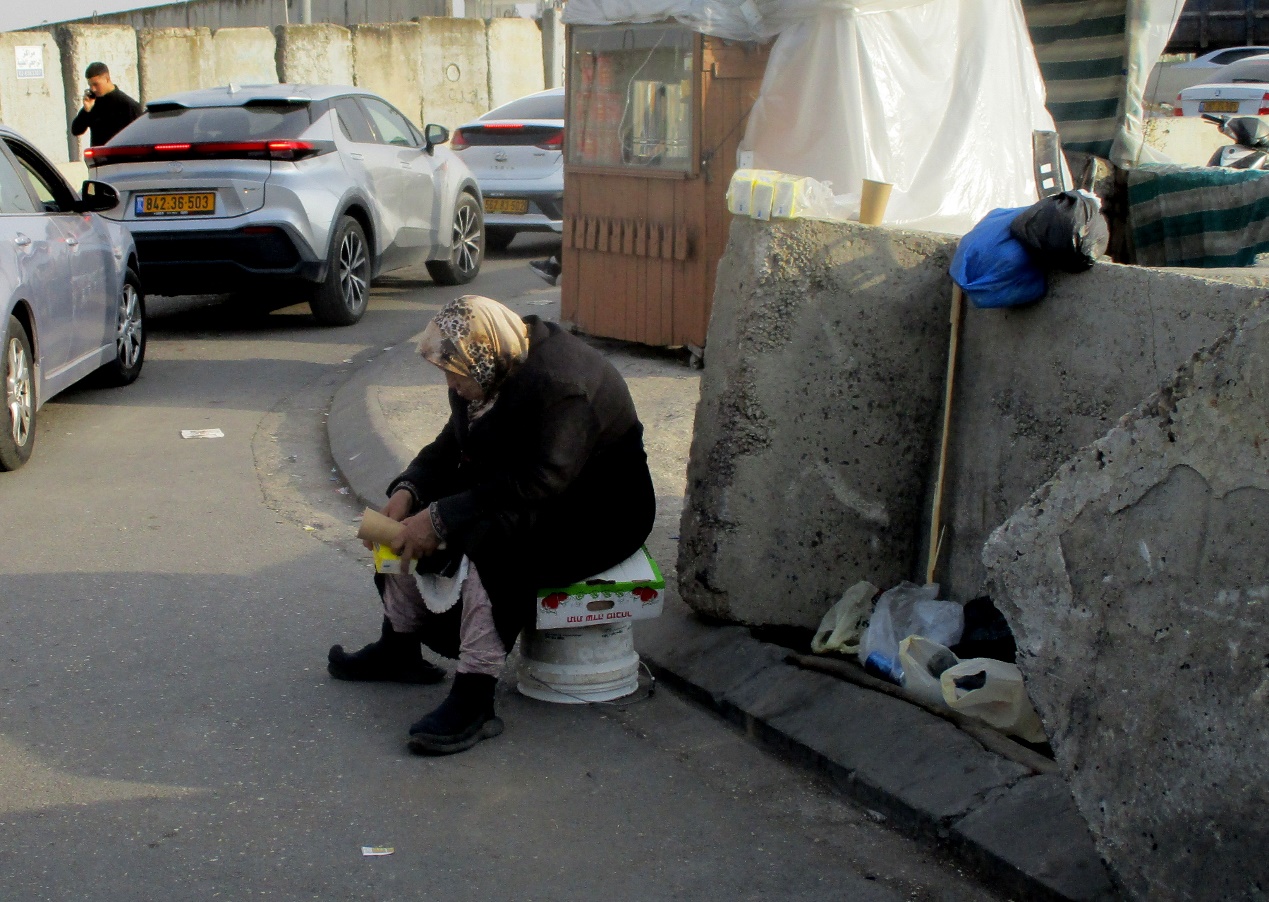 Tamar FleishmanOct-11-2026Qalandiya. Female Beggar
-
