
Qalandiya - Cloudy weather and rain wetting the indoor pedestrian bridge




05.45. A dark, wintry morning. Fortunately, there was a pause in the rain and there was not too much mud on the way to the pedestrian bridge. On the bridge itself, there was a steady stream of men on their way to work. A man who greeted us friendlily on our way to the bridge said “Ilhamdu liAllah, everything is fine today, it’s just a little (“shwai”) cold”. Indeed he, like many others, was without a coat – just a sweater and windbreaker. For the first time, we saw a woman at prayer on a prayer rug she had spread in a corner where the bridge turns at the top of the stairs.
On the Palestinian side, we found short lines at two of the entrances, arranged so that everyone could fit under shelter incase the rain resumed. The lights there were green, on the third entrance was a red light though we saw a few people inside the slalom. Suddenly all lights were red, but then all turned green and some of the men ran over to the third lane.
Our beigel-seller friend Abu Ramzi was not to be seen. It was still too dark to see if he was outside the parking-lot on the Qalandiya side. The gate there is still locked so people have to walk all the way around the parking lot to reach the checkpoint via the al-Ram approach. Luckily it wasn’t raining.
At one of the entrances, a woman has for some time now sat on the floor. At first, she would be begging, but nowadays she sells masks. Opposite her a man was sat at a table, selling masks, coffee from a thermos, and cigarettes. On our previous visit, there was loud shouting between them, as he was affecting her sales, but now they seem to have made peace between them. Later a man arrived with a tray of beigels, boiled eggs and falafel, covered with plastic. He placed these on the ground next to the man at the table, and started to sell – calling out, but not very successfully, it appeared. We heard the woman ask him where Abu Ramzi was – apparently, they are connected. He told us that Abu Ramzi was ill, but didn’t know if this was to do with his eye operation. We wish him a quick recovery.
Meanwhile, the lines had become very short. Now and again just one of the entrances would open and then people moved from one line to another to save a minute or two.
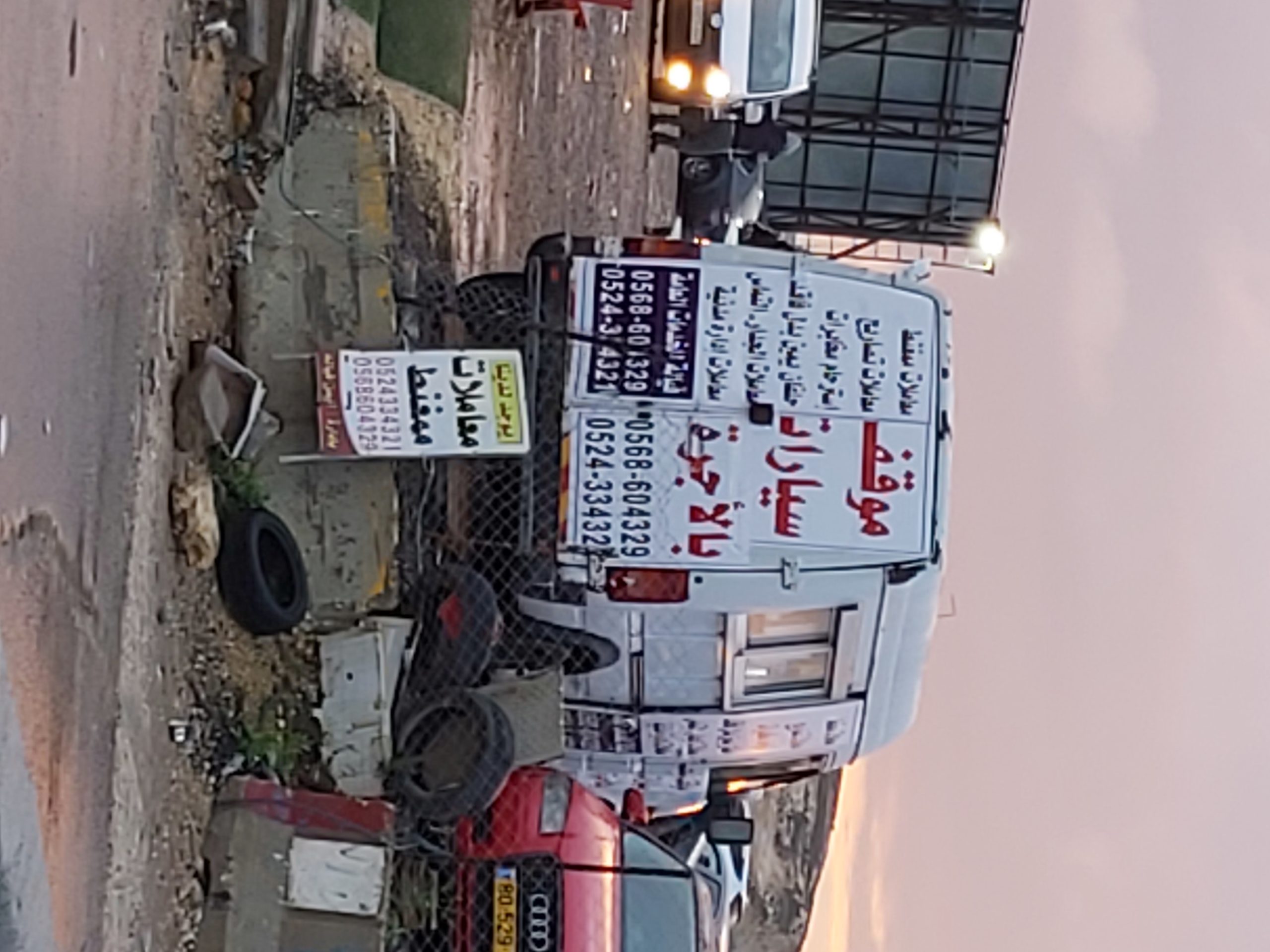
We went toward the kiosk to buy tea and noticed from afar there was a change. The kiosk itself has disappeared and in its place is a motorized ‘shop’ (“gazlan”} which provides also office services and deals with parking – and sells tea and coffee. As far as we could understand from a man there whom we know, called Izan, apparently, the municipality confiscated the kiosk. We had always thought that the area of the kiosk and (informal) parking lot belonged to the family of Ayman and Muhammad. Apparently, they were only renting it. Izan said that Ayman was jailed for a few days; now both he and Mohammad are at home. He did not know what condition Abu Ramzi was in.
We went aside to drink our tea. Refuse all around, in places floating in the puddles caused by the rain. Perhaps the municipality should concentrate more on cleaning than on confiscating kiosks.
It started to drizzle and we returned to the building. There were small lines inside the slalom. Meanwhile, the sun was rising and we watched it between the railings and the watchtower.
At 7 o’clock we entered the middle entrance. The slalom itself was empty and the turnstile at its end was open. Inside only one package-checking machine was working, but other machines were lit. Maybe earlier there were more machines working. We passed quickly. Of the electronic document-checking machines, only 4-5 out of 30 were operating. And only one ‘manned’ station was open, with only one (woman) soldier. (There are usually two, and we have been told in the past that the job of the second one was to check that no one jumped over the electronic post.) A woman with a stroller was given permission by the soldier to pass through one of the electronic posts which she opened for her. But it was too narrow for the stroller. A man tried to help her lift it over the post. A security man approached and told the soldier that she should have sent the woman to the end where there was a special gate for strollers and wheelchairs and he would open it for her. He disappeared and the soldier didn’t know what to do with us – obviously new to her job and not knowing Machsomwatch. So we stood aside while she checked by phone and, satisfied that we were no risk, then let us through. At least during this time she let through the Palestinians who needed manual checking.
When we came out of the building it was raining lightly – an opportunity to test Ronit’s ‘Lekh” (“Go!”} umbrella – and to see conditions on the bridge when it rains. As expected, raindrops come in from the side. Although the rain was light and there was no strong wind, we could see that the floor was wet halfway across from drops that had come in from the side. We could only imagine what it would be like on a stormy day.
At the bottom of the stairs of the bridge people crowd under its cover and also shelter under the pillars. On the way to our car people stop us to tell us that when we come, conditions are better (We know that it’s not quite so…}. One man spoke with us at length and wondered why so much was spent on this sophisticated new checkpoint if the lines are still so long. According to him today fewer workers came because of the rain, but at the beginning of the week, the lines were very long. He claimed that people arriving at 5 passed only at 7. When we told him that we had been told recently that there were not enough soldiers because of Corona quarantine, he answered that when there is an incident on the West Bank suddenly there are unlimited supplies of soldiers.
Qalandiya Checkpoint / Atarot Pass (Jerusalem)
See all reports for this place-
Click here to watch a video from Qalandiya checkpoint up to mid 2019 Three kilometers south of Ramallah, in the heart of Palestinian population. Integrates into "Jerusalem Envelope" as part of Wall that separates between northern suburbs that were annexed to Jerusalem in 1967: Kafr Aqab, Semiramis and Qalandiya, and the villages of Ar-Ram and Bir Nabala, also north of Jerusalem, and the city itself. Some residents of Kafr Aqab, Semiramis and Qalandiya have Jerusalem ID cards. A terminal operated by Israel Police has functioned since early 2006. As of August 2006, northbound pedestrians are not checked. Southbound Palestinians must carry Jerusalem IDs; holders of Palestinian Authority IDs cannot pass without special permits. Vehicular traffic from Ramallah to other West Bank areas runs to the north of Qalandiya. In February 2019, the new facility of the checkpoint was inaugurated aiming to make it like a "border crossing". The bars and barbed wire fences were replaced with walls of perforated metal panels. The check is now performed at multiple stations for face recognition and the transfer of an e-card. The rate of passage has improved and its density has generally decreased, but lack of manpower and malfunctions cause periods of stress. The development and paving of the roads has not yet been completed, the traffic of cars and pedestrians is dangerous, and t the entire vicinity of the checkpoint is filthy. In 2020 a huge pedestrian bridge was built over the vehicle crossing with severe mobility restrictions (steep stairs, long and winding route). The pedestrian access from public transport to the checkpoint from the north (Ramallah direction) is unclear, and there have been cases of people, especially people with disabilities, who accidentally reached the vehicle crossing and were shot by the soldiers at the checkpoint. In the summer of 2021, work began on a new, sunken entrance road from Qalandiya that will lead directly to Road 443 towards Jerusalem and Tel Aviv. At the same time, the runways of the old Atarot airport were demolished and infrastructure was prepared for a large bus terminal. (updated October 2021)
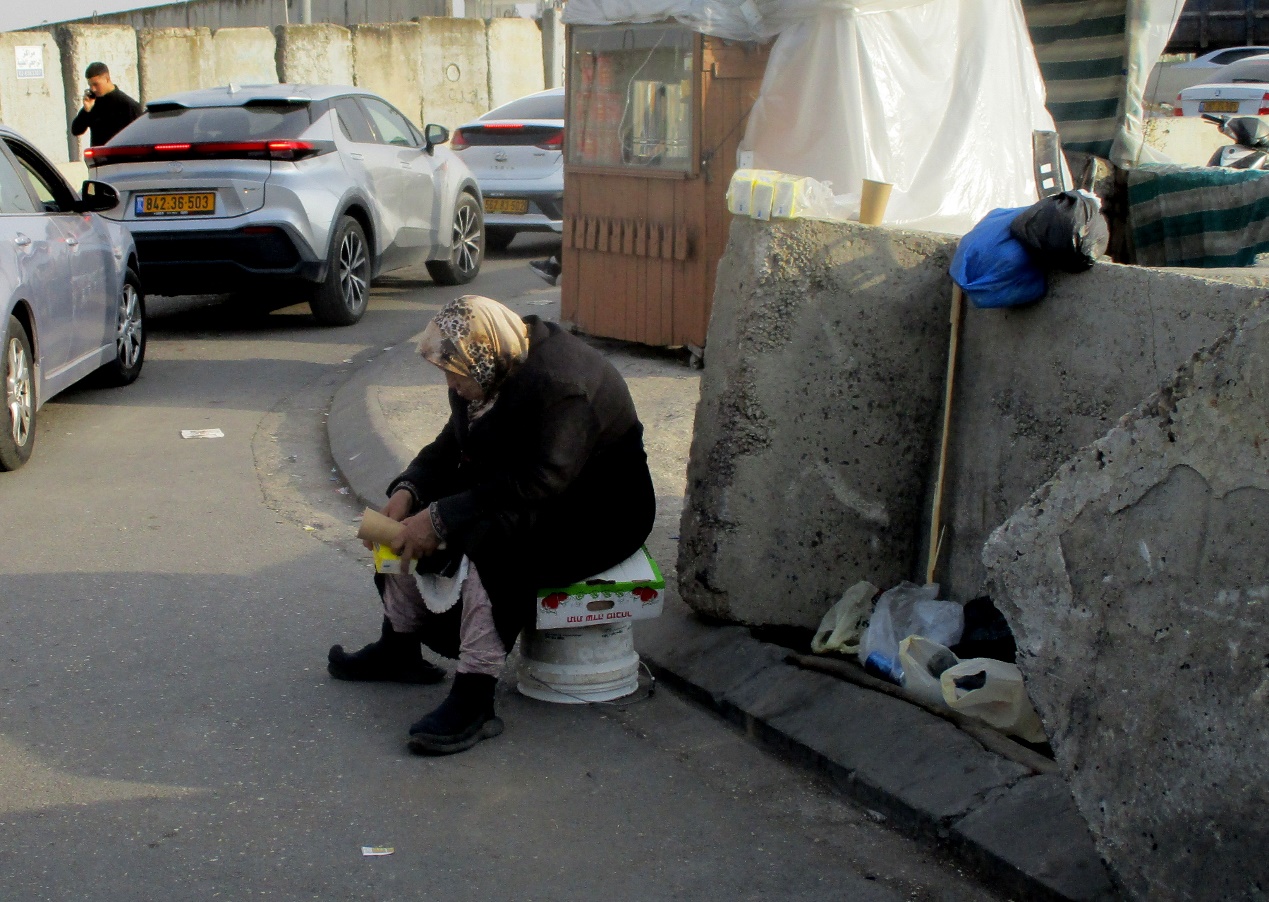 Tamar FleishmanOct-11-2026Qalandiya. Female Beggar
-
