
Qalandiya, Fri 10.8.12, Morning
Translating: Ruth Fleishman
The ritual held at Qalandiya checkpoint on Ramadan Fridays is reminiscent of the one that was held during the Great War, wherein once the sun had set the battles would subside until being renew at sunrise.
At Qalandiya checkpoint, each Friday the camps stand one in front of the other on both side of the blockages, from sunrise till the hour of prayer, the Palestinians stand armed with their praying mats in front of soldier who are armed with rifles and grenades.
The rules and regulations are the same each time. Difference can be found only in the amount of people standing at the gates, the volume of the voices and the tone.
Less sentences of this sort: "Happy holiday… please… I'm sorry but…"
And more or especially of this sort: "Get out of my sight… Yallah… get lost… go home I said!"
Less: "It's fine that you are standing here… you are allowed… you can photograph it all…"
And more or especially: "Stand back… don't stand here… you are in violation of the agreement of the commanders with Watch…"
It was as though the masks had been removed and a sense of truthfulness surfaced at the areas of contact.
The general story is mirrored through the stories of individuals, those are the ones that must be documented: 
The exact words of Arafat, he spoke them from the bottom of his heart:
"Today is a holiday, something spiritual. Why do they humiliate me like this?… I've been standing here for two hours, they have checked me ten times, again and again, each one of them says: 'show me your permit…. show me your permit… show me your permit… 'I'm a man of peace. I'm a peace activist. I can't take this humiliation anymore!
About the woman crossing with her two children and while she was inside the construction, sure that the road to El-Aqsa was open before her, she was detained by a soldier who noticed that the woman had "deceived the army", for her elder son was older then the permitted age (12). The mother was caught red handed and sent away in shame with her children through the revolving gendered door, the one intended for women only.
About a family that came from afar: a father, mother and their two young children, that left their home knowing everything was alright, that their acts were in accordance to the laws of the Ramadan. The father, who had yet to turn forty, had obtained a praying permit, the mother had packed all that was needed for a day out in Jerusalem, but because she was in a hurry she forgot to put her husband's ID in the bag. The young man tried appealing to the hearts of the soldiers and officers, he presented the paper that was issued by the authorities, he presented his wife and children… after having pleaded, begged and requested- the family was sent back.
The greatest victim of the day was a teenager that the soldiers dragged into the sterile zone, they place him against a concrete brick and put plastic handcuffs on his hands. Only the camera managed to stop the completion of the arrest. The camera was attached to the faces of teenager and his capturers and wasn't deterred even when the requests were replaced by orders and threats. Its stubbornness made the officers that were alerted to decide to finish the handling of the teenager inside the checkpoint.
The fragments of information that I was able to gather regarding this incident, indicate that the teenager picked up an IDF grenade that had probably fallen off one of the soldier's belt and then was witnessed raising the hand with the grenade. In a reality in which all the rights had been placed at the hands of one side alone- the ruler, while on the other side is the one ruled over, millions of people remain without rights. It's hard not to ponder about the fact that if the bearing of arms is a right, in the sense that it is legal in the model state, and a longed for ideal of most Israelis, then this right, like many others, must also be symmetrical.
At the appointed time of prayer at El Aqsa a young Imam step on an improvised stage, held a prayer before the crowd, after which the people stood in long and straight lines and replied with prayer, they raised their hands to the sky and knelt on the ground, some on praying mats and others on pieces of cartons or on random pages from a newspaper.
And in front of the soldiers with their pointing rifles, young Palestinians assembled a choir, they raised their arms and together yelled over and over again:
"In our millions we shall go to El Aqsa, even if we are killed we shall go…"
Qalandiya Checkpoint / Atarot Pass (Jerusalem)
See all reports for this place-
Click here to watch a video from Qalandiya checkpoint up to mid 2019 Three kilometers south of Ramallah, in the heart of Palestinian population. Integrates into "Jerusalem Envelope" as part of Wall that separates between northern suburbs that were annexed to Jerusalem in 1967: Kafr Aqab, Semiramis and Qalandiya, and the villages of Ar-Ram and Bir Nabala, also north of Jerusalem, and the city itself. Some residents of Kafr Aqab, Semiramis and Qalandiya have Jerusalem ID cards. A terminal operated by Israel Police has functioned since early 2006. As of August 2006, northbound pedestrians are not checked. Southbound Palestinians must carry Jerusalem IDs; holders of Palestinian Authority IDs cannot pass without special permits. Vehicular traffic from Ramallah to other West Bank areas runs to the north of Qalandiya. In February 2019, the new facility of the checkpoint was inaugurated aiming to make it like a "border crossing". The bars and barbed wire fences were replaced with walls of perforated metal panels. The check is now performed at multiple stations for face recognition and the transfer of an e-card. The rate of passage has improved and its density has generally decreased, but lack of manpower and malfunctions cause periods of stress. The development and paving of the roads has not yet been completed, the traffic of cars and pedestrians is dangerous, and t the entire vicinity of the checkpoint is filthy. In 2020 a huge pedestrian bridge was built over the vehicle crossing with severe mobility restrictions (steep stairs, long and winding route). The pedestrian access from public transport to the checkpoint from the north (Ramallah direction) is unclear, and there have been cases of people, especially people with disabilities, who accidentally reached the vehicle crossing and were shot by the soldiers at the checkpoint. In the summer of 2021, work began on a new, sunken entrance road from Qalandiya that will lead directly to Road 443 towards Jerusalem and Tel Aviv. At the same time, the runways of the old Atarot airport were demolished and infrastructure was prepared for a large bus terminal. (updated October 2021)
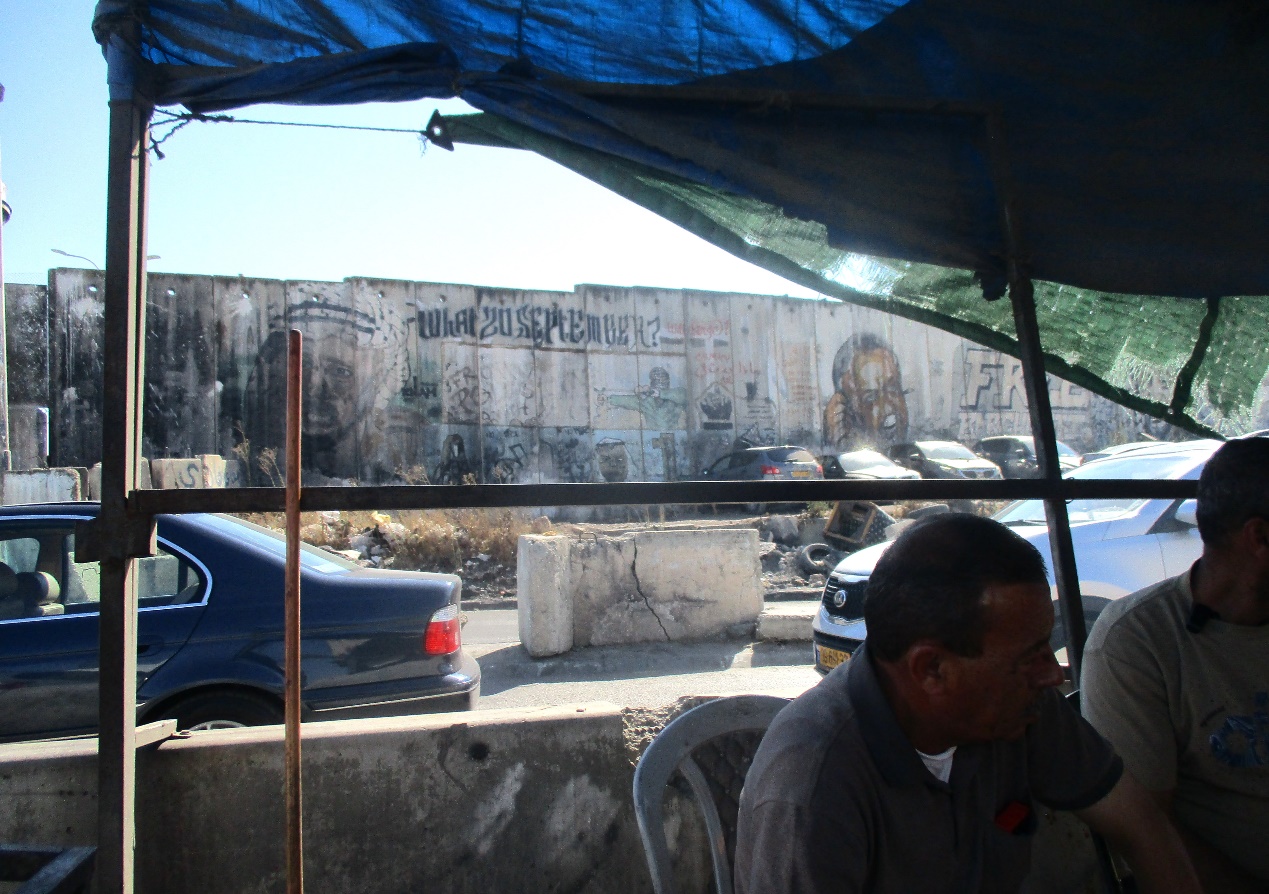 Tamar FleishmanJul-21-2026Qalandiya. Conversation in the shadow of the wall
-
