
Qalandiya, Fri 15.2.13, Morning
Translator: Charles K.
09:00 The shed is filled with four congested lines of men and women crowded into the outer fenced corridors, stretching all the way to the rear.
The humanitarian lane for women, the elderly and the ill hasn’t opened. The DCO representative isn’t here.
A Palestinian says: “They’re all elderly, they want to pray. Now they’re being delayed, but at noon, after prayers have ended, they’ll be let through quickly.” He complains about the soldiers’ behavior; they’re talking on the phone, chatting with one another.
People on line say they’ve been waiting an hour, an hour and a half.
A man arrives at the checkpoint with his two children, on the way to the hospital. As noted, there’s no humanitarian lane.
After we telephone the DCO, more inspection booths open, in addition to the two that were operating. Now they’re all open.
The female soldier in charge of opening the revolving gates sits detached in a structure at the rear of the crowd. She neither hears nor sees. A soldier coming toward us claimed that the inspections can’t be conducted more quickly. After three telephone calls to the DCO, we feel a change.
The female soldier at the DCO is annoyed at our frequent calls. Didn’t she tell us there was someone from the DCO on the way?
09:30 The DCO man arrives, but he’s in no hurry to open the humanitarian gate. He said he’d gone to eat something. I asked him to announce there was a line for women, the elderly and the ill; he said that wasn’t possible, because they’re all elderly and ill. A wonderful response. If everyone needs the humanitarian lane, there’s really no reason to open it.
An older DCO representative arrives – or maybe he’s some other official. He explains that it’s better without a humanitarian lane, because there will only be one inspection window for it inside, and people on that line will ultimately wait longer.
He says he’s not able to redirect people to other lines once they’re inside. This time we kept running into soldiers each of whom does nothing else but his own specific job.
They announce the humanitarian lane for women and the ill, but it doesn’t open yet.
09:40 The line for women and the ill opens.
A blacklisted Palestinian man recounts how he was harassed by the occupation and the army more than ten years ago. The climax of the story came with soldiers breaking into his home at night and shooting him in the leg in front of his three year old son, his mother and his wife. He was jailed for years in Israel.
The reason – theft of his land. He tells us that his son, who’s grown, won’t forget that night.
10:00 Some of the painful images from the checkpoint: confused women and elderly men running hurriedly from the regular to the humanitarian lane, and when the gate there slams in their faces, running back to the regular lines, again and again.
Again I complain that the bathrooms are always closed to people going through the checkpoint, but they still stink.
There are feces on the floor of the shed, apparently belonging to someone who couldn’t wait any longer, but there are no bathrooms.
10:00 The lines become shorter.
Qalandiya Checkpoint / Atarot Pass (Jerusalem)
See all reports for this place-
Click here to watch a video from Qalandiya checkpoint up to mid 2019 Three kilometers south of Ramallah, in the heart of Palestinian population. Integrates into "Jerusalem Envelope" as part of Wall that separates between northern suburbs that were annexed to Jerusalem in 1967: Kafr Aqab, Semiramis and Qalandiya, and the villages of Ar-Ram and Bir Nabala, also north of Jerusalem, and the city itself. Some residents of Kafr Aqab, Semiramis and Qalandiya have Jerusalem ID cards. A terminal operated by Israel Police has functioned since early 2006. As of August 2006, northbound pedestrians are not checked. Southbound Palestinians must carry Jerusalem IDs; holders of Palestinian Authority IDs cannot pass without special permits. Vehicular traffic from Ramallah to other West Bank areas runs to the north of Qalandiya. In February 2019, the new facility of the checkpoint was inaugurated aiming to make it like a "border crossing". The bars and barbed wire fences were replaced with walls of perforated metal panels. The check is now performed at multiple stations for face recognition and the transfer of an e-card. The rate of passage has improved and its density has generally decreased, but lack of manpower and malfunctions cause periods of stress. The development and paving of the roads has not yet been completed, the traffic of cars and pedestrians is dangerous, and t the entire vicinity of the checkpoint is filthy. In 2020 a huge pedestrian bridge was built over the vehicle crossing with severe mobility restrictions (steep stairs, long and winding route). The pedestrian access from public transport to the checkpoint from the north (Ramallah direction) is unclear, and there have been cases of people, especially people with disabilities, who accidentally reached the vehicle crossing and were shot by the soldiers at the checkpoint. In the summer of 2021, work began on a new, sunken entrance road from Qalandiya that will lead directly to Road 443 towards Jerusalem and Tel Aviv. At the same time, the runways of the old Atarot airport were demolished and infrastructure was prepared for a large bus terminal. (updated October 2021)
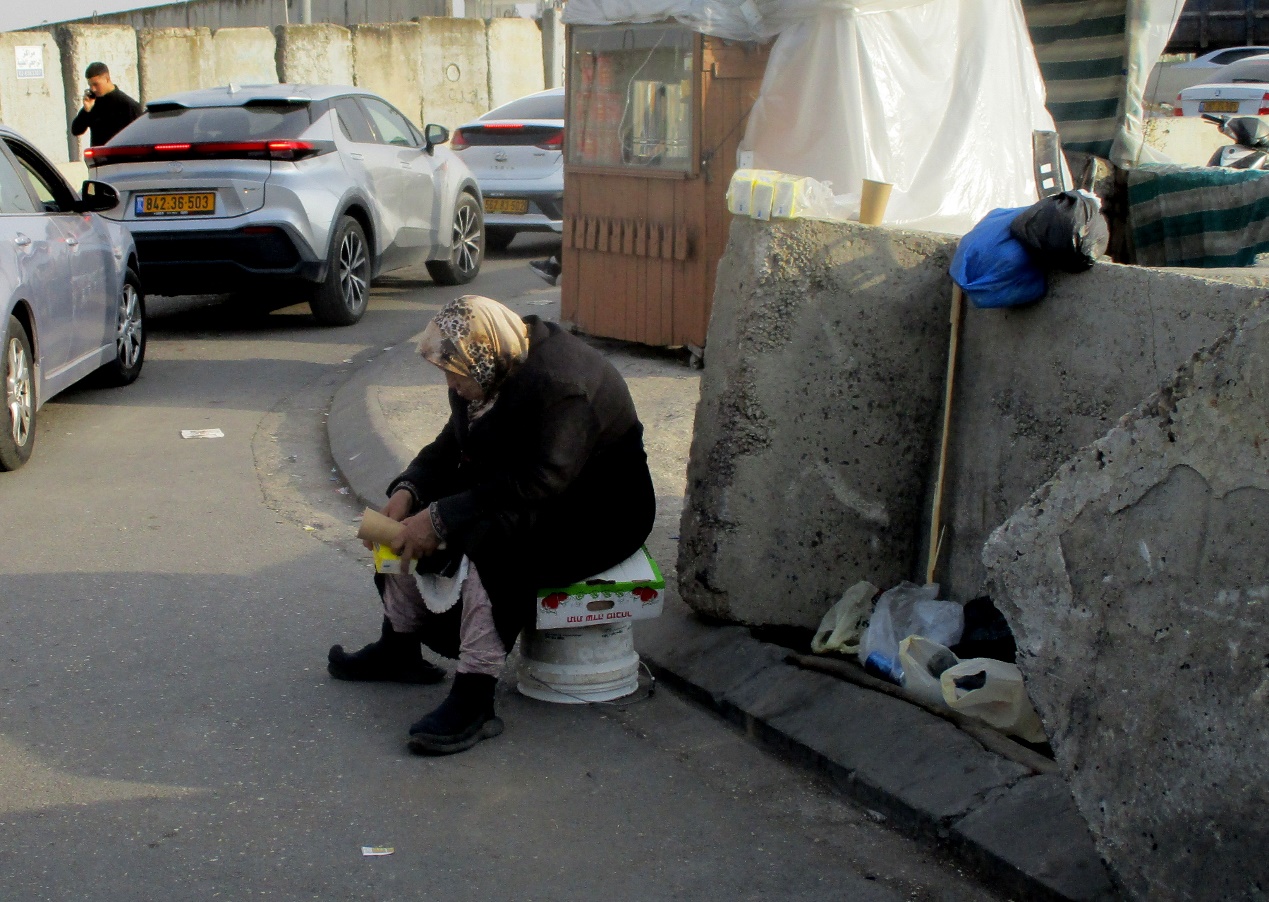 Tamar FleishmanOct-11-2026Qalandiya. Female Beggar
-
