
Qalandiya, Fri 20.8.10, Morning
It would appear that there is nothing better than clear, detailed directives to maintain good order and festivity, particularly if it is backed up by thousands of police and the military, ranged over all the roads leading to the Old City and the execution of meticulous inspections at the roadblocks surrounding Jerusalem which do not permit any compromise or exception from the regulations determined unilaterally by Israel.
The roadblock is crossed via lanes leading to a number of checkpoints; each position confirms the inspection of the previous position so that no exceptions are made nor is there any hope of easing the crossing restrictions. There are lanes for women, for men and for special permits.
The regulations are: men over 50 years of age, women over 45, children under the age of 12 listed in their parent's ID card and children up to the age of 14 who hold a registration certificate showing their identity. Prayer permits for men over 45 years of age, over 35 years of age for women, subject to no Shabak preventions or personally dangerous categories. Those holding work permits are also subject to their workplace being suitable.
Leo is an Englishman who served in the British Army and was stationed in Iraq and Afghanistan until he realised that war is the worst option. His ideology is not to criticise politicians except through political activity. He has come here for a few days to benefit from getting to know the reality at first hand, knowledge which will be of use to him in his new position as a co-ordinator for the governing party (led by Prime Minister Cameron) on the subject of the conflict in our area. There were also Ecumenicals at the roadblock as well as observers from UTCHA.
And so, on the face of it, the crossing appears to be quick, the military and the police have awnings for shade, and fans sprinkling water. The awnings were dismantled in the afternoon by Palestinian youths, employees of the Palestinian company in Ramallah which won the tender to build the shade for the Israeli military and police 'forces'.
The Palestinian men and women, queuing in separate queues at a distance from each other, do not enjoy this relief and their faces do not exhibit festivity but apprehension, exhaustion, tension, anger and hate. (See the photos.)
The lack of festivity is added to by the profusion of the various uniforms of the Border Police, the police recce unit, the civilian police, the olive coloured khaki and the grey khaki and the bright green jackets of the Civil Administration responsible for hearing special requests and assisting, but in actual fact they do the opposite: they do not accept any exceptional needs, they just explain in military slang the various interdictions.
There are many Palestinian paramedics at the roadblock, prepared to take care of fasting people who are unable to tolerate the long wait in the intense heat and their exposure to the burning sun.
While we were present observing the various queues we perceived cases of people wanting to cross in spite of not being included in the 'list of permits' made up of a thousand and one clauses:
Men under 50 who have work or commercial permits for Giv'at Ze'ev – crossed… "Because it's for us". Work permits for Judea and Samaria – denied. A boy aged 12 and two months with his father but without a registration certificate is denied entry.
A woman from Jenin who was 2 months under 45 did not receive the prayer certificate she wanted because her son is in an Israeli prison and also because she is excluded from entry to Israel by the Shabak, and so is her daughter, his sister, aged 12.
A man of over 50 was sure he was going to be let through normally, he had passed the first checkpoint, but unluckily for him he was directed to the queue to be checked in the inspection rooms at the roadblock, and there he was found on the computer to be excluded from entry by the Shabak, and it does not matter even if you are over 50.
Tamar chatted with a man from Tulkarm who told her the following:
In the men's queue a 47 year old man from Tulkarm talked to Leo, complaining that he was not allowed to pray at El Aksa: "It is our place, it belongs to us, it is our holy place…", he recounted that he had studied English literature at the Hebron University for two years, until in 1994 he was wounded in an attack on the University by settlers and was forced to give up his studies.
He said that this morning, after he had eaten before dawn, he left his home in the direction of the Kalandia roadblock. He did the same last week; he will do the same next week and the one after that. The man does not approach the soldie rs. He does not ask them for anything. He just stands and waits. Hoping that his salvation will come from on high above and the way to his place of prayer will open up for him. He does not trust in man. He did not vote in the elections, nor will he as, if and when the next elections take place. He has no opinion on ways to fight or to oppose, he only has his faith. Because: everything comes from on high, from god.
In general the talk between the Palestinian women was that only god can help because only god is stronger than the Israeli occupation, you'll see, they say, the day will come: in a hundred years? Well, 43 have already passes.
Qalandiya Checkpoint / Atarot Pass (Jerusalem)
See all reports for this place-
Click here to watch a video from Qalandiya checkpoint up to mid 2019 Three kilometers south of Ramallah, in the heart of Palestinian population. Integrates into "Jerusalem Envelope" as part of Wall that separates between northern suburbs that were annexed to Jerusalem in 1967: Kafr Aqab, Semiramis and Qalandiya, and the villages of Ar-Ram and Bir Nabala, also north of Jerusalem, and the city itself. Some residents of Kafr Aqab, Semiramis and Qalandiya have Jerusalem ID cards. A terminal operated by Israel Police has functioned since early 2006. As of August 2006, northbound pedestrians are not checked. Southbound Palestinians must carry Jerusalem IDs; holders of Palestinian Authority IDs cannot pass without special permits. Vehicular traffic from Ramallah to other West Bank areas runs to the north of Qalandiya. In February 2019, the new facility of the checkpoint was inaugurated aiming to make it like a "border crossing". The bars and barbed wire fences were replaced with walls of perforated metal panels. The check is now performed at multiple stations for face recognition and the transfer of an e-card. The rate of passage has improved and its density has generally decreased, but lack of manpower and malfunctions cause periods of stress. The development and paving of the roads has not yet been completed, the traffic of cars and pedestrians is dangerous, and t the entire vicinity of the checkpoint is filthy. In 2020 a huge pedestrian bridge was built over the vehicle crossing with severe mobility restrictions (steep stairs, long and winding route). The pedestrian access from public transport to the checkpoint from the north (Ramallah direction) is unclear, and there have been cases of people, especially people with disabilities, who accidentally reached the vehicle crossing and were shot by the soldiers at the checkpoint. In the summer of 2021, work began on a new, sunken entrance road from Qalandiya that will lead directly to Road 443 towards Jerusalem and Tel Aviv. At the same time, the runways of the old Atarot airport were demolished and infrastructure was prepared for a large bus terminal. (updated October 2021)
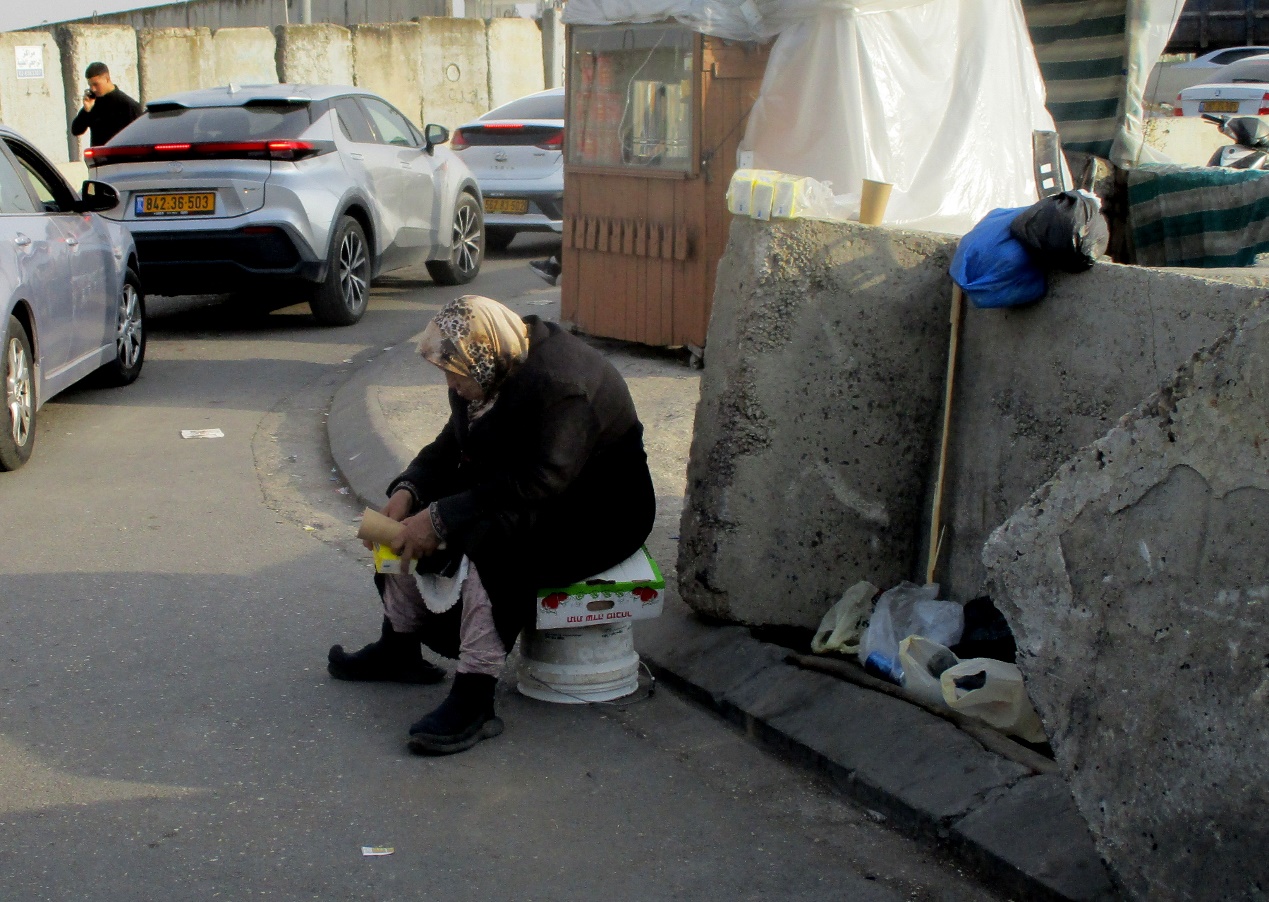 Tamar FleishmanOct-11-2026Qalandiya. Female Beggar
-
