
Qalandiya, Fri 25.3.11, Morning
Translator: Charles K.
A female soldier with a big gun demonstrated how people like us are dealt with.
We arrive at the Qalandiya checkpoint at 09:30. We parked in the parking lot. There aren’t many people at the terminal. Few cross. Men seated at the entrance explained that no Friday permits were issued this week for Temple Mount prayers. Only a few permit holders go through the revolving gates. Elderly people and women with small children get into vehicles in front of the vehicle crossing and go through the vehicle checkpoint.
A few lines of cars waiting a long time to be inspected. We join them. Our car is flying Machsom Watch flags. An armed, female Border Police soldier notices us from some distance away, before we drew close to the position, and she gets ready to treat us like women such as we deserve. We get the harassment reserved for those defined as enemies. Fortunately, we haven’t yet been denied the ability to say what we think about her behavior and still assume that, eventually, we’ll be able to continue on our way. But it’s a lousy feeling. Other soldiers are all around, not one of whom tries to moderate her actions. The checkpoint commander, moreover, who identifies himself as Shmulik, even backs her completely.
Our contact with her opens not only with a demand to see our ID cards, but to open the hood, the trunk, the floor mats, all the compartments. All in a peremptory, rude tone, repeatedly mentioning the attack in Jerusalem. We’re made to understand that we had a part in it and, in addition, that our very presence at the Qalandiya checkpoint testifies to our disloyalty and collaboration with the enemy. We can assume that the soldier (we weren’t told her name) doesn’t suspect us of concealing a bomb in the little pockets of our handbags – after all, she has the power and the backing to demand we empty them as well as all the bags in the car. O, we helpless women…We weren’t able to open the hood…but she didn’t cut corners. She announced in no uncertain terms that we weren’t going anywhere until we opened the hood. We were sent to a traffic bay to be reinspected. Again she checked the trunk – taking everything out this time and inspecting it. She threatens, in all seriousness, that if next time the trunk is such a mess, she won’t let the car through. The entire process was accompanied by orders to get out of the car, get into the car, don’t answer, don’t talk to her – “who do you think you are anyway,” threats of arrest and to call the bomb disposal squad unless we remove everything from the trunk (which was, as noted, messy). The checkpoint commander, rude and adamant, showed up every so often to announce that the soldier has his full backing. Because, that’s how it is, people like us, that’s the treatment they deserve…If we don’t like it, we can go live on the other side – he’s her advocate, he threatens to accuse us of preventing a police officer from carrying out her duties…various uniformed personnel standing around. They all agree with both of them. Some silently, others with an occasional encouragement. We’re getting the treatment that supporters of those who placed the bomb deserve. We’re the enemy. The soldier concluded by throwing our IDs into the car.
The incident was extremely upsetting because of the ease with which an angry soldier, backed by her commander, can behave so rudely, violently, allowing herself to harass us for the sake of harassment, as punishment, just because she can. After all, she just carried out a “thorough inspection,” nothing that violated the regulations. To the contrary, had she wished, she could have asked us to raise our garments…detain us for a few hours (4 hours, if I remember correctly)…call the police because we spoke impolitely…a feeling that anything was possible.
But we’re not Palestinians (who already know there’s no point asking a soldier to speak politely to them, to say “please drive in reverse” – certainly not just a few days after an attack). We returned home – we still have some rights here. For now.
Qalandiya Checkpoint / Atarot Pass (Jerusalem)
See all reports for this place-
Click here to watch a video from Qalandiya checkpoint up to mid 2019 Three kilometers south of Ramallah, in the heart of Palestinian population. Integrates into "Jerusalem Envelope" as part of Wall that separates between northern suburbs that were annexed to Jerusalem in 1967: Kafr Aqab, Semiramis and Qalandiya, and the villages of Ar-Ram and Bir Nabala, also north of Jerusalem, and the city itself. Some residents of Kafr Aqab, Semiramis and Qalandiya have Jerusalem ID cards. A terminal operated by Israel Police has functioned since early 2006. As of August 2006, northbound pedestrians are not checked. Southbound Palestinians must carry Jerusalem IDs; holders of Palestinian Authority IDs cannot pass without special permits. Vehicular traffic from Ramallah to other West Bank areas runs to the north of Qalandiya. In February 2019, the new facility of the checkpoint was inaugurated aiming to make it like a "border crossing". The bars and barbed wire fences were replaced with walls of perforated metal panels. The check is now performed at multiple stations for face recognition and the transfer of an e-card. The rate of passage has improved and its density has generally decreased, but lack of manpower and malfunctions cause periods of stress. The development and paving of the roads has not yet been completed, the traffic of cars and pedestrians is dangerous, and t the entire vicinity of the checkpoint is filthy. In 2020 a huge pedestrian bridge was built over the vehicle crossing with severe mobility restrictions (steep stairs, long and winding route). The pedestrian access from public transport to the checkpoint from the north (Ramallah direction) is unclear, and there have been cases of people, especially people with disabilities, who accidentally reached the vehicle crossing and were shot by the soldiers at the checkpoint. In the summer of 2021, work began on a new, sunken entrance road from Qalandiya that will lead directly to Road 443 towards Jerusalem and Tel Aviv. At the same time, the runways of the old Atarot airport were demolished and infrastructure was prepared for a large bus terminal. (updated October 2021)
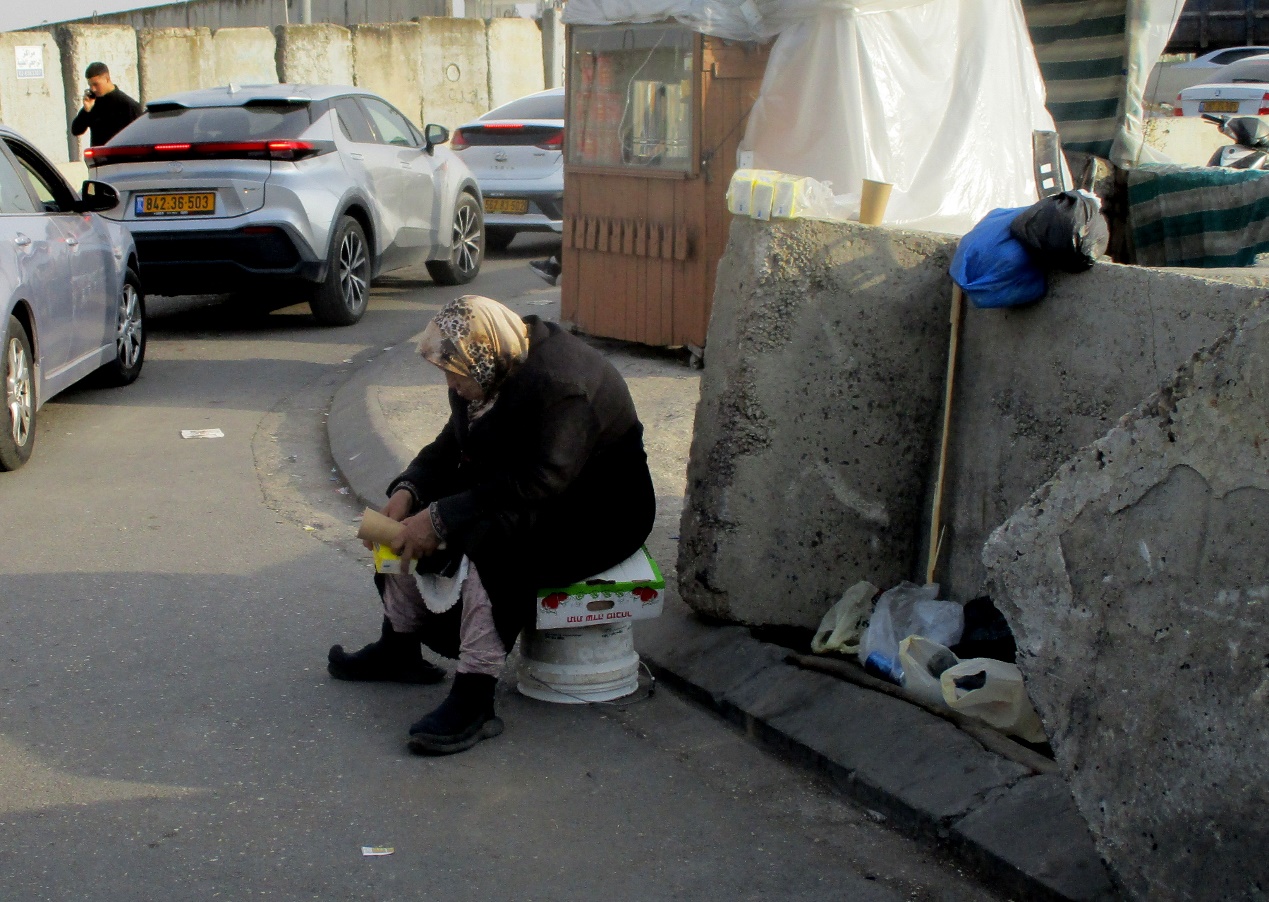 Tamar FleishmanOct-11-2026Qalandiya. Female Beggar
-
