
Qalandiya, Fri 26.11.10, Morning
Translation: Suzanne O.
Kalandiya
The situation at the roadblock this morning was clear from a distance because of the screeching of the female soldiers through the loud speakers and from the growling of the huge crowd.
Within the roadblock: many hundreds of Palestinians trying to cross into Jerusalem stand crowded together for many hours, the queues don't budge and no one knows when they will move, the growling arises from people talking among themselves, grumbling, babies crying, sighs from tired people, a few arguments, a few pleas, all taking place under the discordant shouting from the loud speakers; someone hearing them for the first time would imagine they are in a prison with inferior beings who need to be tamed.
Some 1000 people form queues of some kind: some lean, bent over, on walking sticks, hard working women burnt by the sun, parents holding babies above their heads so that they do not get squashed and men holding an arm up in the air with a burning cigarette between their fingers.
I try to find out why it is like this today, the crossing is either slow or non-existent: I am told that the computers are down; that there are not enough personnel; that the female soldiers are in a bad mood today, therefore the inspection is slow and deliberate; that the inspection is meticulous; that it is because maybe there is some kind of warning.
Everyone agrees that perhaps it is all right or none of it is right, because that is the purpose of the roadblock, to waste time and strength, to take charge, to control, to inspect, to abuse and to oppress, to strengthen separation and detachment, the isolation and the indignities meted out to the Palestinians.
In the final inspection lane in the chronicle of the roadblock, the aspect of indignities is most obvious in the preparation for removing belts, watches and jewellery and getting documents ready; one woman says: if anyone will give me the film from the security cameras I will enter it into a documentary competition under the section: human dignity. It is sure to win.
And indeed in this very lane before the exit, when each person has stood for hours, a noisy argument starts between the keepers of justice and right and the violent thugs and the good looking thugs. Those Palestinians who wish to keep their self respect under the eyes of the security cameras, prefer to give in, and more than once a person who is in the right is asked to give way, or another calls out: "Yes Arav Alana saraf" (Arabs keep your self respect). "We are not cattle", "Don't let us down in front of the female soldiers who surely enjoy seeing us argue among ourselves". The queuing is hard, the continual standing on your feet while the smell of urine pervades everywhere, the turnstiles that close in your face and separate a child from his parents, the final inspection is the pinnacle of all the activities at the roadblock when a relaxed, self satisfied female soldier asks an old woman, how old are you and then says don't tell lies, you're not 80 you are 78 years old, and another one screams at the mother of a mentally disabled child, "control him or I won't let you through". I saw a woman raise her arms in front of a window of a female soldier, as she shouted at her, "Arfi, Arfi", meaning that she wanted her to hold up her documents in front of the window but the woman was so scared and frightened that she raised her arms in the attitude of someone surrendering in the face of a weapon.
At 9:00 a.m. representatives of the Ecumenicals arrived, dispirited from their efforts to get the humanitarian gate open for those with medical permits for today, after many telephone calls made by them to Dalia Bassa, two soldiers accompanied by another two heavily armed soldiers arrived, conferred and made phone calls, made phone calls and conferred again and finally opened the gate for a few minutes, allowing about 20 people through, and then with expressions of distaste on their faces, retreated to the inspectors and the booths and the buildings. The look of distaste is because of the smell of urine against which they were not armed. Although the Ecumenicals' desire to help is understandable in the face of such hardship and at the very least their contact with Dalia B., benefitted a number of people, the absurd thing is that among the great throng there were old people almost collapsing over their walking sticks, disabled people on crutches, a blind person accompanied by his brother, a mother in great distress with her mentally disabled son, a deaf mute albino, sick people permanently in need of treatment who do not have specific permits for today. So there is a semblance of making an effort to be considerate of the needs of the population by the civilian administration.
The mutual need of some of the Palestinians and me to speak starts a conversation and a woman says: "See how a permit to pray becomes a permit to be freed from gaol, full of prohibitions and threats of punishment, just a prayer permit, just for Friday, just from 5:00 a.m. to 7:00 p.m., just for the area around Jerusalem, a picture of in black and white, and above it prohibitions from the list with three exclamation marks, not to be granted to anyone prohibited, no driving a car, a magnetic card is required".
Another woman tells me that she is from Gaza, a group of UNWRA employees obtained permits to attend a conference in Ramallah, they didn't all get them, three of them were prohibited and didn't come, and the permits themselves arrived after of months of negotiations on the subject. She was concerned that a female soldier might not feel like letting her through even though she has a permit, because she is from Gaza.
A man asked how long the journey from the roadblock to the mosque takes, he left Nablus at 5:00 a.m., it is now 11:00 a.m., and the prayer is in a short time. He still has at least another hour to go until he reaches the final checkpoint. Another man says that if the Palestinians give up the right to go to Jerusalem many Israelis will be very sorry, they will lose jobs and money, another interrupts and says Jerusalem must not be left to the Jews alone, he holds a copy of the newspaper 'el kuds' whose headline, spread across the whole front page, warns of the accelerated Judaisization of the Jordan Valley and Jerusalem and the destruction of a mosque on the West Bank.
Qalandiya Checkpoint / Atarot Pass (Jerusalem)
See all reports for this place-
Click here to watch a video from Qalandiya checkpoint up to mid 2019 Three kilometers south of Ramallah, in the heart of Palestinian population. Integrates into "Jerusalem Envelope" as part of Wall that separates between northern suburbs that were annexed to Jerusalem in 1967: Kafr Aqab, Semiramis and Qalandiya, and the villages of Ar-Ram and Bir Nabala, also north of Jerusalem, and the city itself. Some residents of Kafr Aqab, Semiramis and Qalandiya have Jerusalem ID cards. A terminal operated by Israel Police has functioned since early 2006. As of August 2006, northbound pedestrians are not checked. Southbound Palestinians must carry Jerusalem IDs; holders of Palestinian Authority IDs cannot pass without special permits. Vehicular traffic from Ramallah to other West Bank areas runs to the north of Qalandiya. In February 2019, the new facility of the checkpoint was inaugurated aiming to make it like a "border crossing". The bars and barbed wire fences were replaced with walls of perforated metal panels. The check is now performed at multiple stations for face recognition and the transfer of an e-card. The rate of passage has improved and its density has generally decreased, but lack of manpower and malfunctions cause periods of stress. The development and paving of the roads has not yet been completed, the traffic of cars and pedestrians is dangerous, and t the entire vicinity of the checkpoint is filthy. In 2020 a huge pedestrian bridge was built over the vehicle crossing with severe mobility restrictions (steep stairs, long and winding route). The pedestrian access from public transport to the checkpoint from the north (Ramallah direction) is unclear, and there have been cases of people, especially people with disabilities, who accidentally reached the vehicle crossing and were shot by the soldiers at the checkpoint. In the summer of 2021, work began on a new, sunken entrance road from Qalandiya that will lead directly to Road 443 towards Jerusalem and Tel Aviv. At the same time, the runways of the old Atarot airport were demolished and infrastructure was prepared for a large bus terminal. (updated October 2021)
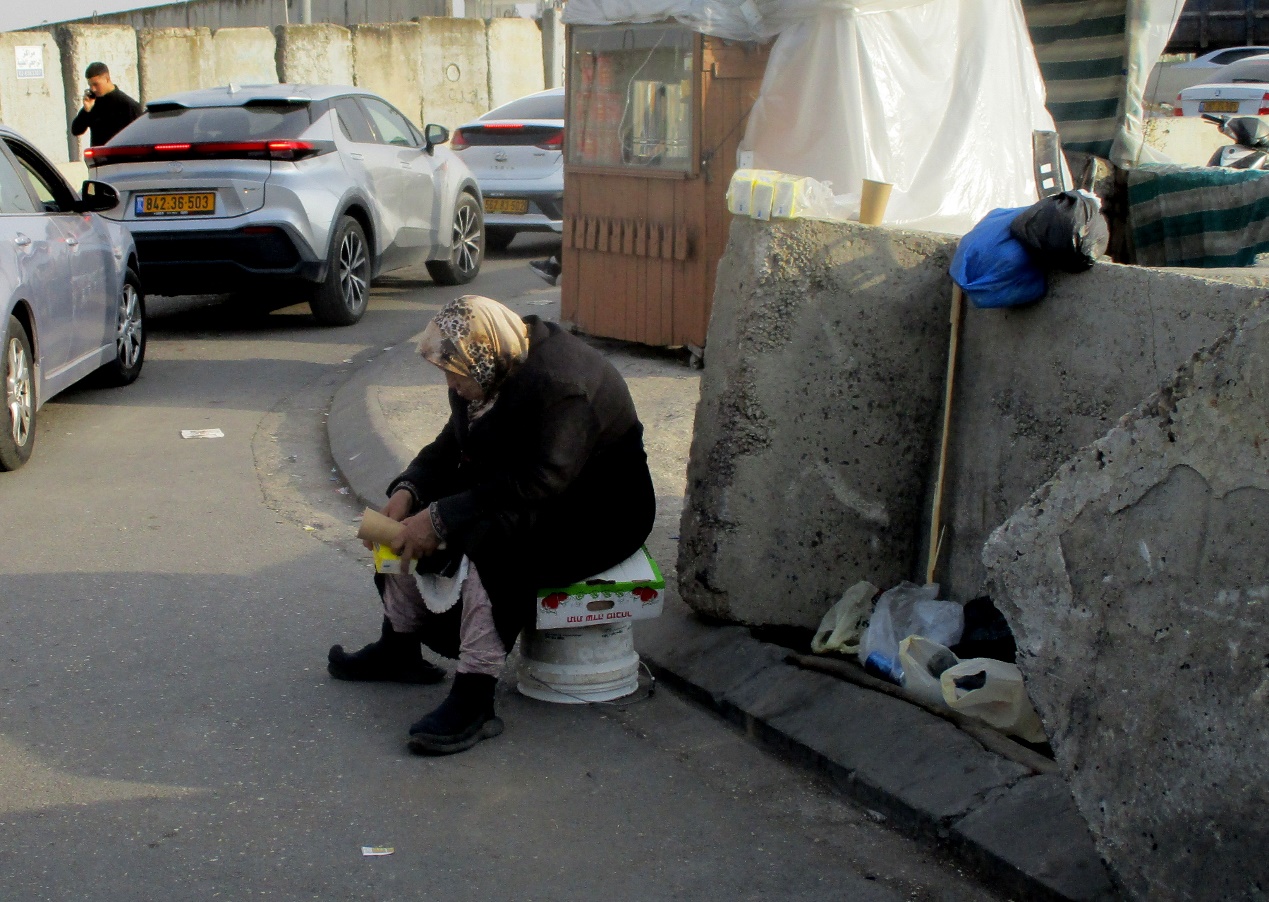 Tamar FleishmanOct-11-2026Qalandiya. Female Beggar
-
