
Qalandiya, Mon 16.7.12, Afternoon
Translation: Bracha B.A.
We left for the checkpoint with two guests, which gave the shift a different perspective. We were certain that nothing would happen and spent the way offering our guests short explanations. We did not get to Anta in the end and arrived via the old road between A-Ram and Qalandiya. We considered leaving the car on the Israeli side of the checkpoint, which would me we would have to return by way of the checkpoint or enter the parking lot. Despite a long traffic jam we arrived after 20 minutes and parked on the Palestinian side.
We gave our guests an explanation about the checkpoint and then entered the checkpoint. We encountered Palestinian children who were on their way to a sulha at Neveh Shalom – an integrated Arab-Israeli village. (See details here. Their escort asked us if we could help six of the children cross who had permits but who had not brought their kushan (registration certificates). The permits had pictures of the children, so it was not clear to me why a kushan was required as well.
I made a telephone call to the officer in charge of the permits at Qalandiya who came out to see us immediately. The children and their escort were allowed to cross within 20 minutes.
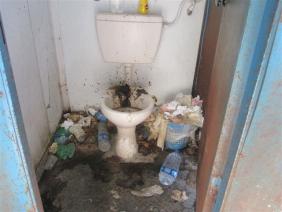
Another incident involved a Palestinian who had received a letter for "family unification" but the letter was in the system and he had to get a new magnetic card and fill out a form and pay NIS 40. He was brought to the Liaison and Coordination Administration, where they explained the procedure to him for the third time. We were pleased that our guests had an opportunity to see us in action. From there we visited the filthy restrooms and Netanya photographed the ones on the way to Ramallah.
We found a note on the windshield of our car in English and Arabic instructing us not to park our car in the checkpoint parking lot on Thursdays from 20:00 to 05:00 and that any car parked there would be towed. The note read "During the Holy Month of Ramadan" in Arabic.)
We drove by way of Jeba-Lil where we were surprised to see two Palestinians vehemently arguing with two soldiers. Their relatives who had been driving north were stopped at the checkpoint and their expensive jeep was parked on the side of the road parallel to the checkpoint. The people who had come with bottles of soft drinks discovered that their relatives were not there. Here we learned that if people were detained they must approach the Central Command since they are the ones responsible for finding out what happened to missing people. After about a half hour the central command answered and verified that the people had been detained for questioning, but refused to offer any information, except that they would either be released or arrested, after which the family would be notified. I would hate to be in that situation. It should be noted that there was traffic backed up on the road north of Qalandiya and there was a line of cars two kilometers long. At 18:00 we decided not to drive to Anta and to end the shift.
Qalandiya Checkpoint / Atarot Pass (Jerusalem)
See all reports for this place-
Click here to watch a video from Qalandiya checkpoint up to mid 2019 Three kilometers south of Ramallah, in the heart of Palestinian population. Integrates into "Jerusalem Envelope" as part of Wall that separates between northern suburbs that were annexed to Jerusalem in 1967: Kafr Aqab, Semiramis and Qalandiya, and the villages of Ar-Ram and Bir Nabala, also north of Jerusalem, and the city itself. Some residents of Kafr Aqab, Semiramis and Qalandiya have Jerusalem ID cards. A terminal operated by Israel Police has functioned since early 2006. As of August 2006, northbound pedestrians are not checked. Southbound Palestinians must carry Jerusalem IDs; holders of Palestinian Authority IDs cannot pass without special permits. Vehicular traffic from Ramallah to other West Bank areas runs to the north of Qalandiya. In February 2019, the new facility of the checkpoint was inaugurated aiming to make it like a "border crossing". The bars and barbed wire fences were replaced with walls of perforated metal panels. The check is now performed at multiple stations for face recognition and the transfer of an e-card. The rate of passage has improved and its density has generally decreased, but lack of manpower and malfunctions cause periods of stress. The development and paving of the roads has not yet been completed, the traffic of cars and pedestrians is dangerous, and t the entire vicinity of the checkpoint is filthy. In 2020 a huge pedestrian bridge was built over the vehicle crossing with severe mobility restrictions (steep stairs, long and winding route). The pedestrian access from public transport to the checkpoint from the north (Ramallah direction) is unclear, and there have been cases of people, especially people with disabilities, who accidentally reached the vehicle crossing and were shot by the soldiers at the checkpoint. In the summer of 2021, work began on a new, sunken entrance road from Qalandiya that will lead directly to Road 443 towards Jerusalem and Tel Aviv. At the same time, the runways of the old Atarot airport were demolished and infrastructure was prepared for a large bus terminal. (updated October 2021)
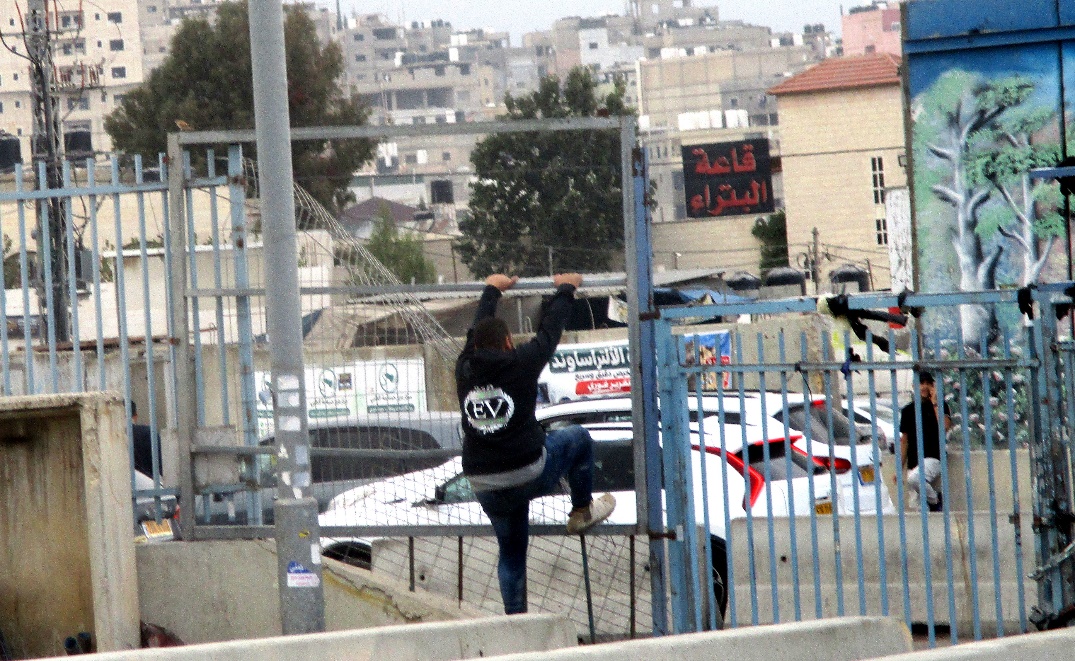 Tamar FleishmanOct-27-2026Qalandiya. Closure – Climbing over the fence
-
