
Qalandiya, Mon 25.2.13, Afternoon
4 pm to 5.15 pm
Many years ago when I went to Qalandiya for the first time I thought it was like the Wild West. Today I thought that again and also that the whole scene there is so surrealistic. I tried to take photographs and I don't know how much of that comes out but the sight of small children selling all sorts of balloon toys, windmills, prayer leaflets, etc. merging with the soldiers shooting what basically looked like tear gas , people trying to get past at the right moment so as not to be caught by the stone throwers or the retaliation of the army, the older men standing watching as one does at a movie set… the stone throwers are mainly the younger men. .I don't know what a person coming from a normal country would make of all this.
The bus route was closed and in the parking lot on the Israeli side were two police vehicles though the car lane seemed to be working efficiently and there were very few people at the checking booths. Hard to tell if it was because people were scared to go out or if many of the workers were at home because of Purim.
We met a reporter for El Kuds paper and he said that yesterday at Abu Dis where he has a store there was also stone throwing and tear gas and one of the soldiers had thrown a gas grenade into his store……..which means that many of his goods are no longer usable. One young man had told us that about 20 young men had been hurt but I think that was an exaggeration and the reporter also said he knew nothing of that. At any rate for the hour that we watched we did not see soldiers or stone throwers wounded although there is no telling what the tear gas did in areas which we did not see.
Look at image 5029….the child selling the balloon toys and his face half covered by the rifle of the soldier standing next to him is the one that strikes me most. The children were wandering round the soldiers with no signs of fear which again is surrealistic. I have often seen the child in this picture Each time I see him I think he has the saddest eyes of any child I have ever seen and I wonder what his family life is like. I have often heard that they are beaten if they come home without money. By the way the reporter from El Kuds said that he had written a report on the children but nothing that he knows of has been done for them.
5028 The woman covering her mouth from the gas and in the distance the clouds of gas
Other pictures show the young men on the hilltop too far away to do any damage but every now and then one of them would come running down to the main road and throw a stone……..not always making sure that he did not hit a Palestinian car.
At one stage when we were called by some taxi drivers to get into their car so as to get away from the gas one of them told us that he had not sent his children to school for the past few days. I asked him what sort of father the man was who sent the children whom we saw out to sell their toys knowing that there was more than a vague possibility of violence.
Brenda who has not been at Qalandiya for a while said that she came away feeling so saddened and near tears. I feel nothing. I am part of it and yet I am outside it. When she said that when she got home she was going to take a shower and put her clothes into the washing machine I remembered the years I had done just that. Tomorrow I will wear the same clothes as I am going to Hebron and then they also will go into the washing machine but maybe I have become apathetic over the years.


Qalandiya Checkpoint / Atarot Pass (Jerusalem)
See all reports for this place-
Click here to watch a video from Qalandiya checkpoint up to mid 2019 Three kilometers south of Ramallah, in the heart of Palestinian population. Integrates into "Jerusalem Envelope" as part of Wall that separates between northern suburbs that were annexed to Jerusalem in 1967: Kafr Aqab, Semiramis and Qalandiya, and the villages of Ar-Ram and Bir Nabala, also north of Jerusalem, and the city itself. Some residents of Kafr Aqab, Semiramis and Qalandiya have Jerusalem ID cards. A terminal operated by Israel Police has functioned since early 2006. As of August 2006, northbound pedestrians are not checked. Southbound Palestinians must carry Jerusalem IDs; holders of Palestinian Authority IDs cannot pass without special permits. Vehicular traffic from Ramallah to other West Bank areas runs to the north of Qalandiya. In February 2019, the new facility of the checkpoint was inaugurated aiming to make it like a "border crossing". The bars and barbed wire fences were replaced with walls of perforated metal panels. The check is now performed at multiple stations for face recognition and the transfer of an e-card. The rate of passage has improved and its density has generally decreased, but lack of manpower and malfunctions cause periods of stress. The development and paving of the roads has not yet been completed, the traffic of cars and pedestrians is dangerous, and t the entire vicinity of the checkpoint is filthy. In 2020 a huge pedestrian bridge was built over the vehicle crossing with severe mobility restrictions (steep stairs, long and winding route). The pedestrian access from public transport to the checkpoint from the north (Ramallah direction) is unclear, and there have been cases of people, especially people with disabilities, who accidentally reached the vehicle crossing and were shot by the soldiers at the checkpoint. In the summer of 2021, work began on a new, sunken entrance road from Qalandiya that will lead directly to Road 443 towards Jerusalem and Tel Aviv. At the same time, the runways of the old Atarot airport were demolished and infrastructure was prepared for a large bus terminal. (updated October 2021)
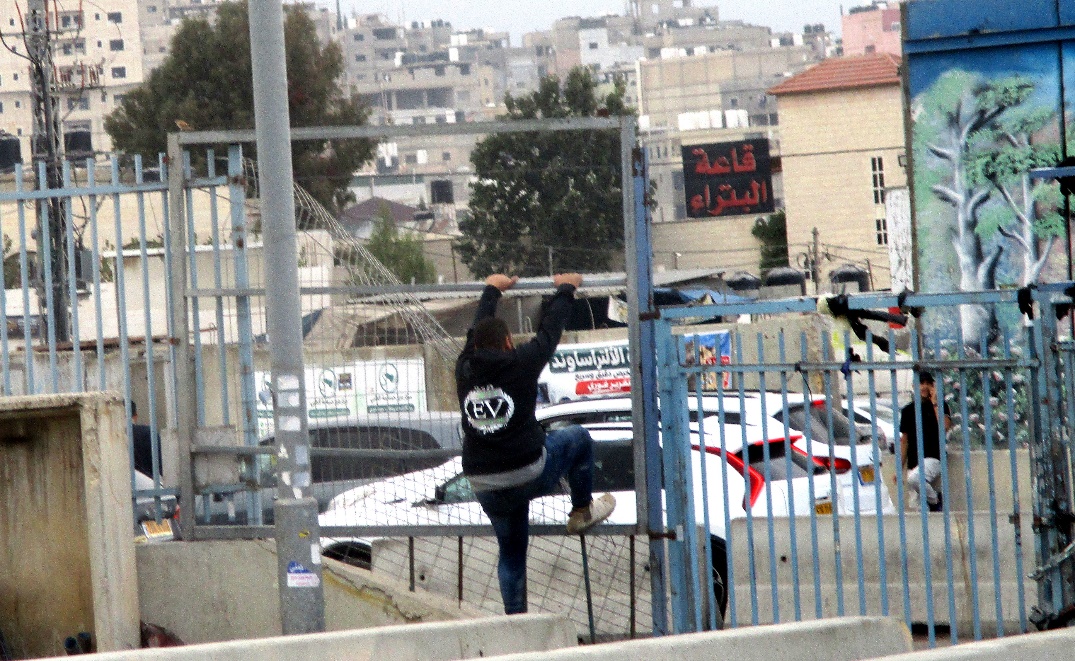 Tamar FleishmanOct-27-2026Qalandiya. Closure – Climbing over the fence
-
