
Qalandiya, Mon 30.4.12, Afternoon
Two ambulances were waiting in the parking lot at the southern entrance to Qalandiya CP. Natanya got out of the car to find out what was happening while I went to park. It turned out that all was under control – one Palestinian ambulance was delivering two patients to the two Israeli ones. One of the ambulance drivers, who came from Bethlehem, asked to forward his appreciation to MW saying that there were fewer problems when MW women were on duty at the CP.
From afar we could see a fairly large line of people waiting in the queue for bus passengers. We thought that such a line was a bad sign, but conditions in the pedestrian CP were not so bad. Actually, things would not have been so bad if the (female) soldiers on duty in the “aquariums” had been working efficiently. People on line in Passageway 4 told us that they could see the soldiers talking and horsing around instead of working seriously. In the end, it turned out that there were problems with the computer and the soldiers asked for help. The person sent to administer the help was the medic (apparently some of his patients are computers). They soon gave up on the patient and moved to another computer, transferring all those on line in Passageway 4 as well. But the 2 soldiers continued to talk and gossip and the line made very slow progress. In the end we did get through to the Jerusalem side where we met up with the medic and his guard. We asked them how the soldiers were “instructed” to “serve” the Palestinians passing through the CP. The word “serve” didn’t bother them but they told us that soldiers bring their “attitudes” from home with them when they enter the army, as if there is nothing to be done about the “anti” behavior. And we all know that a little education and motivation can help a lot – so why isn’t some effort invested in changing behavior?
We returned to the northern side of the CP. On the way we stopped to peer into the aquarium in Passageway 1 where another 2 female soldiers were checking the people through to Jerusalem. One of them was looking at their ID cards while the other, who was presumably supposed to be looking at the x-ray machine photos of their packages, was busy filling out some form. On the table next to her was a selection of Sudoku and crossword puzzles from the newspaper. Not once did she look up at the screen showing the contents of the packages.
When we left the CP we saw an ambulance waiting in the northern parking lot. The patient in the ambulance needed dialysis treatment and was trying to reach Hadassah Hospital in Ein Karem. But his family had not made the necessary arrangements, so there was no way! Even Yael S., whom we phoned for help, couldn’t manage the impossible. In the end the patient and the man accompanying him (both of whom had permits to enter Israel) decided to try their luck at another CP. They took a taxi and drove off. We gave them our phone number (should we be able to be of help), but we never heard from them so we’re hoping that they managed to get to the hospital in time.
Last week we forgot to mention the help given by Hannah Barag in contacting Officer Alaa who helped the woman with her three children pass through the CP. Thanks Hannah!
Qalandiya Checkpoint / Atarot Pass (Jerusalem)
See all reports for this place-
Click here to watch a video from Qalandiya checkpoint up to mid 2019 Three kilometers south of Ramallah, in the heart of Palestinian population. Integrates into "Jerusalem Envelope" as part of Wall that separates between northern suburbs that were annexed to Jerusalem in 1967: Kafr Aqab, Semiramis and Qalandiya, and the villages of Ar-Ram and Bir Nabala, also north of Jerusalem, and the city itself. Some residents of Kafr Aqab, Semiramis and Qalandiya have Jerusalem ID cards. A terminal operated by Israel Police has functioned since early 2006. As of August 2006, northbound pedestrians are not checked. Southbound Palestinians must carry Jerusalem IDs; holders of Palestinian Authority IDs cannot pass without special permits. Vehicular traffic from Ramallah to other West Bank areas runs to the north of Qalandiya. In February 2019, the new facility of the checkpoint was inaugurated aiming to make it like a "border crossing". The bars and barbed wire fences were replaced with walls of perforated metal panels. The check is now performed at multiple stations for face recognition and the transfer of an e-card. The rate of passage has improved and its density has generally decreased, but lack of manpower and malfunctions cause periods of stress. The development and paving of the roads has not yet been completed, the traffic of cars and pedestrians is dangerous, and t the entire vicinity of the checkpoint is filthy. In 2020 a huge pedestrian bridge was built over the vehicle crossing with severe mobility restrictions (steep stairs, long and winding route). The pedestrian access from public transport to the checkpoint from the north (Ramallah direction) is unclear, and there have been cases of people, especially people with disabilities, who accidentally reached the vehicle crossing and were shot by the soldiers at the checkpoint. In the summer of 2021, work began on a new, sunken entrance road from Qalandiya that will lead directly to Road 443 towards Jerusalem and Tel Aviv. At the same time, the runways of the old Atarot airport were demolished and infrastructure was prepared for a large bus terminal. (updated October 2021)
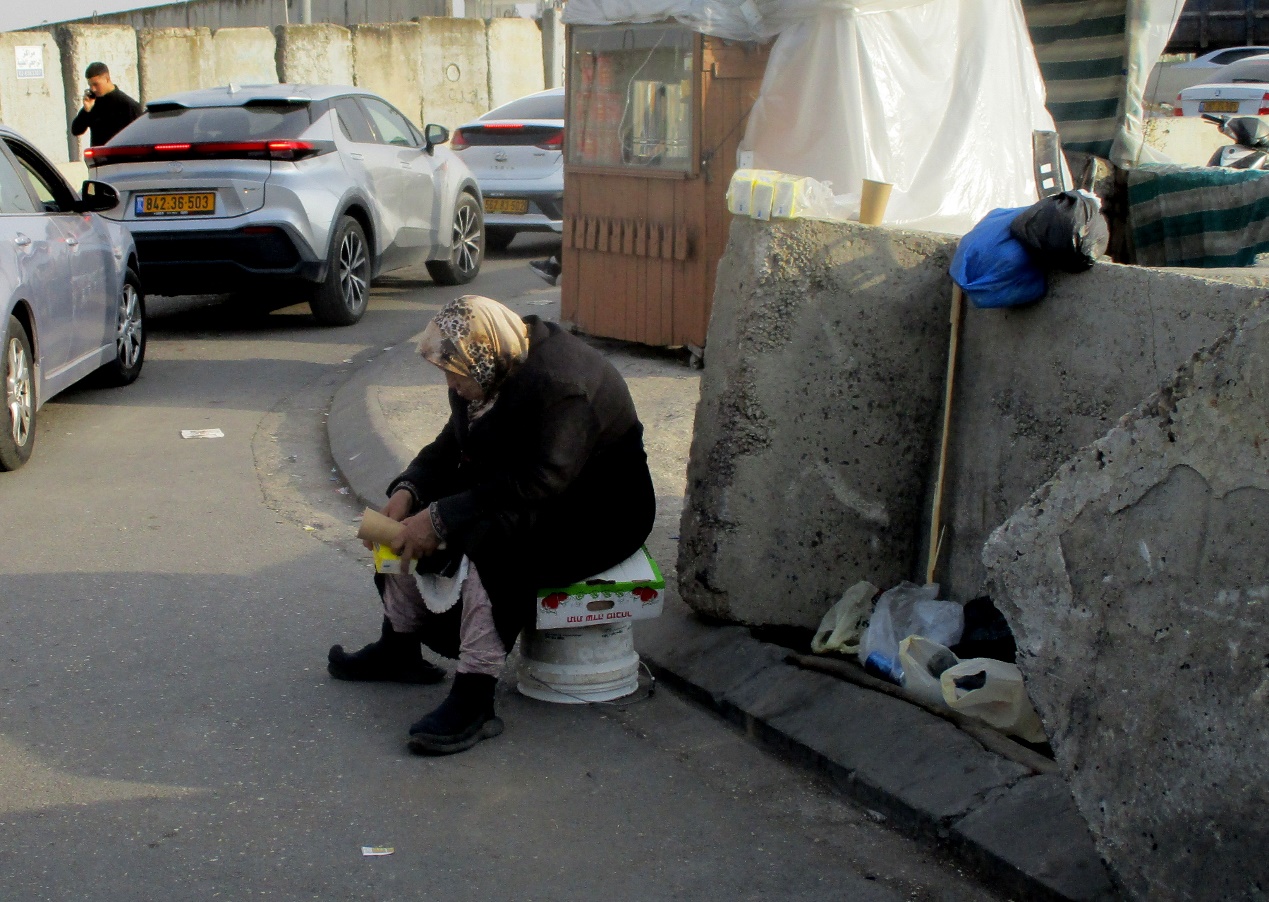 Tamar FleishmanOct-11-2026Qalandiya. Female Beggar
-
