
Qalandiya - Mustafa is detained on his way to his new-born son in hospital

The last time armed agents of the ruling power destroyed the fruit stand that was Abdallah’s source of livelihood was last August.
Of the stand, situated on one of the junction corners, only shards remain.
First Abdallah withdrew at home in despair, but very quickly took himself in stride – after all, bread must be brought to the family table and expenses are steep, just rent and school fees for two of his children amount to over two thousand shekel, before food is even mentioned.
Abdallah began to work as a Hebron-fruit provider for shops and stands in Ramallah, but his debtors list grew and grew.
Again he had no other choice, and created a kind of stand where he stands at the crossroads and does what he knows best, selling the season’s fruit, baladi (local) as he calls them. This time the stand is smaller, more modest, located at another corner of the junction and Abdallah hopes that they, the armed Civil Administration or municipality agents who would raid his stand twice a year, will let him pass this summer in peace.
***
For hours, Mustafa was stuck between here and there, waiting for the bureaucratic maze to be solved so that he would be permitted to take the few steps across the checkpoint and continue on his way to see his tiny new-born son who lies alone in Al Makassad Hospital in East Jerusalem, an 18-day-old baby born prematurely, who does not know that he is alone nor when any of his parents will come to sit beside him, caress and care for him.
The inspection booth personnel did not allow the man to cross the checkpoint, and his fatherly conscience would not allow him to go back.
So Mustafa stood, as if planted on the spot, leaned on the wall and waited. From time to time he would look at his cell phone screen, at his son’s pictures. He presented them to me as well, and allowed me to take a photo.
The phone also contains the transit permit he received from the authorities that morning, but a bureaucratic mishap occurred and the permit was not posted on the checkpoint computer, so the father was refused.
It would take some moments to fix this, they said, but the moments turned into hours, and more hours.
- Not long ago, a Red Crescent medical team member told me that bureaucratic procedure has become much tighter during the past month. When he said this, I did not know whether he was right, but Mustafa’s case – his helplessness and the photo of his helpless son – proved that I had been told the truth.
- And as always, I wonder why the secret Security Services are involved in medical cases and why a father is detained for whatever reason from sitting by his son in the hospital?
Qalandiya Checkpoint / Atarot Pass (Jerusalem)
See all reports for this place-
Click here to watch a video from Qalandiya checkpoint up to mid 2019 Three kilometers south of Ramallah, in the heart of Palestinian population. Integrates into "Jerusalem Envelope" as part of Wall that separates between northern suburbs that were annexed to Jerusalem in 1967: Kafr Aqab, Semiramis and Qalandiya, and the villages of Ar-Ram and Bir Nabala, also north of Jerusalem, and the city itself. Some residents of Kafr Aqab, Semiramis and Qalandiya have Jerusalem ID cards. A terminal operated by Israel Police has functioned since early 2006. As of August 2006, northbound pedestrians are not checked. Southbound Palestinians must carry Jerusalem IDs; holders of Palestinian Authority IDs cannot pass without special permits. Vehicular traffic from Ramallah to other West Bank areas runs to the north of Qalandiya. In February 2019, the new facility of the checkpoint was inaugurated aiming to make it like a "border crossing". The bars and barbed wire fences were replaced with walls of perforated metal panels. The check is now performed at multiple stations for face recognition and the transfer of an e-card. The rate of passage has improved and its density has generally decreased, but lack of manpower and malfunctions cause periods of stress. The development and paving of the roads has not yet been completed, the traffic of cars and pedestrians is dangerous, and t the entire vicinity of the checkpoint is filthy. In 2020 a huge pedestrian bridge was built over the vehicle crossing with severe mobility restrictions (steep stairs, long and winding route). The pedestrian access from public transport to the checkpoint from the north (Ramallah direction) is unclear, and there have been cases of people, especially people with disabilities, who accidentally reached the vehicle crossing and were shot by the soldiers at the checkpoint. In the summer of 2021, work began on a new, sunken entrance road from Qalandiya that will lead directly to Road 443 towards Jerusalem and Tel Aviv. At the same time, the runways of the old Atarot airport were demolished and infrastructure was prepared for a large bus terminal. (updated October 2021)
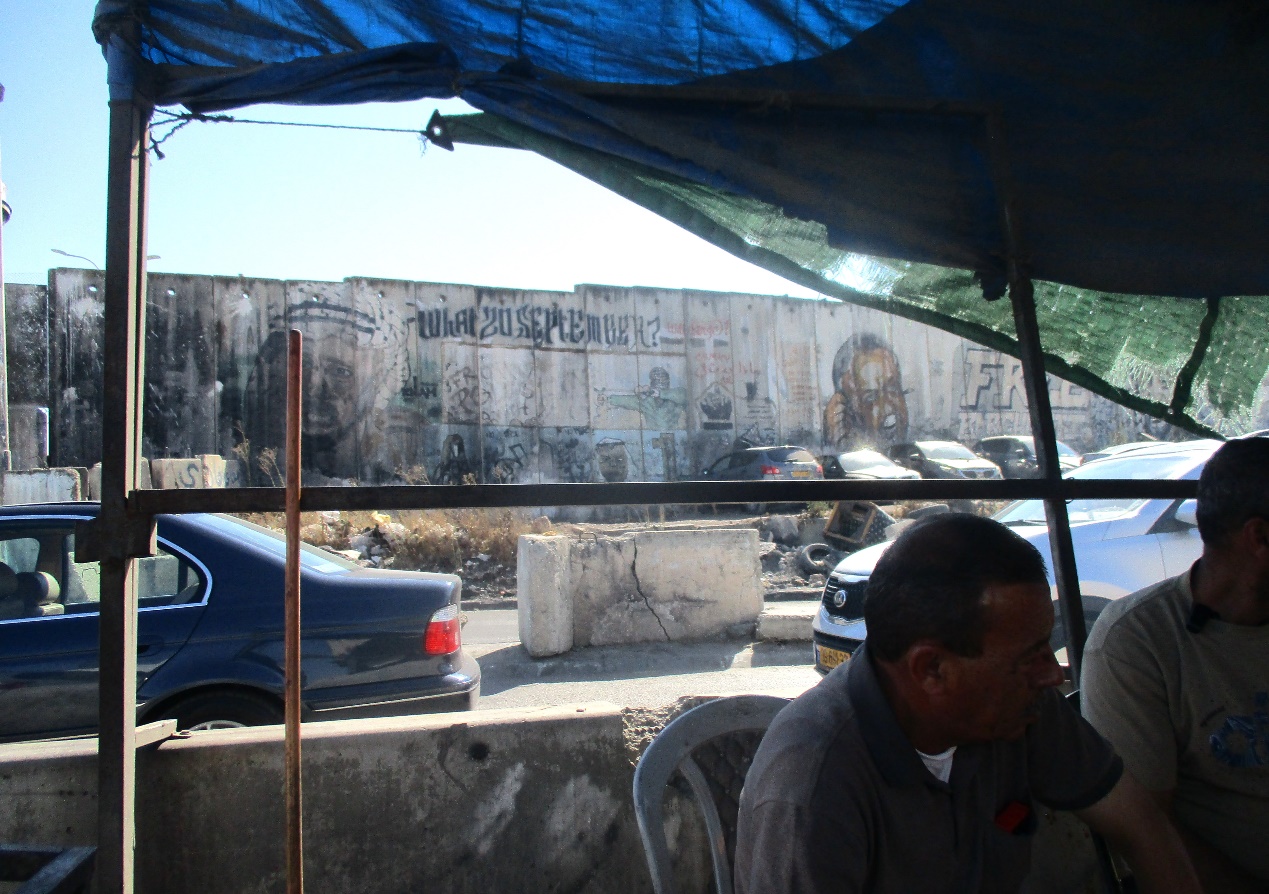 Tamar FleishmanJul-21-2026Qalandiya. Conversation in the shadow of the wall
-
