
Qalandiya - no queues, no delays
A ‘reasonable’ morning in Qalandiya. We continue to park on the Palestinian side because due to the works on the Israeli side there is no place to park there. We arrived around six. Our first stop is at our friend Abu Ramzi, the pretzel seller. He is fine, but his mood has been low since his wife’s death. It’s hard to live without a wife, he says.
Near him there is a falafel stand with other foods that operates as usual, then the kiosk and after that stands the cake seller. In the nearby square, there is now another kiosk, in the place where there was an old fruit and vegetable stand, which used to open later, and which the city inspectors destroyed a few months ago.
In the checkpoint complex itself, there were no queues under the shed or outside it during our entire stay. The three entrances were open all the time and the many people who arrived entered immediately without delay. This time, too, the woman arrived with the toddler in a stroller. She went to the stand next to the gate that could be opened to the passage without turnstiles and rang the phone. We went over to talk to her. She said that the boy is sick and she goes with him twice a week for treatment. We asked whom she was calling, did she have the phone number of someone at the checkpoint who should come to open it? It turns out that she calls the (Jewish) driver who is waiting for her on the Israeli side and drives them to the hospital (probably from The Road to Recovery). He is the one who has contact with the necessary people inside the checkpoint. After a few minutes, a security guard came from another direction and opened the gate for her. We saw a new yellow note on the gate that said it is a humanitarian transition for the sick.


The flow of people continued as usual both from the entrance to the checkpoint complex from the east and of young people climbing the fence from the direction of Qalandiya. Everyone entered immediately. But one of the people turns to us and says that two days ago there were queues that reached outside the entire checkpoint complex. We asked if this was due to a lack of soldiers inside and the answer was: “There are soldiers, but they are not helping.” After he moved inside he called us from inside. I approached the carousel and saw that inside the hall was indeed very busy. Nevertheless, at no point did queues accumulate outside.
A little before seven I entered the checkpoint. Out of six checkpoints, five were open. The queues in front of them were short and within a few minutes, I passed. On the Israeli side, I watched from the bridge towards the works on the underpass, the bus parking lot and the bus terminal. The stations are covered, but the road from the bridge to them is not covered. A modern toilet building was placed at the end of the terminal (station area). Next time I may go down and check if this is indeed active.


When we got back to the car, we took pictures from the parking lot of the new road that was paved parallel to the existing road, where at this time the traffic in the direction of the vehicle barrier is sluggish. We drove through A-Ram towards the Jabba Binyamin intersection (Adam). When we got into the car, the news began to arrive about the attack at the entrance to Jerusalem. Before the intersection, the Jabba temporary checkpoint was manned and the soldiers photographed the Palestinian vehicles that passed by. After the checkpoint, we reached the intersection and turned to return to Jerusalem through Hizmeh. The traffic situation up to the Hizmeh checkpoint was reasonable, but the usual morning traffic jams started from Pisgat Zeev and later, due to the attack, they were even longer than usual.
Qalandiya Checkpoint / Atarot Pass (Jerusalem)
See all reports for this place-
Click here to watch a video from Qalandiya checkpoint up to mid 2019 Three kilometers south of Ramallah, in the heart of Palestinian population. Integrates into "Jerusalem Envelope" as part of Wall that separates between northern suburbs that were annexed to Jerusalem in 1967: Kafr Aqab, Semiramis and Qalandiya, and the villages of Ar-Ram and Bir Nabala, also north of Jerusalem, and the city itself. Some residents of Kafr Aqab, Semiramis and Qalandiya have Jerusalem ID cards. A terminal operated by Israel Police has functioned since early 2006. As of August 2006, northbound pedestrians are not checked. Southbound Palestinians must carry Jerusalem IDs; holders of Palestinian Authority IDs cannot pass without special permits. Vehicular traffic from Ramallah to other West Bank areas runs to the north of Qalandiya. In February 2019, the new facility of the checkpoint was inaugurated aiming to make it like a "border crossing". The bars and barbed wire fences were replaced with walls of perforated metal panels. The check is now performed at multiple stations for face recognition and the transfer of an e-card. The rate of passage has improved and its density has generally decreased, but lack of manpower and malfunctions cause periods of stress. The development and paving of the roads has not yet been completed, the traffic of cars and pedestrians is dangerous, and t the entire vicinity of the checkpoint is filthy. In 2020 a huge pedestrian bridge was built over the vehicle crossing with severe mobility restrictions (steep stairs, long and winding route). The pedestrian access from public transport to the checkpoint from the north (Ramallah direction) is unclear, and there have been cases of people, especially people with disabilities, who accidentally reached the vehicle crossing and were shot by the soldiers at the checkpoint. In the summer of 2021, work began on a new, sunken entrance road from Qalandiya that will lead directly to Road 443 towards Jerusalem and Tel Aviv. At the same time, the runways of the old Atarot airport were demolished and infrastructure was prepared for a large bus terminal. (updated October 2021)
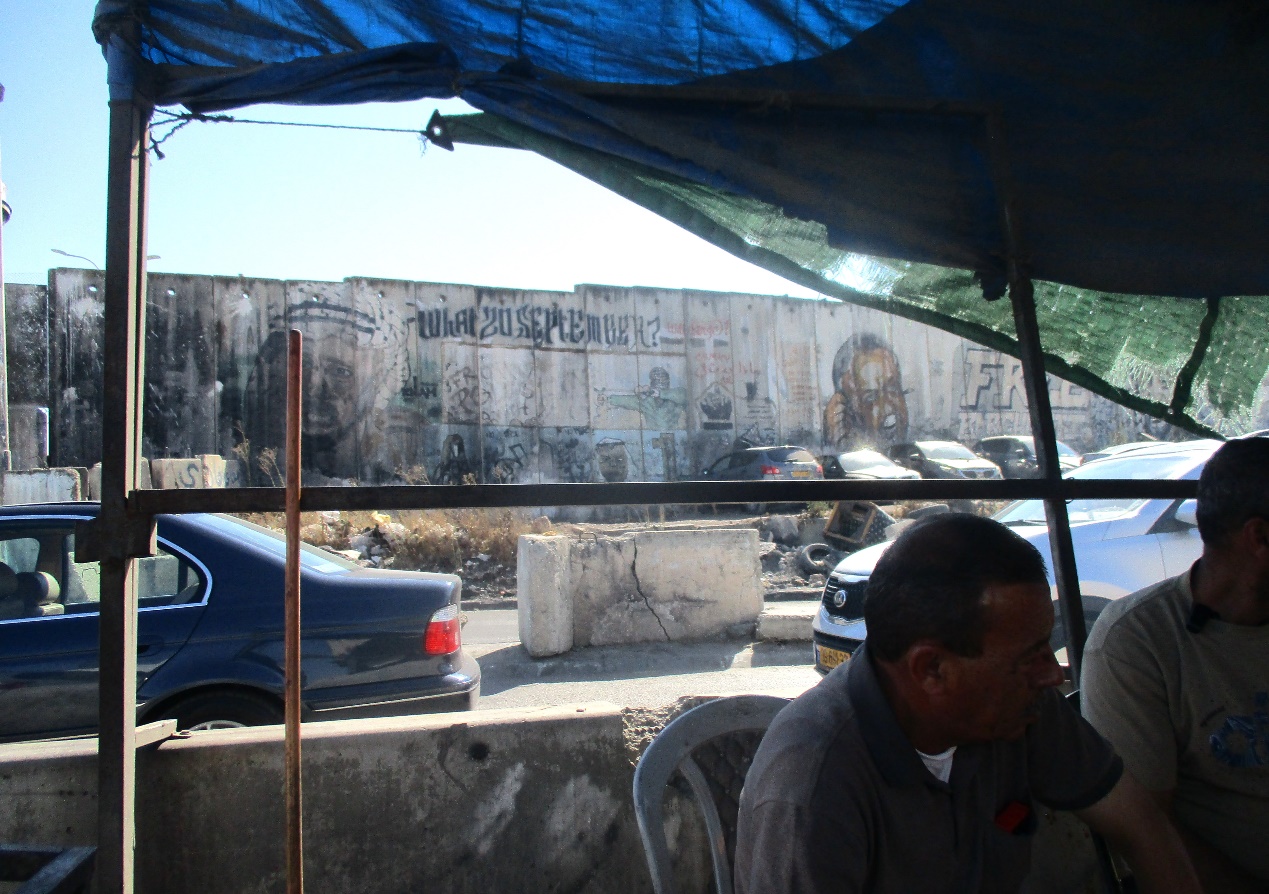 Tamar FleishmanJul-21-2026Qalandiya. Conversation in the shadow of the wall
-
