
Qalandiya - Opening of the new checkpoint
This morning we did not come for a regular watch, for health reasons. It turned out that this was the last morning of the old checkpoint. At about 11 o’clock the new one was to open. Liora and I had come to meet people who were appealing for permits, and decided to come on foot so as to see the wonders…
Already on the way to the checkpoint we saw groups of soldiers, journalists and photographers invited in honour of the occasion. They stood in the square in front of the checkpoint and afterwards next to the fence, where soldiers explained to them what was happening.
We entered via the old checkpoint and found it empty and deserted. At the kiosk next to the shed we met Iman, Muhammad and others moving its contents to the new kiosk they had erected at the entrance to the new checkpoint. A big notice proclaims the new checkpoint, and next to it another gives details of opening hours and services of the D.C.O., government ministries, Post Office.
Journalists have arrived here, and received explanations, and took photographs.
The entrance is wide and good, and on the right hand side is a toilet building. We did not check if it was open to the public (In the old checkpoint there was a filthy, smelly one – which had been locked for almost a year). The soldiers we spoke to later said that the toilets would be open. We will check next week.
At the start of the checkpoint there are a few entrances. One enters a short ‘slalom’ between perforated white metal walls to reach the first turnstile. On the right of the entrance is door through which one could enter. While we were there a man arrived in a wheelchair and the policeman opened the door for him.
The sign above the entrance says (translated freely) “Please keep the checkpoint clean, which has been erected for you and your convenience and to facilitate service.”
After passing the turnstile one waits in line, which was now short, for another turnstile, and then one reaches the passage through the magnometer and screening machine. Between the stations there is a cubicle where soldiers sit, checking the screen. We gave them welcome greetings. Today everyone is smiling and satisfied – let’s hope it remains like this. Here, too, next to the turnstile there is a door one can pass through. A woman soldier let the journalists through it, and let us also pass. But we wanted to use the route where Palestinians pass, so we waited a little more at the turnstile. After the screening there is another turnstile. After passing it, one reaches the true “wonder” – electronic checking stations.
We were told there are 20 such checking stations. Every Palestinian who has a magnetic card and permit can pass through them. He inserts his card, as one does a Rav-Kav on entering a train. A camera photographs him, thus identifying him and the turnstile opens automatically.
All the journalists waited with their cameras for a Palestinian to come and pass.
Whoever does not have a magnetic card passes a manned station.
In honour of the opening all is open and full of soldiers, police, journalists and photographers. If we understood correctly, on normal days there is a division between the stations that lead to Jerusalem and those leading to the D.C.O. and various offices. After the passage there is a direction sign on the floor.
We went towards the left. There is an entrance towards the Ministry of the Interior and the Post Office. One reaches them via a bridge. Presumably here, too, there is a bypass.
The exit towards Jerusalem is via the old checkpoint, in the section after the checking stations, and we reached the final turnstile that we always used in the past (always open). The soldiers who exited with us were amazed to hear us say, that in spite of welcoming the innovations, the best would be to have no checkpoints at all… Strange women, these!
Qalandiya Checkpoint / Atarot Pass (Jerusalem)
See all reports for this place-
Click here to watch a video from Qalandiya checkpoint up to mid 2019 Three kilometers south of Ramallah, in the heart of Palestinian population. Integrates into "Jerusalem Envelope" as part of Wall that separates between northern suburbs that were annexed to Jerusalem in 1967: Kafr Aqab, Semiramis and Qalandiya, and the villages of Ar-Ram and Bir Nabala, also north of Jerusalem, and the city itself. Some residents of Kafr Aqab, Semiramis and Qalandiya have Jerusalem ID cards. A terminal operated by Israel Police has functioned since early 2006. As of August 2006, northbound pedestrians are not checked. Southbound Palestinians must carry Jerusalem IDs; holders of Palestinian Authority IDs cannot pass without special permits. Vehicular traffic from Ramallah to other West Bank areas runs to the north of Qalandiya. In February 2019, the new facility of the checkpoint was inaugurated aiming to make it like a "border crossing". The bars and barbed wire fences were replaced with walls of perforated metal panels. The check is now performed at multiple stations for face recognition and the transfer of an e-card. The rate of passage has improved and its density has generally decreased, but lack of manpower and malfunctions cause periods of stress. The development and paving of the roads has not yet been completed, the traffic of cars and pedestrians is dangerous, and t the entire vicinity of the checkpoint is filthy. In 2020 a huge pedestrian bridge was built over the vehicle crossing with severe mobility restrictions (steep stairs, long and winding route). The pedestrian access from public transport to the checkpoint from the north (Ramallah direction) is unclear, and there have been cases of people, especially people with disabilities, who accidentally reached the vehicle crossing and were shot by the soldiers at the checkpoint. In the summer of 2021, work began on a new, sunken entrance road from Qalandiya that will lead directly to Road 443 towards Jerusalem and Tel Aviv. At the same time, the runways of the old Atarot airport were demolished and infrastructure was prepared for a large bus terminal. (updated October 2021)
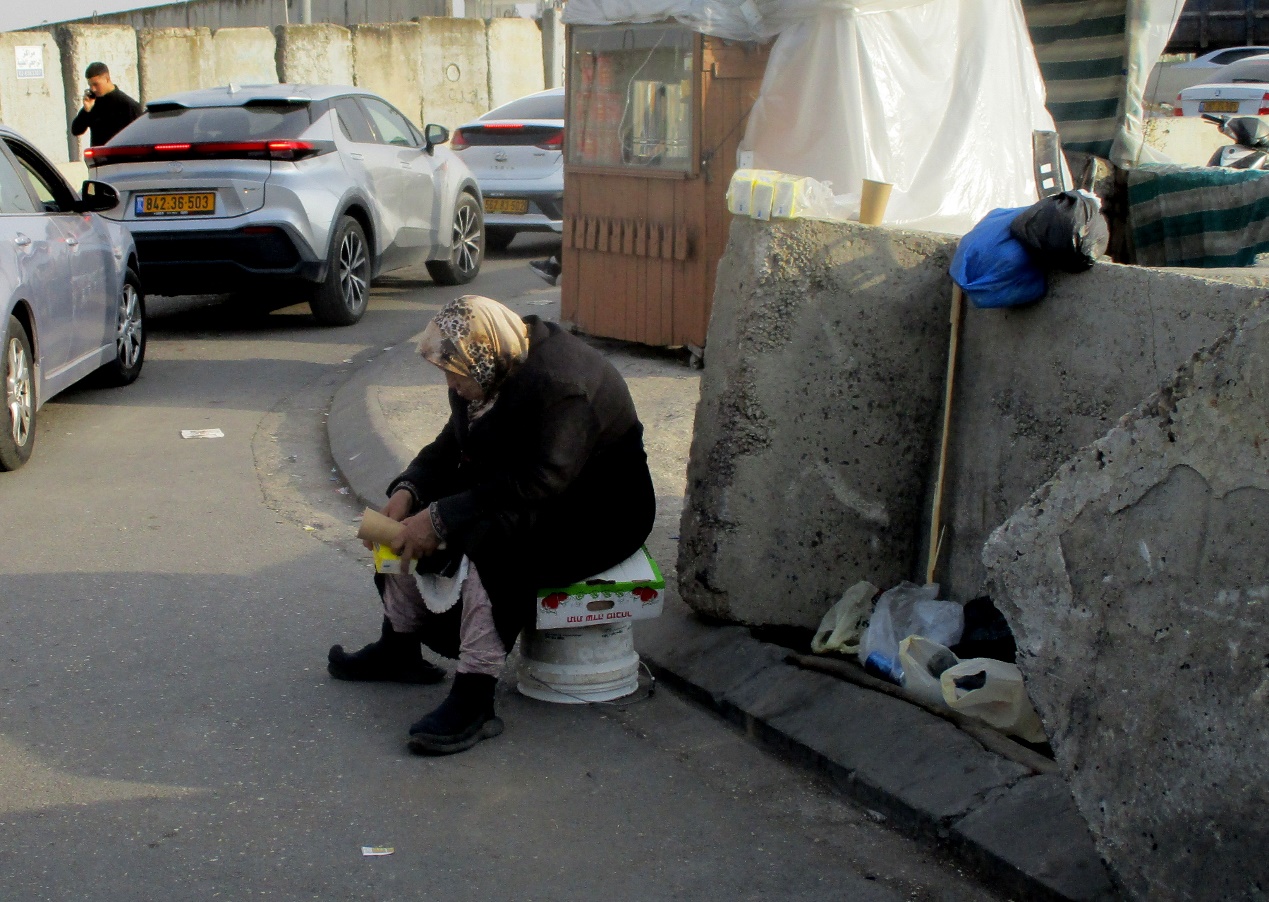 Tamar FleishmanOct-11-2026Qalandiya. Female Beggar
-
