
Qalandiya: Outside the Ivory Towers, Reality Between the Wall and Apartheid
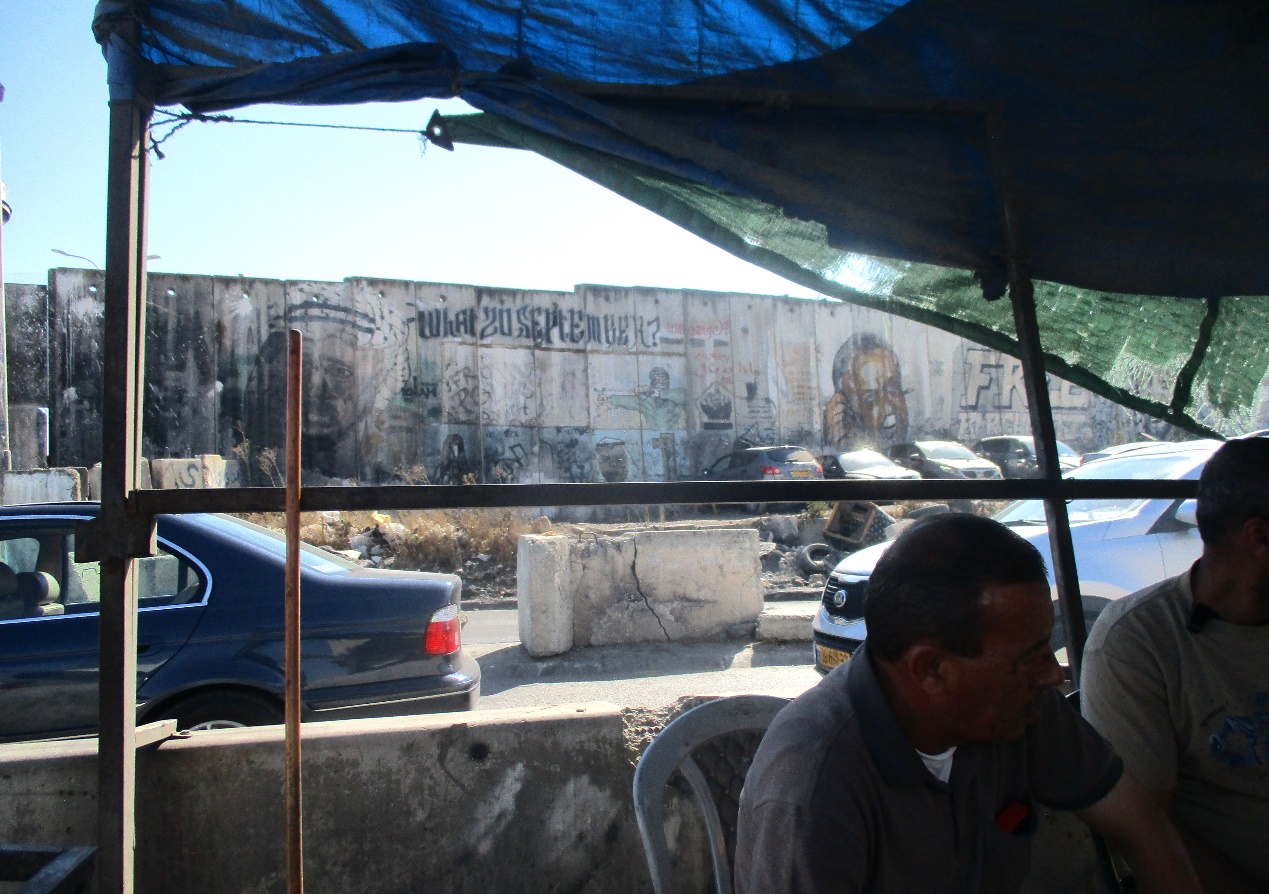
“Whoever calls the State of Israel an apartheid state, has no right to be in the State of Israel”, Chief Justice Stein stated.
On a hot, steamy day, this statement urged me to get to a part of the country that has no part in the State of Israel – a part of the country that is the wild part of life, to the company of people whose lives since October 7, 2023 are in suffocating closure, who are struggling for their mere existence.
The people I met are not bothered by statements of this ignorant chief justice. They are concerned with their own hardships and those of their family members, with the question whether they would have enough money to buy food to quieten the hunger of their children. They struggle with two weighty authorities – on the one hand the legal and procedural weight of the State of Israel, and on the other the ever-increasing weight of the Palestinian Authority because of its loss of tax money which it should be getting by Israeli law and which Israel is not transferring so the civilians are being taxed for every marginal detail.
“I have made only 50 shekels since this morning” said a taxi driver waiting in vain for passengers. “Just gas and cigarettes, and then not enough money for food. Only God can help us” said the man whose only recourse now is to trust God.
The wall that separates societies, the people who risk their lives in order to cross it, hoping to land safely without being killed or arrested, whose goal is to get to a place where they can eke out even a bit of a living – the difference between our blood, masters of this universe, and their blood, the oppressed and occupied, not counted as humans at all – is all paraphrased by George Orwell: “All ‘people’ are equal, but some are more equal than others”.
All of this and more are a call as it were to the Chief Justice and his buddies, to come here clean-handed, see reality with their own eyes and then go back to their ivory tower and come to conclusions.
If this is not apartheid – then there is no apartheid at all in this world!
And besides – a child, about 8-years-old, lay on the sidewalk in the shade of the wall enclosing the checkpoint, resting from the heat and from chasing clients to whom he had offered his measly wares.
When he noticed me, he stood up and his face lit up, asking whether I brought him his portrait which I had photographed in our last meeting. I nodded my head, and even before I took out the photo envelope, the child was already jumping up and down and clapping.
So little is needed to lighten the day of these stricken, miserable children…

Location Description
Qalandiya Checkpoint / Atarot Pass (Jerusalem)
See all reports for this place-
Click here to watch a video from Qalandiya checkpoint up to mid 2019 Three kilometers south of Ramallah, in the heart of Palestinian population. Integrates into "Jerusalem Envelope" as part of Wall that separates between northern suburbs that were annexed to Jerusalem in 1967: Kafr Aqab, Semiramis and Qalandiya, and the villages of Ar-Ram and Bir Nabala, also north of Jerusalem, and the city itself. Some residents of Kafr Aqab, Semiramis and Qalandiya have Jerusalem ID cards. A terminal operated by Israel Police has functioned since early 2006. As of August 2006, northbound pedestrians are not checked. Southbound Palestinians must carry Jerusalem IDs; holders of Palestinian Authority IDs cannot pass without special permits. Vehicular traffic from Ramallah to other West Bank areas runs to the north of Qalandiya. In February 2019, the new facility of the checkpoint was inaugurated aiming to make it like a "border crossing". The bars and barbed wire fences were replaced with walls of perforated metal panels. The check is now performed at multiple stations for face recognition and the transfer of an e-card. The rate of passage has improved and its density has generally decreased, but lack of manpower and malfunctions cause periods of stress. The development and paving of the roads has not yet been completed, the traffic of cars and pedestrians is dangerous, and t the entire vicinity of the checkpoint is filthy. In 2020 a huge pedestrian bridge was built over the vehicle crossing with severe mobility restrictions (steep stairs, long and winding route). The pedestrian access from public transport to the checkpoint from the north (Ramallah direction) is unclear, and there have been cases of people, especially people with disabilities, who accidentally reached the vehicle crossing and were shot by the soldiers at the checkpoint. In the summer of 2021, work began on a new, sunken entrance road from Qalandiya that will lead directly to Road 443 towards Jerusalem and Tel Aviv. At the same time, the runways of the old Atarot airport were demolished and infrastructure was prepared for a large bus terminal. (updated October 2021)
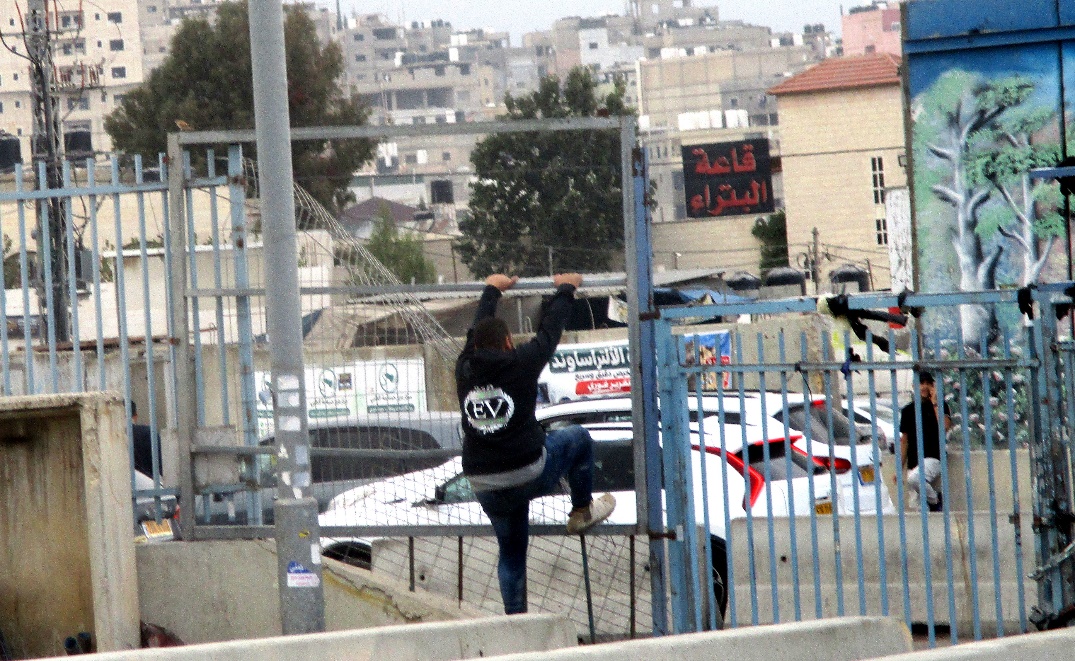 Tamar FleishmanOct-27-2026Qalandiya. Closure – Climbing over the fence
-
