
Qalandiya - relaxing background music is played out of the speakers
A Checkpoint with Muzak
After parking in the new pay lot at 6:15, we met Adam Rasgon of the Times of Israel (who had arrived earlier to interview Palestinians in Arabic) and located ourselves at the entrance to the new checkpoint . While there we were approached by a man who asked for details on contacting Sylvia and gave him the card with the numbers and times to call her team. Most of the time, however, while showing the flag for anyone with a question or a request, we answering Rasgon’s questions about the checkpoint. We also took him on a brief tour of the old (adjacent) facility and recreated its epic history. Now the deserted and darkened checkpoint serves as a waiting room for the people who are not permitted to enter Israel before 8:00 a.m. but arrive (due to limited transportation schedules) earlier. Given all the technological improvements in the new checkpoint and the fast clip that workers traverse it in the morning, it’s difficult to understand the need to maintain the rule prohibiting men aged 55 and over and women aged 50 and over – who do not require a permit to enter Israel –from traversing the checkpoint before 8:00 a.m. This rule is an imposition on no few older (to say nothing of elderly) people. We believe the time has come to rescind it, at least at a “cutting-edge” checkpoint like Qalandiya.
In light of a critical article on Qalandiya written by his predecessor a few years back, Rasgon was very interested in checking out the quality of the toilets. There are no toilets at the new checkpoint (according to the answer he received from the soldier he asked while going through the security check). Whoever needs one before entering the new building is directed (by a sign near the entrance) to those (formerly infamous ones) in the old checkpoint. But for reasons unknown, they were locked this morning.
After an hour we entered the checkpoint to undergo the security check, and the first new addition we noticed was the Muzak playing out of speakers. May the planners and operators of the checkpoint forgive us, but as soon as we identified this innovation we burst out laughing! Apparently the former want to go very far in making the “experience” at the new checkpoint a pleasurable one. But the presence of Muzak at a checkpoint – which over the past half century has become the emblem of the ills of Israel’s ongoing military rule over the neighboring Palestinians — is so absurd that one could not help but laugh. Another thing: during our earlier passages through the new checkpoint, the first carousel (leading into the checking stations) was opened for 10 people at a time, while this time it was for only one person each time the soldiers opened it. Nevertheless, the security check took only about 2-3 minutes, part of it walking through the station.
After our documents were checked, on a hunch we turned to the left toward the “Government Compound” (the District Coordination Office, Ministry of Interior and Post Office) and there, in the Interior Ministry, found the toilet that our journalist guest was so eager to track down. But because there is no sign directing people to it, one can hardly be sure that others would find this toilet in an hour of need.
Qalandiya Checkpoint / Atarot Pass (Jerusalem)
See all reports for this place-
Click here to watch a video from Qalandiya checkpoint up to mid 2019 Three kilometers south of Ramallah, in the heart of Palestinian population. Integrates into "Jerusalem Envelope" as part of Wall that separates between northern suburbs that were annexed to Jerusalem in 1967: Kafr Aqab, Semiramis and Qalandiya, and the villages of Ar-Ram and Bir Nabala, also north of Jerusalem, and the city itself. Some residents of Kafr Aqab, Semiramis and Qalandiya have Jerusalem ID cards. A terminal operated by Israel Police has functioned since early 2006. As of August 2006, northbound pedestrians are not checked. Southbound Palestinians must carry Jerusalem IDs; holders of Palestinian Authority IDs cannot pass without special permits. Vehicular traffic from Ramallah to other West Bank areas runs to the north of Qalandiya. In February 2019, the new facility of the checkpoint was inaugurated aiming to make it like a "border crossing". The bars and barbed wire fences were replaced with walls of perforated metal panels. The check is now performed at multiple stations for face recognition and the transfer of an e-card. The rate of passage has improved and its density has generally decreased, but lack of manpower and malfunctions cause periods of stress. The development and paving of the roads has not yet been completed, the traffic of cars and pedestrians is dangerous, and t the entire vicinity of the checkpoint is filthy. In 2020 a huge pedestrian bridge was built over the vehicle crossing with severe mobility restrictions (steep stairs, long and winding route). The pedestrian access from public transport to the checkpoint from the north (Ramallah direction) is unclear, and there have been cases of people, especially people with disabilities, who accidentally reached the vehicle crossing and were shot by the soldiers at the checkpoint. In the summer of 2021, work began on a new, sunken entrance road from Qalandiya that will lead directly to Road 443 towards Jerusalem and Tel Aviv. At the same time, the runways of the old Atarot airport were demolished and infrastructure was prepared for a large bus terminal. (updated October 2021)
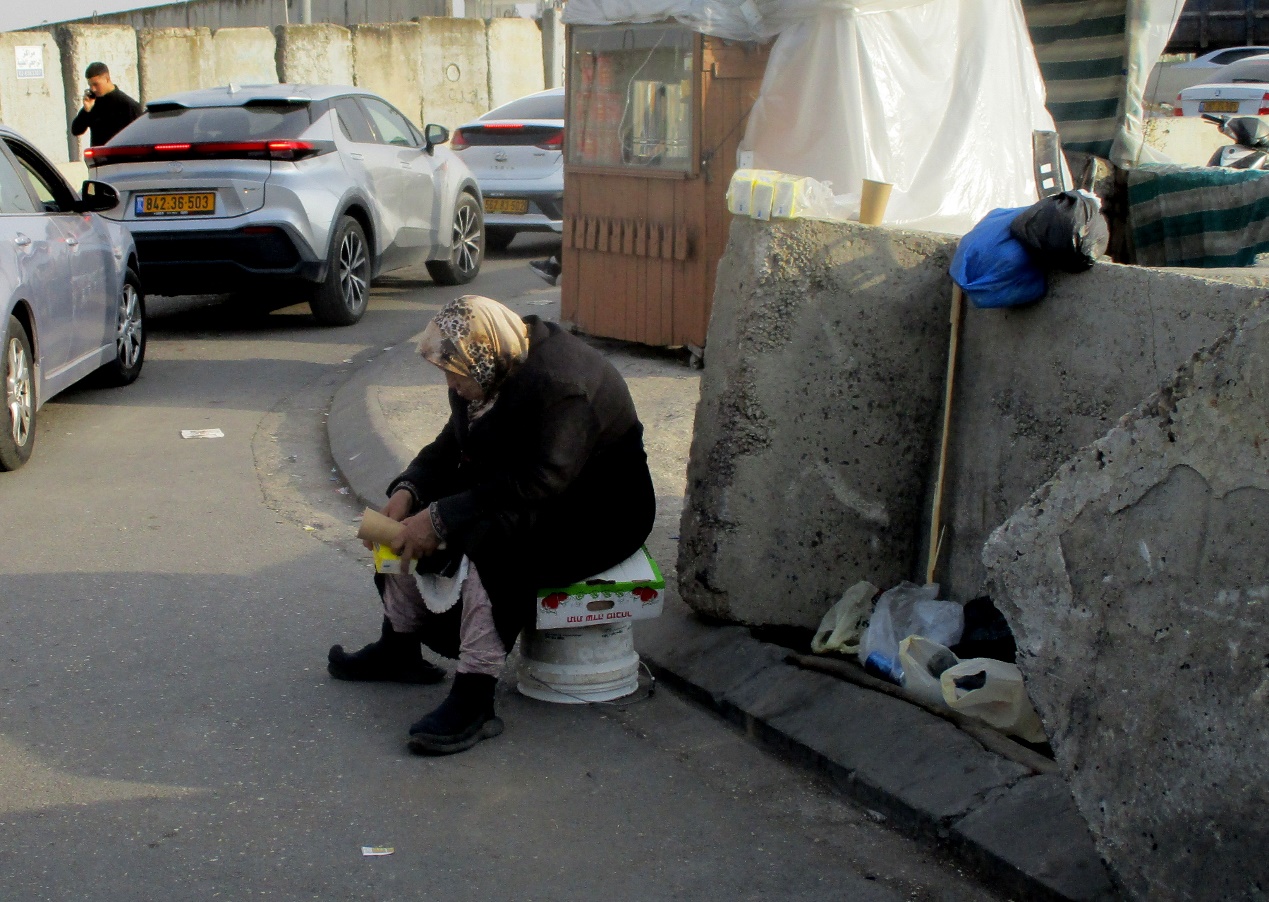 Tamar FleishmanOct-11-2026Qalandiya. Female Beggar
-
