
Qalandiya - road-building work continues
As reported last week, we decided to start coming later, as the Palestinians come later than in the past. We arrived at 6.15. On the way we saw notices pointing to “Atarot Mall.” Outside it was like mid-day, at peak hour. We did not even try the free parking lot and made straight for the new paid-parking one (20 shekels). The man operating it, an elderly Palestinian, has already become our friend. Today, as expected, the talk is about the elections, and that there this nothing new under the sun …
Int eh square in front of the checkpoint there are road-building works, and one has to take great care crossing the road, particularly in the dark. On our way back later, when there was full light, we photographed…
Many people were outside on the Israel side, and a steady stream exited the checkpoint. Many greeted us, hurrying on to work. The approach to the Palestinian side is blocked by a white metal wall – there, too, there are works in progress. People coming out show us how to pass this – and instructions are also written on the meal wall.
We passed to the Palestinian side. Our friend the beigel-seller was standing on the pavement outside the shed. Meanwhile, he is allowed to be there. The falafel kiosk is gone. Entry to the checkpoint is flowing, but it turns out that only the rightmost entrance is open. We stood close to the other two, telling people not to use them. Then we noticed that there are now lights above the entrances, green or red, indicating which are open.
On one of the walls is a notice from yesterday, reporting the location of the polling booth. Apparently, it was possible to vote here.
Later we learned that the lights do not always show correctly the status of entry – sometimes all three were red when some entrances were open, or a closed entry showed a green light. At one point all entries were closed and queues formed. People were confused, not knowing to which entrance to turn. Luckily, this lasted only a short while, the entrances were mostly open, and the lines vanished.
The toilet building, whose entrance is from the old shed, is still locked although there is a light on inside… In the area of the new checkpoint there are still no trash-bins, and people improvise – throwing rubbish in a bucket, or in sacks against the pillars. There is also litter on the ground – a pity.
We went to the tea kiosk. The area behind it is today clear of cars. Iman explains that parking is now not allowed because of preparations for Ramadan, when entrance will from there on Fridays. We went to the road to see the concrete barriers that had been erected to separate the traffic lanes. This is good for the cars, but less so for pedestrians who have to cross the road to reach the checkpoint. Young folk jump over the barrier, endangering themselves. Women and elderly folk take a roundabout way.
We noticed that at one point blocks had been used to create steps over the barrier.
We returned to the checkpoint. By now all the entrances were open and passage was swift. At 7 o’clock we left and were through in a few minutes.
Qalandiya Checkpoint / Atarot Pass (Jerusalem)
See all reports for this place-
Click here to watch a video from Qalandiya checkpoint up to mid 2019 Three kilometers south of Ramallah, in the heart of Palestinian population. Integrates into "Jerusalem Envelope" as part of Wall that separates between northern suburbs that were annexed to Jerusalem in 1967: Kafr Aqab, Semiramis and Qalandiya, and the villages of Ar-Ram and Bir Nabala, also north of Jerusalem, and the city itself. Some residents of Kafr Aqab, Semiramis and Qalandiya have Jerusalem ID cards. A terminal operated by Israel Police has functioned since early 2006. As of August 2006, northbound pedestrians are not checked. Southbound Palestinians must carry Jerusalem IDs; holders of Palestinian Authority IDs cannot pass without special permits. Vehicular traffic from Ramallah to other West Bank areas runs to the north of Qalandiya. In February 2019, the new facility of the checkpoint was inaugurated aiming to make it like a "border crossing". The bars and barbed wire fences were replaced with walls of perforated metal panels. The check is now performed at multiple stations for face recognition and the transfer of an e-card. The rate of passage has improved and its density has generally decreased, but lack of manpower and malfunctions cause periods of stress. The development and paving of the roads has not yet been completed, the traffic of cars and pedestrians is dangerous, and t the entire vicinity of the checkpoint is filthy. In 2020 a huge pedestrian bridge was built over the vehicle crossing with severe mobility restrictions (steep stairs, long and winding route). The pedestrian access from public transport to the checkpoint from the north (Ramallah direction) is unclear, and there have been cases of people, especially people with disabilities, who accidentally reached the vehicle crossing and were shot by the soldiers at the checkpoint. In the summer of 2021, work began on a new, sunken entrance road from Qalandiya that will lead directly to Road 443 towards Jerusalem and Tel Aviv. At the same time, the runways of the old Atarot airport were demolished and infrastructure was prepared for a large bus terminal. (updated October 2021)
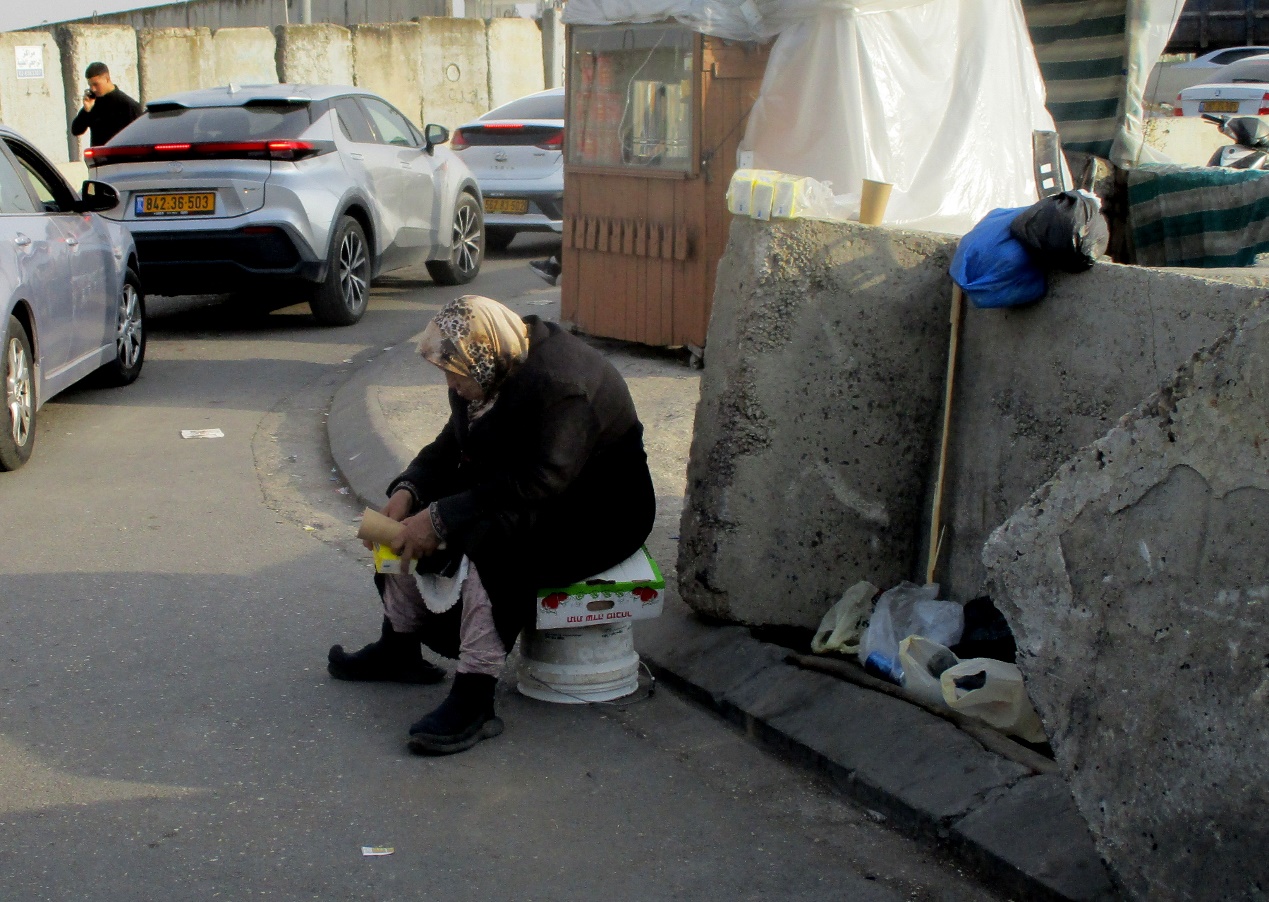 Tamar FleishmanOct-11-2026Qalandiya. Female Beggar
-
