
Qalandiya, Sun 2.1.11, Afternoon
"If we don't laugh- we die!"
Ever since those long lost days of collective punishment, when the privet punishment of a single person was inflicted on the general public, we haven't witnessed such an event:
Three concrete blocks were placed so as to block the traffic lane (in addition to the lane blocked a couple of months ago) by the front square of the checkpoint. This caused havoc and chaos all around the checkpoint, and any one hopping to head back, found himself trapped in a bottleneck.
"I've been driving from Ramala for an hour and a half already…"– the person who told us this didn't know that his ride would take a lot longer. He kept on placing his complaints before us through the car window: "We live in a ghetto, but at least give us some options… you are laughing at us to our faces… we have an identity, we have honor, we are humane, aren't animals…"
The vehicle of another driver had begun to steam at the checkpoint due to these conditions. His wife and two children were still seated in the car while he was rebuked by a security man: "you can't stand here! Move the car!"- How?… where to?
Some young men made an effort to control the traffic in order of dissolving the traffic jam- but it was in vain.
We were told that on the previous day it was the same. Only at midnight did the traffic start moving again.
When we asked someone why they didn't try removing the blockage themselves, the speaker smiled and pointed above at the tower:"They sit over there, watching everything".
A friend told us that she had to wait four hours on Saturday when she was heading back from her job in Ramala. When ambulance sirens were heard, the cars move aside and a narrow lane was formed. She hurried and followed the ambulance, that's how she managed escape.
Behind the staged "initiatives/changes/improvements" presented here lately, behind the declarations of "improvements in service" and "reliefs in the checkpoint", is a clever ideological and concrete attempt to perpetuate the occupation and segregation, while deepening the fractions in the community solidarity, and enhancing the hostility between the people who own a blue ID and the residents of the West Bank, by separating them.
And now the latest attempt, a physical obstacle added to the bureaucratic ones, designed to separate between the remaining urban fabric between Ramala and Jerusalem, to cause more difficulties to move from one city to the other, which are the centre of the lives of many people, so as to realize the vision of the "Unification of Jerusalem'.
This is no coincidence or arbitrariness, this is the result of sophistication and long term planning, reflected in the education (taming?) of the Palestinian society which is tended towards submissiveness in front of any new hardening in their life: they no longer raise their voices or fists, they stopped yelling at the blind cameras. They talk among themselves or with us about their sorrows. Even when for no apparent reason, the traffic at the checkpoint stopped, and the line only grew longer and wider, they wouldn't yell. "If we shout- a bullet in the head", they said. Even once they had reached the soldier's post, they refrained from asking as to the reason for the blockage. We wondered about this and were answered: "We have our reasons…"
We passed the checkpoint accompanied by people with privileges at the new ward which is intended for those with blue IDs, in the lane that was supposed to be the quicker and more efficient among the two. We were trapped and cramped for an hour. An hour of shoving and pushing, an hour until we arrived at the other side of the checkpoint. During such times, momentary friendships develop due to common fate. Barriers collapse, people talk about personal issues as well as public matters.
Munir stood nearby and told us that every day he arrives at his home at the Armenian quarter, two and a half hours after he had left work. Others were interested to know why we stood there with them, when they heard the answer they said: "It's good that Jewish women feel a bit like the Arabs". They saw it as a shared moment, a brief moment, but didn't really think of us at someone who shared their fate. We felt that they treated us with affection and respect. It was a time of anger, bitterness, despair, but also of laughter and black humor: "If we don't laugh- we die".
– The maintenance at the new ward, which is still new, isn't at its best. Not only is there dust in every crack and hole, but there is also a tear in the side wall facing west, that is suppose to protect from wind and rain. Through that tear the roads of the Atarot airport can be seen, a relic of the ancient times.
-At the bus parking lot a man's body was being transferred from one ambulance to the other, the dead and the living face the same destiny.
The man had heart surgery in a hospital at Nablus but didn't survive, he was being taken back home to be buried at Gaza.
Qalandiya Checkpoint / Atarot Pass (Jerusalem)
See all reports for this place-
Click here to watch a video from Qalandiya checkpoint up to mid 2019 Three kilometers south of Ramallah, in the heart of Palestinian population. Integrates into "Jerusalem Envelope" as part of Wall that separates between northern suburbs that were annexed to Jerusalem in 1967: Kafr Aqab, Semiramis and Qalandiya, and the villages of Ar-Ram and Bir Nabala, also north of Jerusalem, and the city itself. Some residents of Kafr Aqab, Semiramis and Qalandiya have Jerusalem ID cards. A terminal operated by Israel Police has functioned since early 2006. As of August 2006, northbound pedestrians are not checked. Southbound Palestinians must carry Jerusalem IDs; holders of Palestinian Authority IDs cannot pass without special permits. Vehicular traffic from Ramallah to other West Bank areas runs to the north of Qalandiya. In February 2019, the new facility of the checkpoint was inaugurated aiming to make it like a "border crossing". The bars and barbed wire fences were replaced with walls of perforated metal panels. The check is now performed at multiple stations for face recognition and the transfer of an e-card. The rate of passage has improved and its density has generally decreased, but lack of manpower and malfunctions cause periods of stress. The development and paving of the roads has not yet been completed, the traffic of cars and pedestrians is dangerous, and t the entire vicinity of the checkpoint is filthy. In 2020 a huge pedestrian bridge was built over the vehicle crossing with severe mobility restrictions (steep stairs, long and winding route). The pedestrian access from public transport to the checkpoint from the north (Ramallah direction) is unclear, and there have been cases of people, especially people with disabilities, who accidentally reached the vehicle crossing and were shot by the soldiers at the checkpoint. In the summer of 2021, work began on a new, sunken entrance road from Qalandiya that will lead directly to Road 443 towards Jerusalem and Tel Aviv. At the same time, the runways of the old Atarot airport were demolished and infrastructure was prepared for a large bus terminal. (updated October 2021)
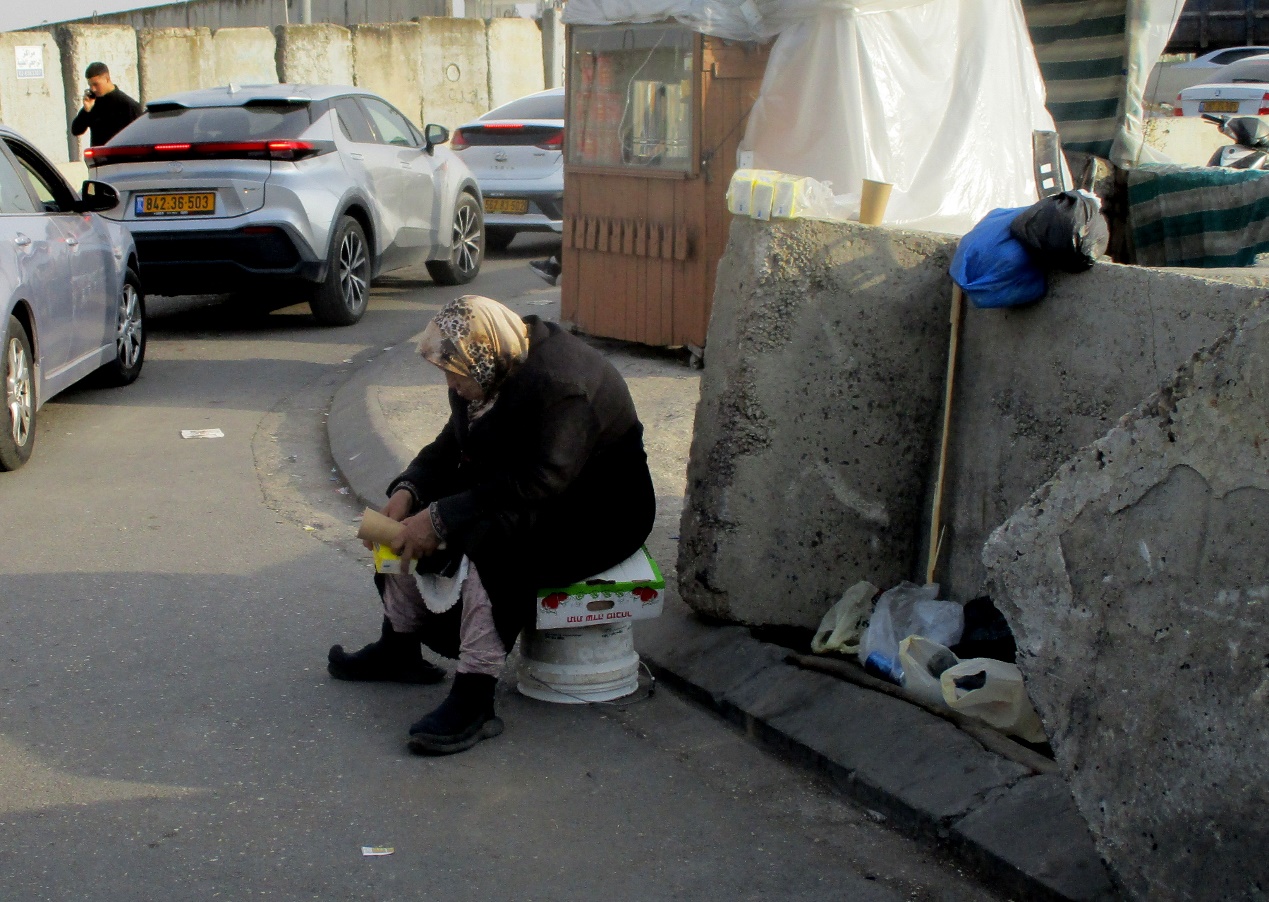 Tamar FleishmanOct-11-2026Qalandiya. Female Beggar
-
