
Qalandiya, Sun 20.3.11, Afternoon
Translation: Ruth Fleishman
According to the laws of occupation justice is on the side of the man with the rifle.
A police ambush at the entrance to Palestine that was hunting traffic offenders (seat belts, baby seats…) so as to enrich the state treasury, caused the traffic to proceed slowly by the wall.
As difficult as the exit from the Palestinian territories to Jerusalem is, we learnt that the reverse rout is not necessarily easier.
Due to the Purim closure only few people arrived at the checkpoint, however, the waiting time wasn't shorter.
The soldiers preformed their work in slow motion, in each one of the manned posts were several men/women in uniform; while one person was running the inspection the others crowded around him, either observing his actions or staring at them.
Zia, who had returned on Saturday from a visit to Ramallah, told us that it was only after three hours of standing cramped with hundreds of others, waiting by the checkpoint gates, that she managed to arrive at the other side. She could have avoided the hassle and saved herself some time by passing through Hizme- a checkpoint that serves the privileged and mainly the settlers, but our friend felt that she should stand with the unprivileged, in solidarity with them.
We split and used two lanes to cross the checkpoint:
The soldier behind the bullet proof window at the post in one of the lanes was astounded and said with horror: "She is Jewish!!… what is she doing here?…"
Four soldiers manned the other post, they were in the midst of a genuine brainstorm when the metal detector had spotted a toy gun, that was owned by a five year old boy and was placed in his mother's bag. The bag that had contained this weapon had to be sent back and forth on the convey belt until the soldiers saw it. The mother and son were told to take their shoes off (perhaps they thought they were hiding ammunition for the gun?). Only once they figured out that the gun was plastic and posed no threat to the state of Israel and that the boy was no ticking bomb, the mother and son were permitted to head on.
A young man that often passes through the checkpoint said that a couple of days earlier, while his vehicle and documents were being inspected, a female soldier approached him (T) and asked: "Would you like to get screwed from the behind?", the driver, who because of the emotional state he was in, didn't hold back (as survivors do), was enraged and started shouting at the soldier who insulted him.
"What's wrong with you? I'm kidding….", replied T.
The young man paid the price for his attempt to fight for his honor when he returned two days later and was recognized by one to T friends. The soldier accused him of being the one who did the insulting, and prevented him from heading on keeping him at the checkpoint for over an hour. He was released only after an especially thorough inspection of his car was preformed, and being a "regular" at the checkpoint, he is familiar with the different types of inspections.
Qalandiya Checkpoint / Atarot Pass (Jerusalem)
See all reports for this place-
Click here to watch a video from Qalandiya checkpoint up to mid 2019 Three kilometers south of Ramallah, in the heart of Palestinian population. Integrates into "Jerusalem Envelope" as part of Wall that separates between northern suburbs that were annexed to Jerusalem in 1967: Kafr Aqab, Semiramis and Qalandiya, and the villages of Ar-Ram and Bir Nabala, also north of Jerusalem, and the city itself. Some residents of Kafr Aqab, Semiramis and Qalandiya have Jerusalem ID cards. A terminal operated by Israel Police has functioned since early 2006. As of August 2006, northbound pedestrians are not checked. Southbound Palestinians must carry Jerusalem IDs; holders of Palestinian Authority IDs cannot pass without special permits. Vehicular traffic from Ramallah to other West Bank areas runs to the north of Qalandiya. In February 2019, the new facility of the checkpoint was inaugurated aiming to make it like a "border crossing". The bars and barbed wire fences were replaced with walls of perforated metal panels. The check is now performed at multiple stations for face recognition and the transfer of an e-card. The rate of passage has improved and its density has generally decreased, but lack of manpower and malfunctions cause periods of stress. The development and paving of the roads has not yet been completed, the traffic of cars and pedestrians is dangerous, and t the entire vicinity of the checkpoint is filthy. In 2020 a huge pedestrian bridge was built over the vehicle crossing with severe mobility restrictions (steep stairs, long and winding route). The pedestrian access from public transport to the checkpoint from the north (Ramallah direction) is unclear, and there have been cases of people, especially people with disabilities, who accidentally reached the vehicle crossing and were shot by the soldiers at the checkpoint. In the summer of 2021, work began on a new, sunken entrance road from Qalandiya that will lead directly to Road 443 towards Jerusalem and Tel Aviv. At the same time, the runways of the old Atarot airport were demolished and infrastructure was prepared for a large bus terminal. (updated October 2021)
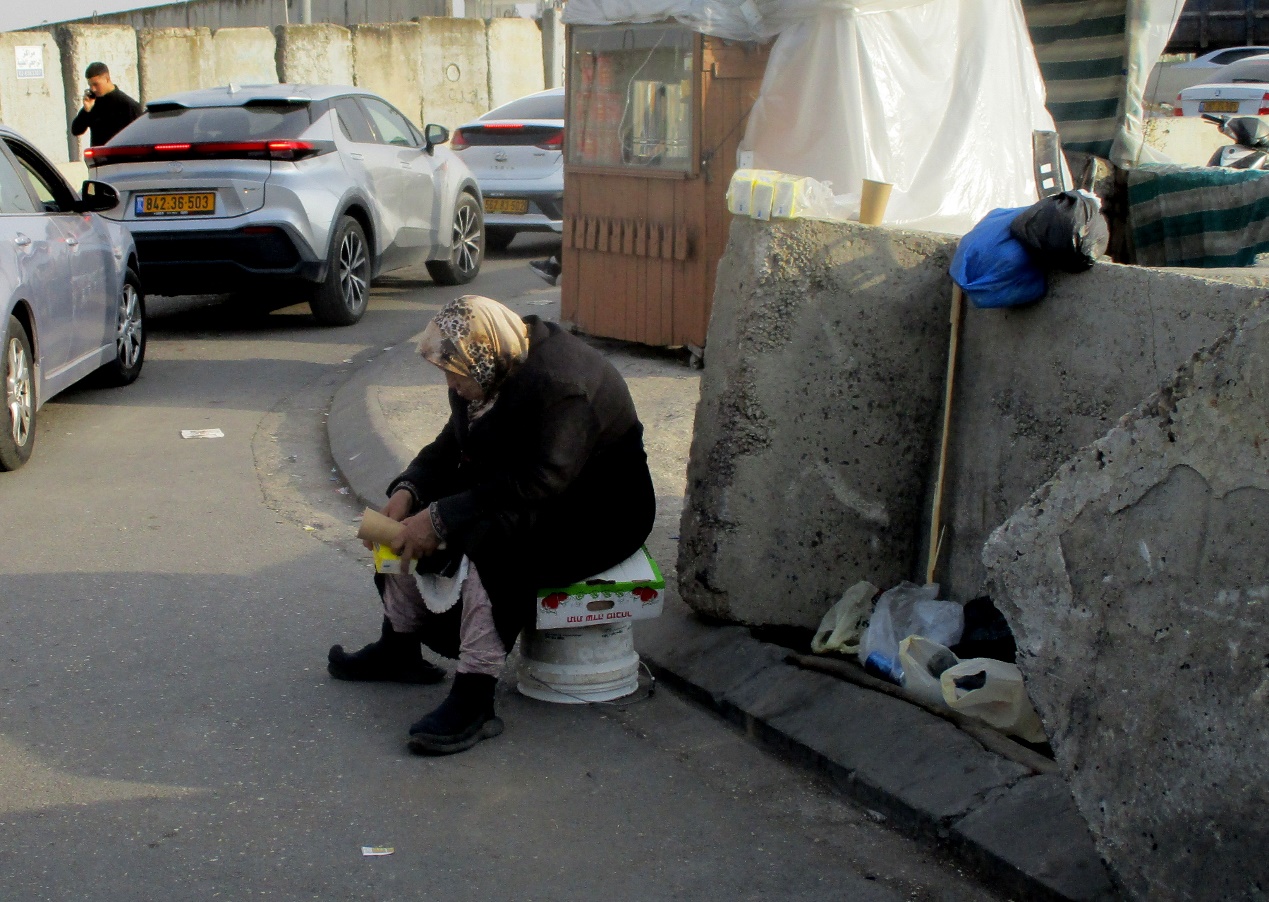 Tamar FleishmanOct-11-2026Qalandiya. Female Beggar
-
