
Qalandiya, Sun 3.1.10, Afternoon
Natanya translating.
"It is very bad at Qalandiya," says an old woman to us. She sat at the side of the café at Beit Hanina where we met on our way to Qalandiya.
She repeated that and sighed. Her daughter-in-law who sat next to her told us some of the experiences of the residents of "larger" Jerusalem. She says one day she left for work and forgot her purse.(Her little son had taken money from the purse and returned it to the wrong bag). Only when she got to the checkpoint at Azaiem …one of the checkpoints of the Jerusalem separation barrier she found that she did not have her purse and ID with her. She begged the soldiers who knew her as she goes through the checkpoint daily to let her through but nothing helped and she had to go back home, take her ID and only then go on to work.
It is truly hard at Qalandiya and even just to watch what is happening is hard over and over again. The occupation raises its monotonous head, daily, law and dirty. There is always a line there. People are always waiting. If the checkpoint is full or not the passage takes time. One can never know which sleeves is a better one, which one will suddenly close, and which will suddenly open. Suddenly the passage will close with no reason for a few minutes and more and no one will bother to explain to the people why or for how long. Because the Palestinians who are those ruled by the checkpoint do not speak. Sometimes the rulers will say a word or give an explanation to the women who come to watch there (such as we do) but never to the Palestinians. They only speak through the loudspeakers, shouting at them in Hebrew mixed with some Arabic to move to here, to go over there, to stand, to be quiet, to go back. They, the Palestinians are always treated as enemies or in a "better" case as those who are a nuisance, who are just causing confusion, or as those who have no rights to say anything and definitely not to be listened to by those who rule them.

Also the area around Qalandiya where they have to wait is contemptible and repulsive. The area is exceptionally filthy, the toilets do now work, large holes in the waiting area, the polite signs in English and Arabic are a mockery. The Palestinians who are experience react to all this as it is.

Two hours, between 16.00 to 18.00 we watched what was happening there until we went on to other checkpoints.
We saw women with babies in their arms ( a photo is attached by Tamar Fleischman) waiting for more than half an hour in the freezing cold of the afternoon. We counted the time. We saw a blind woman, coming forward slowly slowly and carefully between the obstacles scattered in the waiting area and into the sleeves contained in the iron fences and barbed wire which look more like cages than a decent path for thousands of people to go through day by day.

We saw small children selling chewing gum for a shekel so as to help with the household expenses. We saw taxis offering those who have blue IDs to take them to Hizma where it is easier to go through without being checked. We saw again how only one or two sleeves amongst the many that Qalandiya is so proud of were working and that the "humanitarian lane" was closed also to those for whom it was meant.

We saw the new building which is being built next to the existing one. Another checkpoint which causes despair as it has not been built just in the name of Heaven or for the sake of peace.
And in spite of that we saw one moment of joy when Tamar gave Yunis, a small boy who was trying to make a living there the photos that she had taken of him during the previous shift. It was wonderful to see the big smile of the little boy who had so badly wanted to be photographed against the separation wall which he was pointing to.
From Qalandiya we went to Ar-Ram to see with longing eyes how Israel had managed to turn this little town which once had been bustling with life to a ghetto closed in on all sides by a terrorist wall. Today Ar-Ram is a sad place, dark and empty.

At Ar-Ram we met a friend of Tamar and Ronnie who said that that day the police had arrested his cousin for the criminal offence of being "illegal" while in Shuafat. (Because as one knows Shuafat is also part of Israel, part of the holy land as a town of "greater Jerusalem" where Palestinian refugees are considered illegal.
At the checkpoint of Jaba-Lil where we stopped at the side of the road the soldier in charge explained to us politely and pleasantly that he is there "to protect the settlers" and that unlike the settlers we are not allowed to be there. Tamar on her part explained to him also politely and sweetly that his prohibition has no legal status and that the GCO's order is not relevant and that in any case we have the right and the duty which we have taken on ourselves to watch, to protest and to document all the checkpoints spread out over the West Bank including this one. After a short discussion during which the pleasant soldier said that he could summon the police and we explained that we would not leave until we had done what we had come for the freezing cold enforced itself on all of us and we left having agreed not to agree and promised that we would come back …we would or our friends….also in the days to come.
Qalandiya Checkpoint / Atarot Pass (Jerusalem)
See all reports for this place-
Click here to watch a video from Qalandiya checkpoint up to mid 2019 Three kilometers south of Ramallah, in the heart of Palestinian population. Integrates into "Jerusalem Envelope" as part of Wall that separates between northern suburbs that were annexed to Jerusalem in 1967: Kafr Aqab, Semiramis and Qalandiya, and the villages of Ar-Ram and Bir Nabala, also north of Jerusalem, and the city itself. Some residents of Kafr Aqab, Semiramis and Qalandiya have Jerusalem ID cards. A terminal operated by Israel Police has functioned since early 2006. As of August 2006, northbound pedestrians are not checked. Southbound Palestinians must carry Jerusalem IDs; holders of Palestinian Authority IDs cannot pass without special permits. Vehicular traffic from Ramallah to other West Bank areas runs to the north of Qalandiya. In February 2019, the new facility of the checkpoint was inaugurated aiming to make it like a "border crossing". The bars and barbed wire fences were replaced with walls of perforated metal panels. The check is now performed at multiple stations for face recognition and the transfer of an e-card. The rate of passage has improved and its density has generally decreased, but lack of manpower and malfunctions cause periods of stress. The development and paving of the roads has not yet been completed, the traffic of cars and pedestrians is dangerous, and t the entire vicinity of the checkpoint is filthy. In 2020 a huge pedestrian bridge was built over the vehicle crossing with severe mobility restrictions (steep stairs, long and winding route). The pedestrian access from public transport to the checkpoint from the north (Ramallah direction) is unclear, and there have been cases of people, especially people with disabilities, who accidentally reached the vehicle crossing and were shot by the soldiers at the checkpoint. In the summer of 2021, work began on a new, sunken entrance road from Qalandiya that will lead directly to Road 443 towards Jerusalem and Tel Aviv. At the same time, the runways of the old Atarot airport were demolished and infrastructure was prepared for a large bus terminal. (updated October 2021)
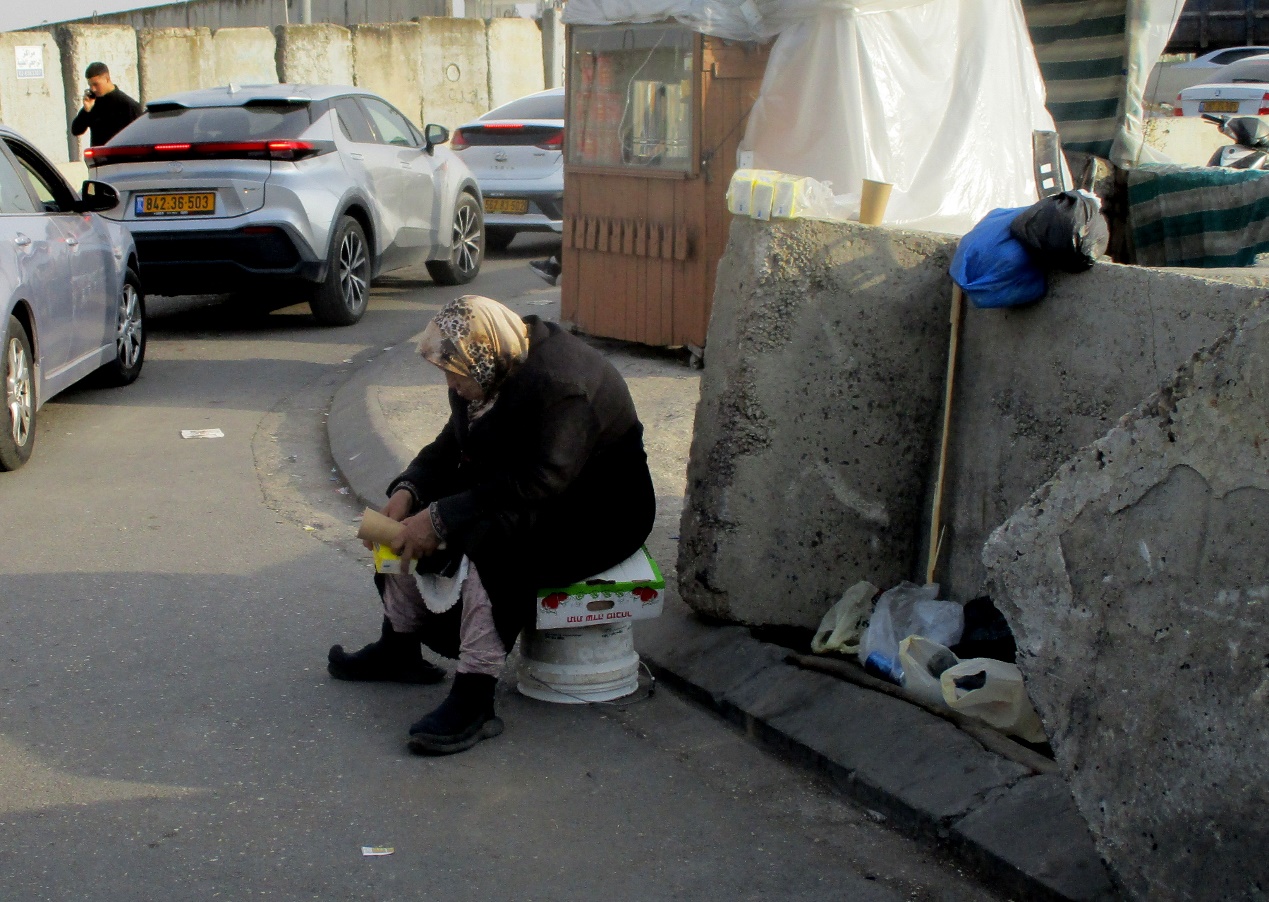 Tamar FleishmanOct-11-2026Qalandiya. Female Beggar
-
