
Qalandiya, Sun 5.6.11, Afternoon
Naksa Day- The day of setback
It started off with a demonstration. The women (so we were told) walked in the front line in a non-violent civil protest.
The protesters who headed towards the checkpoint were halted by military ammunition. Gas and stun grenades. The younger demonstrators wouldn't hold back, and started throwing stones. Some of them were old acquaintances and others were new, they were residents of the camp and the nearby towns who had spent their childhoods and teenage years inside ghettos that imprisoned their bodies and souls.
When the order was disturbed the soldiers took to their bullet proof posts- at the entrances of homes, at the windows on top floors and on the roofs.
Over and over again, the grenades thundered, the bullets whistled and the smothering gas fumes rose up above.
The wind was the only one not to obey the rules or fulfill the orders, it changed directions and carried the gas back to the faces of its launchers. The weaker ones had their satisfaction for short periods of time. But the military arsenal was varied and inventive: the "Skunk" vehicle was tuned on, it sprayed the younger ones with a blue glowing liquid bearing the reek of decaying carcasses. That stench mixed with the gas fumes and the smell that rose from the sewage that, as always, streamed down the allies, formed an odor that was hard to bear.
During the short breaks between rounds of shoots, the young ones prepared themselves while singing their protest songs. Even if the lyrics weren't understood, the melody was relatable. In response they were fired at, causing the singers to flee.
The camps differed not only by their nationality, clothing and weaponry.
The military men were posted in that estranged and unfamiliar place, they were fulfilling orders and they were backed up by a governmental system, the troops of youth on the other hand, weren't posted there by anyone and they did not receive any back up. Nobody had sent them there. Each one of them came and fought for himself, according to his own personal moral code.
Once the military commanders identified two brothers of the Abu-Rahma family among the demonstrators, two of the heroes of Bil'in, soldiers were sent to neutralize and arrest them. The brothers were attacked and their faces sprayed at. In act of solidarity, tens of people huddled around them, creating a human buffer that was impenetrable and had dissolved only once the brothers' friends carried them to an ambulance and they were then taken away.
Naksa Day was the name of that day, the setback day. None of them seemed to have suffered a setback or defeat.
We saw hundreds of the younger generation- the third generation to the occupation, and they were proud, defiant and daring.
In light of the individuals of which the whole was composed, it would have been more appropriate had the day been known as "the day of shame".
The many people who had caused these events should have hidden their faces in shame. But they did not grasp the disgracefulness of their actions, it didn't penetrate the depth of their souls.
They didn't feel ashamed when they overtook the possessions of others and used it as though it was their own, when they prevented shop keepers from reaching the entrance to their source of livelihood, when they captured the shaded and well-kept entrance of an apartment, and turned it into a place for rest and nourishment, leaving at the doorstep their leftovers and their bullet casings.
They did not blush nor did their hands shake with horror at the sound of the order: "permission to shoot rubber bullets at sling shots!" after which an orchestra of shots was heard, the shooters clapped their hands and danced on the roof tops at the sight of the evacuation of the injured.
The same went for their friends who did not hesitate to unzip their trousers to urinate at the entrance of a back garden at one of the allies of the refugee camp.
They all, commanders and subordinates, left the place light-hearted and cheerful, without noticing the mark of Cain that had been scorched on their foreheads.
The wall, a silent witness, bearing a painted declaration of hope: "Long Live Free Palestine".
Qalandiya Checkpoint / Atarot Pass (Jerusalem)
See all reports for this place-
Click here to watch a video from Qalandiya checkpoint up to mid 2019 Three kilometers south of Ramallah, in the heart of Palestinian population. Integrates into "Jerusalem Envelope" as part of Wall that separates between northern suburbs that were annexed to Jerusalem in 1967: Kafr Aqab, Semiramis and Qalandiya, and the villages of Ar-Ram and Bir Nabala, also north of Jerusalem, and the city itself. Some residents of Kafr Aqab, Semiramis and Qalandiya have Jerusalem ID cards. A terminal operated by Israel Police has functioned since early 2006. As of August 2006, northbound pedestrians are not checked. Southbound Palestinians must carry Jerusalem IDs; holders of Palestinian Authority IDs cannot pass without special permits. Vehicular traffic from Ramallah to other West Bank areas runs to the north of Qalandiya. In February 2019, the new facility of the checkpoint was inaugurated aiming to make it like a "border crossing". The bars and barbed wire fences were replaced with walls of perforated metal panels. The check is now performed at multiple stations for face recognition and the transfer of an e-card. The rate of passage has improved and its density has generally decreased, but lack of manpower and malfunctions cause periods of stress. The development and paving of the roads has not yet been completed, the traffic of cars and pedestrians is dangerous, and t the entire vicinity of the checkpoint is filthy. In 2020 a huge pedestrian bridge was built over the vehicle crossing with severe mobility restrictions (steep stairs, long and winding route). The pedestrian access from public transport to the checkpoint from the north (Ramallah direction) is unclear, and there have been cases of people, especially people with disabilities, who accidentally reached the vehicle crossing and were shot by the soldiers at the checkpoint. In the summer of 2021, work began on a new, sunken entrance road from Qalandiya that will lead directly to Road 443 towards Jerusalem and Tel Aviv. At the same time, the runways of the old Atarot airport were demolished and infrastructure was prepared for a large bus terminal. (updated October 2021)
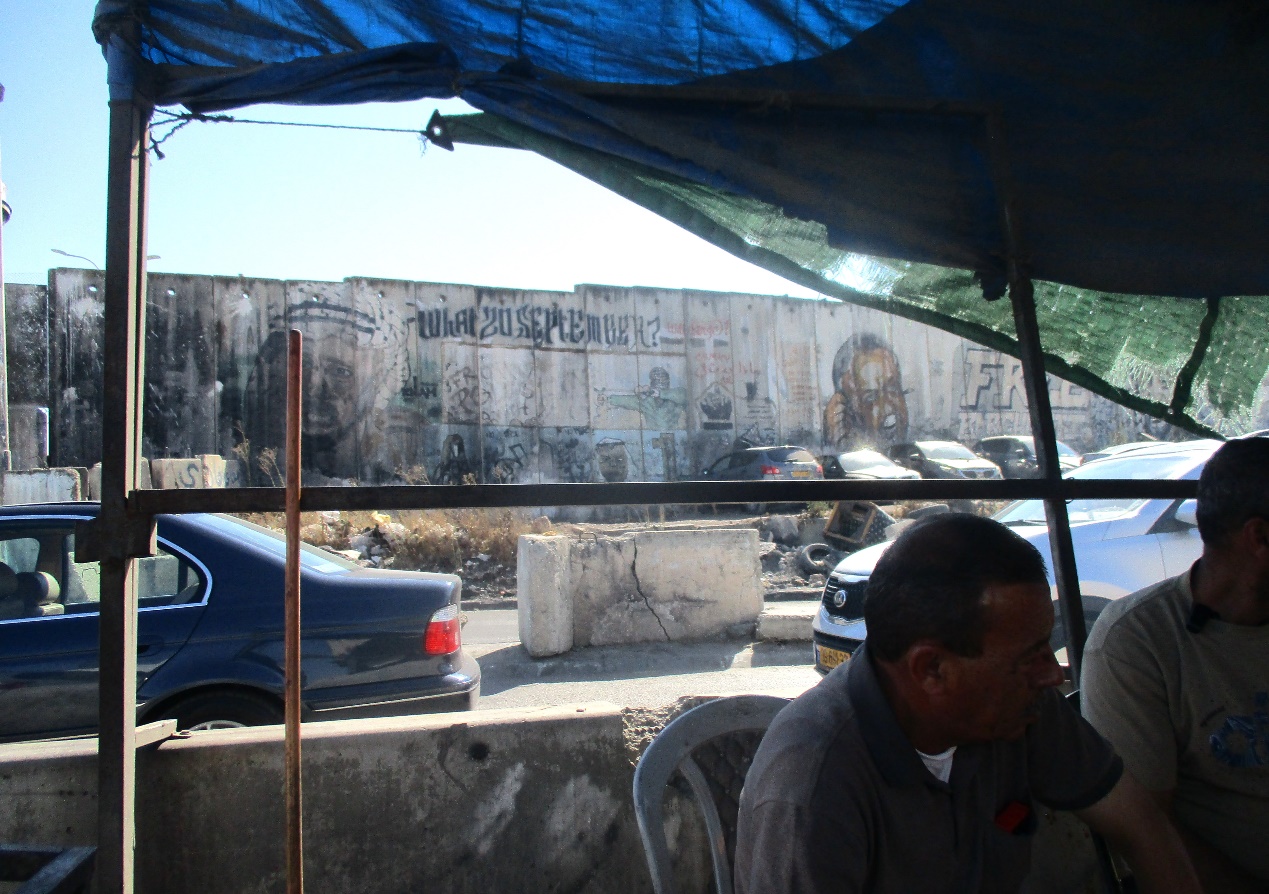 Tamar FleishmanJul-21-2026Qalandiya. Conversation in the shadow of the wall
-
