
Qalandiya - Surprisingly Moderate Traffic
Despite our expectation that the checkpoint would be full to overflowing this morning—the last before an 11-day closure imposed on the West Bank due to the Sukkot holiday—the lines extended only slightly beyond the shed when we arrived at 5:30 a.m. And the situation remained that way, more or less, throughout the shift, despite the fact that Checking Station 5 was closed until 6:45 and when it opened Station 4 closed for a while. Our women had already reported that Sunday, two days earlier, was a particularly difficult morning. The beygale seller told us that Monday, the previous morning, had also been one of heavy traffic. Today, by 7:45, the lines were contained within the shed.
At 6:00 a couple with a sick toddler in a stroller arrived on their way to the hospital. They, of course, had a permit that would have entitled them to go through the Humanitarian Gate, were it manned at that hour. We were (very pleasantly) surprised when the soldier in the “Aquarium” noticed them, opened one of the windows that looks out on the area by the Humanitarian Gate and, spoke with them. They asked him when the gate would open. He took the trouble to call the hotline to find out and then replied that the gate would not open before 6:30. Thus he recommended that they pack up the stroller and join a line going through the cages, which they did.
At 6:15, at the request of the people gathered and waiting in front the gate, we called the same line to ask when the gate would be opened (traditionally it is slated to open at 6:15) and were told that it would be opened “soon.” Ten minutes later a security guard arrived with the key to the gate, opened the lock, but waited until 6:30 before allowing the crowd—of 30 people by that time—to pass through it. Upon doing so, they all entered the “sleeve” leading to Checking Station 5 (which was closed) and stood there until slowly realizing that it wasn’t in operation. We suggested to the Civil Administration officer who had arrived in the meantime that an announcement be made over the loudspeaker informing people that Station 5 was closed. That did not happen.
Fifteen minutes later, Station 5 opened and Station 4 closed, but people continued to enter the “sleeve” leading to 4 and wait there because they were unaware that the soldiers had taken a break. We then suggested to one of the security guards (the person closest to the bars separating us) that a public service announcement be made that Station 4 was temporarily not in operation so that people would not waste their time standing hopelessly by it. “They [the people running the checkpoint] know what they’re doing!” he snapped, upon which we were overcome with relief.
The soldier who took up his position in the “Aquarium” at 6:15 changed the strategy of his predecessor and allowed only a few people through each time he opened the turnstiles at the end of the cages. This policy caused a rise in tension among the people on line. Close to 7:00, when an argument broke out by the entrance to the cage on the left—a magnet for violence because of the ease with which people can jump the queue there—we feared the line discipline would collapse, as it too often does due to this flashpoint, making the wait even longer.
The argument broke out a time when the turnstiles had not opened for quite a while. A policeman, Civil Administration officer, and two security guards were present. Yet they all applied themselves to checking the permits of the trickle of people approaching the Humanitarian Gate, while no one paid attention to the work of the soldier controlling the turnstiles. Only in the wake of shouts and whistles from the exasperated people on line did one of the four give the soldier an order to open the turnstiles. And then, too, he was quite stingy with the amount of people he let through, heightening the disgruntlement on the queues. But fear not: they know what they’re doing.
Toward the end of the shift, one of the security guards, whom we had not met before, called out to us and asked who we were. The conversation with him was brief and very cordial, and in the course thereof he told us that the renovation will add 8 checking stations, bringing the number to 12 rather than the 10 we had been told about earlier, and that the work would go on for two years (rather than a year and a half). One way or the other, it will be quite a while before the situation will ease at Qalandia.
At 7:37 the Civil Administration officer and the security guards left but the policeman continue to operate the Humanitarian Gate.
At 7.18 we joined the shortest of the three lines at a distance of about 4 meters from the entrance the cage through which it led. Because the strategy of stinginess continued, it took us 30 minutes to reach a checking station (more than 20 of them before we even reached the turnstile at the end of the cage) and leave.
Qalandiya Checkpoint / Atarot Pass (Jerusalem)
See all reports for this place-
Click here to watch a video from Qalandiya checkpoint up to mid 2019 Three kilometers south of Ramallah, in the heart of Palestinian population. Integrates into "Jerusalem Envelope" as part of Wall that separates between northern suburbs that were annexed to Jerusalem in 1967: Kafr Aqab, Semiramis and Qalandiya, and the villages of Ar-Ram and Bir Nabala, also north of Jerusalem, and the city itself. Some residents of Kafr Aqab, Semiramis and Qalandiya have Jerusalem ID cards. A terminal operated by Israel Police has functioned since early 2006. As of August 2006, northbound pedestrians are not checked. Southbound Palestinians must carry Jerusalem IDs; holders of Palestinian Authority IDs cannot pass without special permits. Vehicular traffic from Ramallah to other West Bank areas runs to the north of Qalandiya. In February 2019, the new facility of the checkpoint was inaugurated aiming to make it like a "border crossing". The bars and barbed wire fences were replaced with walls of perforated metal panels. The check is now performed at multiple stations for face recognition and the transfer of an e-card. The rate of passage has improved and its density has generally decreased, but lack of manpower and malfunctions cause periods of stress. The development and paving of the roads has not yet been completed, the traffic of cars and pedestrians is dangerous, and t the entire vicinity of the checkpoint is filthy. In 2020 a huge pedestrian bridge was built over the vehicle crossing with severe mobility restrictions (steep stairs, long and winding route). The pedestrian access from public transport to the checkpoint from the north (Ramallah direction) is unclear, and there have been cases of people, especially people with disabilities, who accidentally reached the vehicle crossing and were shot by the soldiers at the checkpoint. In the summer of 2021, work began on a new, sunken entrance road from Qalandiya that will lead directly to Road 443 towards Jerusalem and Tel Aviv. At the same time, the runways of the old Atarot airport were demolished and infrastructure was prepared for a large bus terminal. (updated October 2021)
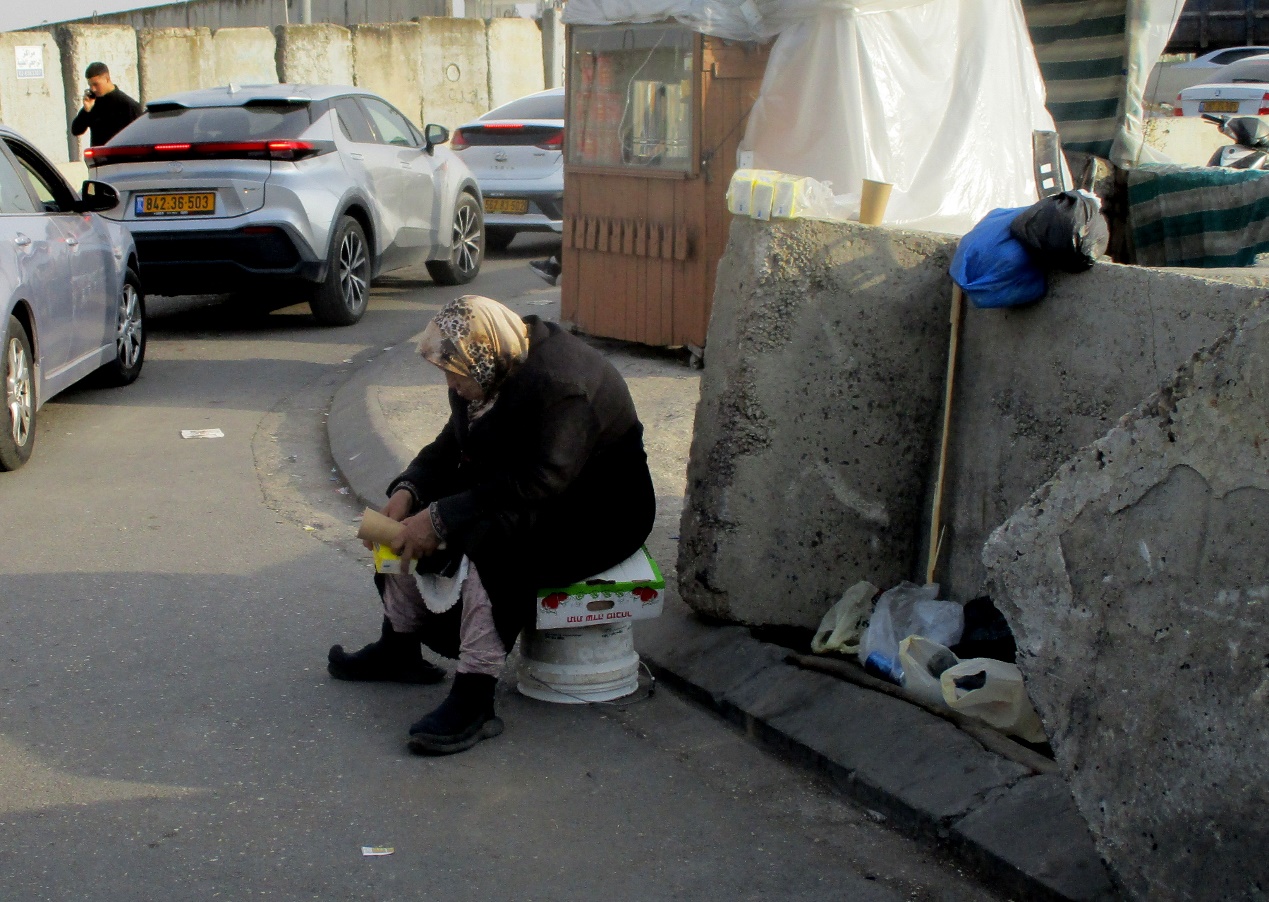 Tamar FleishmanOct-11-2026Qalandiya. Female Beggar
-
