
Qalandiya - the gate that had been locked with metal chains was opened
In this great darkness, livelihood distress and hopelessness, so little is required to suddenly have people smiling in satisfaction…
Suddenly, without any prior notice or preparation, the gate that had been locked with metal chains for months was opened, and the passersby’s way is opened as it was in the past.
Some captain came and closed it back then, said a refugee camp resident, and this morning soldiers came and opened it.


Intentions to reach the DCO offices were dashed.
- They are supposed to work until five p.m. but closed shop at four, I have no idea why, said the security guard.
I took the path leading out of the checkpoint.
But what I knew, that the offices were closed, remained unknown to family members who arrived from Ramallah – a mother, a father and their two daughters who came to the offices to receive a transit permit for the father, the only one of the four who does not possess the “right permit” which grants its holder the right to meet family members from across the apartheid wall.
After the four had made the not-at-all easy journey climbing up and down four metal staircases and reached the Civil Administration offices, the weak light and vacant benches were not really signs of an empty place.

The father who walked first pushed the turnstile leading to the shed in front of the offices. But then the unexpected happened and the turnstile locked. No more movement either in or out. The father found himself stuck between the metal bars, his wife and daughters outside, and I who by chance reached the other side on my way out of the checkpoint. I alerted the security guard standing near the ID inspection post. He reached the caged man and tried again and again to push the metal bars, but nothing happened. He alerted his friend who alerted another friend, so three stocky, armed men stood and pushed and shook – but the metal bars insisted and would not relent. The man stayed stuck inside, while the woman and her two daughters on the other side, so close to her husband and yet so far – wept bitterly. Don’t worry, said the armed men, we’ll get him out of here, just another few moments. But these moments grew longer. Consulting her husband and believing the security guards, the woman took her daughters and turned to visit her sister in Jerusalem. Time didn’t stop, half-an-hour went by, people passing on their way stared in wonder at the man stuck in a turnstile with a group of security guards clucking around him helplessly. Then a policeman was summoned and joined the group, but even he couldn’t help. The metal bars wouldn’t give in.
The policeman suggested that the man grab the bars and try to cross above them where there’s a space, perhaps he could get out the rest of his body. The man climbed, got his head out but the rest of his body wouldn’t. He climbed back down and waited. More consultations, pushing and pulling, promises – we won’t leave you alone… Don’t worry. Another few moments… But the minutes grew longer.
Ever since his wife left, the man made no sounds. Not a word, a sigh or a request. He stood caged in and waited.

As the clock showed that nearly an hour had gone by, it grew dark, and despite the promise “We’ll stay with you for as long as it takes”, the would-be helpers grew impatient and a brainstorm yielded the decision to summon one of the DCO people to come with the key and let the man out. Why just now? No idea.
They called whoever they called. Soon the guy with the key will come, they said. Then the policeman climbed up, took down the upper panel of the turnstile, grappled everywhere, pushed every protrusion, and… wonder of wonders! – the knot was undone and the apparatus was free. The security guards were happy, the policeman was happy, they happily took leave of the man who was finally freed and went away happy and content. And the man who had left home hours ago to visit his family in Jerusalem left the checkpoint in the opposite direction of the one taken by his wife and daughters, back to Ramallah.
***
This is not a violent event, neither a shooting nor even an arrest. An event on the margins of dramatic occasions, that illuminates a reality of control in every bit of life of millions of people for decades. People who have not known a single day of freedom. Why is a person not entitled to meet his family as much as he will just because he is human? Why do young girls have to watch their father being humiliated and go without him where they were promised to visit as a family? Such questions echo – and must continue to echo.
Qalandiya Checkpoint / Atarot Pass (Jerusalem)
See all reports for this place-
Click here to watch a video from Qalandiya checkpoint up to mid 2019 Three kilometers south of Ramallah, in the heart of Palestinian population. Integrates into "Jerusalem Envelope" as part of Wall that separates between northern suburbs that were annexed to Jerusalem in 1967: Kafr Aqab, Semiramis and Qalandiya, and the villages of Ar-Ram and Bir Nabala, also north of Jerusalem, and the city itself. Some residents of Kafr Aqab, Semiramis and Qalandiya have Jerusalem ID cards. A terminal operated by Israel Police has functioned since early 2006. As of August 2006, northbound pedestrians are not checked. Southbound Palestinians must carry Jerusalem IDs; holders of Palestinian Authority IDs cannot pass without special permits. Vehicular traffic from Ramallah to other West Bank areas runs to the north of Qalandiya. In February 2019, the new facility of the checkpoint was inaugurated aiming to make it like a "border crossing". The bars and barbed wire fences were replaced with walls of perforated metal panels. The check is now performed at multiple stations for face recognition and the transfer of an e-card. The rate of passage has improved and its density has generally decreased, but lack of manpower and malfunctions cause periods of stress. The development and paving of the roads has not yet been completed, the traffic of cars and pedestrians is dangerous, and t the entire vicinity of the checkpoint is filthy. In 2020 a huge pedestrian bridge was built over the vehicle crossing with severe mobility restrictions (steep stairs, long and winding route). The pedestrian access from public transport to the checkpoint from the north (Ramallah direction) is unclear, and there have been cases of people, especially people with disabilities, who accidentally reached the vehicle crossing and were shot by the soldiers at the checkpoint. In the summer of 2021, work began on a new, sunken entrance road from Qalandiya that will lead directly to Road 443 towards Jerusalem and Tel Aviv. At the same time, the runways of the old Atarot airport were demolished and infrastructure was prepared for a large bus terminal. (updated October 2021)
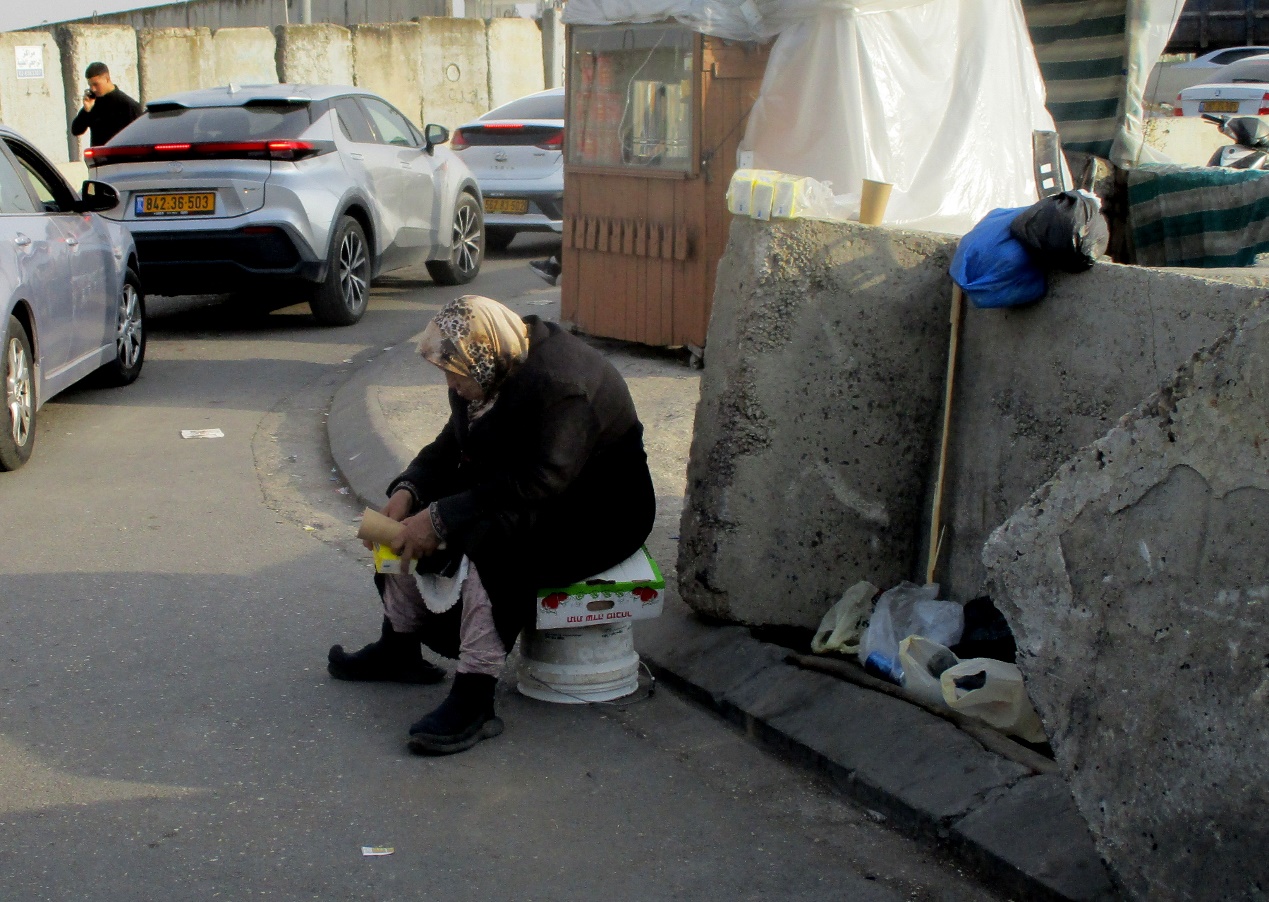 Tamar FleishmanOct-11-2026Qalandiya. Female Beggar
-
