
Qalandiya - The gate towards the refugee camp is open
A calm morning in Qalandiya, a new section of road and problems on the way back.
We arrived at a quarter to six and parked on the Palestinian side. Our first stop is at our friend Abu Ramzi, the pretzel seller. He tells us that yesterday there was a lot of crowding at the checkpoint, it is not clear why.
Near him there is a falafel and another food stand that operates as usual, and opposite, the kiosk. The cake seller has settled for some time now under the shed, near one of the entrances to the checkpoint building. The ticket booth for mobile phones (Palestinians usually use a phone with a prepaid card) and charging Rav Kav, is also located at the edge of the covered shed.
As our friend Tamar Fleishman already reported, one day soldiers simply came and opened the gate in the fence which allows entry to the checkpoint compound from the side close to the Qalandiya refugee camp.
Why was the gate closed for several years, why did they make sure to close and block every opening that the Palestinians tried to open – you don’t know. But the pedestrians are very satisfied with the situation. It saves them walking all the way around the parking lot, and the young and sturdy ones no longer need to climb the fences (as we have photographed them doing more than once). Now there is a continuous stream of people constantly passing through the gate.


Among those passing through the gate is also our friend H, whom we meet again here after years of absence.
He says that on weekdays it’s usually fine (except after the attacks in Jerusalem, when there was a feeling
that on purpose people could not move at the usual rate), but on Fridays there is actually a problem. Many people
arrive to go to prayer, but only one or two positions are working and there is congestion. Today everything
seems to function reasonably well, the 3 entrances were constantly open. From the westernmost entrance
we saw that occasionally people come back and go to another entrance, apparently to find shorter lines there
inside.
Around 6:45 I entered through the middle entrance. Inside the hall is the door that connects with the entrance
The western one is closed, but the one that connects with the eastern entrance is open and people are moving to the line which seems shorter to them. All 4 baggage check stations at these two entrances were open.
The queues in front of them are long and winding inside the hall, but they move quickly. There were a few positions open checking electronic certificates and while I waited more opened.
At a checkpoint the manual certificates are presented by women with children. Children do not have a magnetic card, which would allow them to pass through the station by electronic check.
The policeman explains to the soldier in the position that a woman who has received a permit to go to an embassy is also allowed to take her children with her to the consulate. But then it turns out that the woman who was detained has a permit to look for a job and not a special permit to go to the embassy. With such a certificate, God forbid you pass! She has her child with her, even though she explains that today she has an appointment at the embassy… she is sent back.
Despite everything, passing through the checkpoint took less than fifteen minutes. I went up to the bridge to photograph the progress of the works on the underpass. It is difficult for us to decipher what exactly is planned here.
We drove back to Jerusalem via A-Ram. Shortly after the checkpoint area there is a new square and a new road that goes up and connects to the part of A-Ram that is adjacent to the wall. There is a new wall section here and at the top of the hill there is an opening in this wall and the road passes through it. We drove and passed, stopped and took pictures from the side and also from the other side, from the top of the hill. We are still having trouble deciphering what is planned here.
Let’s hope that there will be a relief for those passing through the vehicle checkpoint.


After we stopped for the photos, it was clear to us that the temporary Jabba checkpoint would be manned, but we did not expect the traffic jam that greeted us right after the main entrance to A- Ram. Most of the time we simply stood, and from time to time we advanced a little. It was obvious that the traffic across the street was also being blocked, because the lines were long
The road would be empty, then several cars arrived at once. We stood patiently between the cars, most of them with Palestinian plates.
At a certain point, an armored police car overtakes the queue from the side, beeping to cars to make way for him. There was a big truck in front of us and there was nowhere to move as long as the cars in front of it didn’t move forward.
With no choice, the army vehicle had to wait and then noticed us. The driver, a soldier in uniform opened the door and looked at us with a surprised look and then closed it back. After a moment he opened the door again and signaled to us who wanted to talk to us. “Are you Jewish?” “What are you doing here? ” We explained who we are and that we always have been coming, and that now we were leaving. We asked what had happened and he explains that stones were being thrown, and suggests that we try to follow him. We refused and said that if we went after him we’d have much more chance of attacks with stones. Of course we also wanted to see what happens to the Palestinians, and not to the privileged Jews.
In the meantime, the truck managed to move forward and make way for him and he drove off. Shortly after him another car arrived. This time police, who activates a siren and bypass the queue. We continued to wait patiently until we could pass the barrier.
After that, the traffic cleared up a bit, but the entire road leading from the Adam junction to the Hizmeh checkpoint was congested and the movement progressed slowly. We saw no signs of stone-throwing on our route. After the Hizmeh checkpoint at Pisgat Zeev, there were the usual traffic jams, but by the time we arrived on Begin Road it was already after eight, so it was less congested there.
Qalandiya Checkpoint / Atarot Pass (Jerusalem)
See all reports for this place-
Click here to watch a video from Qalandiya checkpoint up to mid 2019 Three kilometers south of Ramallah, in the heart of Palestinian population. Integrates into "Jerusalem Envelope" as part of Wall that separates between northern suburbs that were annexed to Jerusalem in 1967: Kafr Aqab, Semiramis and Qalandiya, and the villages of Ar-Ram and Bir Nabala, also north of Jerusalem, and the city itself. Some residents of Kafr Aqab, Semiramis and Qalandiya have Jerusalem ID cards. A terminal operated by Israel Police has functioned since early 2006. As of August 2006, northbound pedestrians are not checked. Southbound Palestinians must carry Jerusalem IDs; holders of Palestinian Authority IDs cannot pass without special permits. Vehicular traffic from Ramallah to other West Bank areas runs to the north of Qalandiya. In February 2019, the new facility of the checkpoint was inaugurated aiming to make it like a "border crossing". The bars and barbed wire fences were replaced with walls of perforated metal panels. The check is now performed at multiple stations for face recognition and the transfer of an e-card. The rate of passage has improved and its density has generally decreased, but lack of manpower and malfunctions cause periods of stress. The development and paving of the roads has not yet been completed, the traffic of cars and pedestrians is dangerous, and t the entire vicinity of the checkpoint is filthy. In 2020 a huge pedestrian bridge was built over the vehicle crossing with severe mobility restrictions (steep stairs, long and winding route). The pedestrian access from public transport to the checkpoint from the north (Ramallah direction) is unclear, and there have been cases of people, especially people with disabilities, who accidentally reached the vehicle crossing and were shot by the soldiers at the checkpoint. In the summer of 2021, work began on a new, sunken entrance road from Qalandiya that will lead directly to Road 443 towards Jerusalem and Tel Aviv. At the same time, the runways of the old Atarot airport were demolished and infrastructure was prepared for a large bus terminal. (updated October 2021)
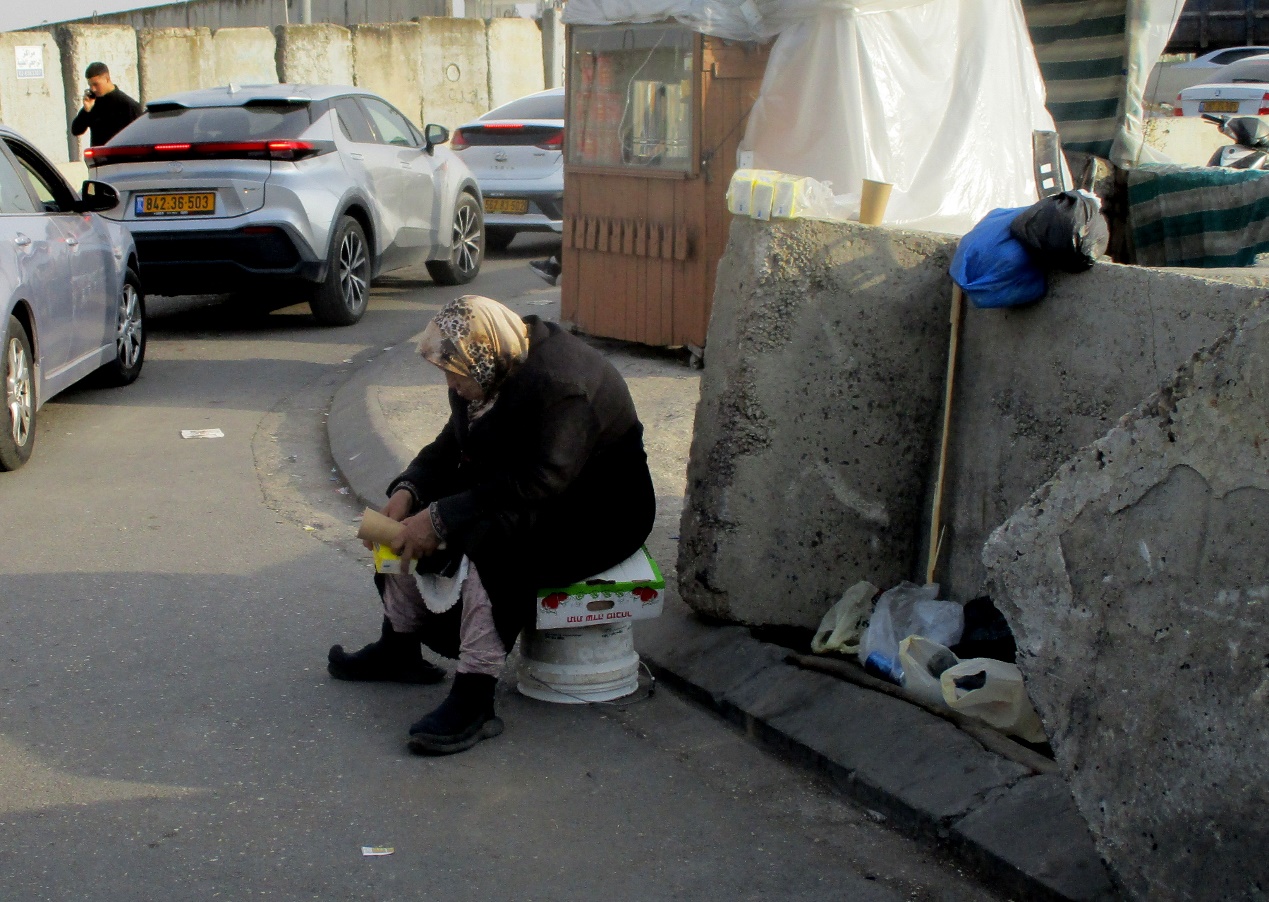 Tamar FleishmanOct-11-2026Qalandiya. Female Beggar
-
